All casesNo. 048
Anthropic, Where Human Attention Became the Bottleneck
Agents work six times the staff hours, yet about 80% of sessions sit waiting
- Case no.
- 048
- Primary source
- Anthropic research reports on its own workforce (self-study)
- Source published
- 2026-10-16
Summary
- AI agent work time reached six times that of all employees combined.
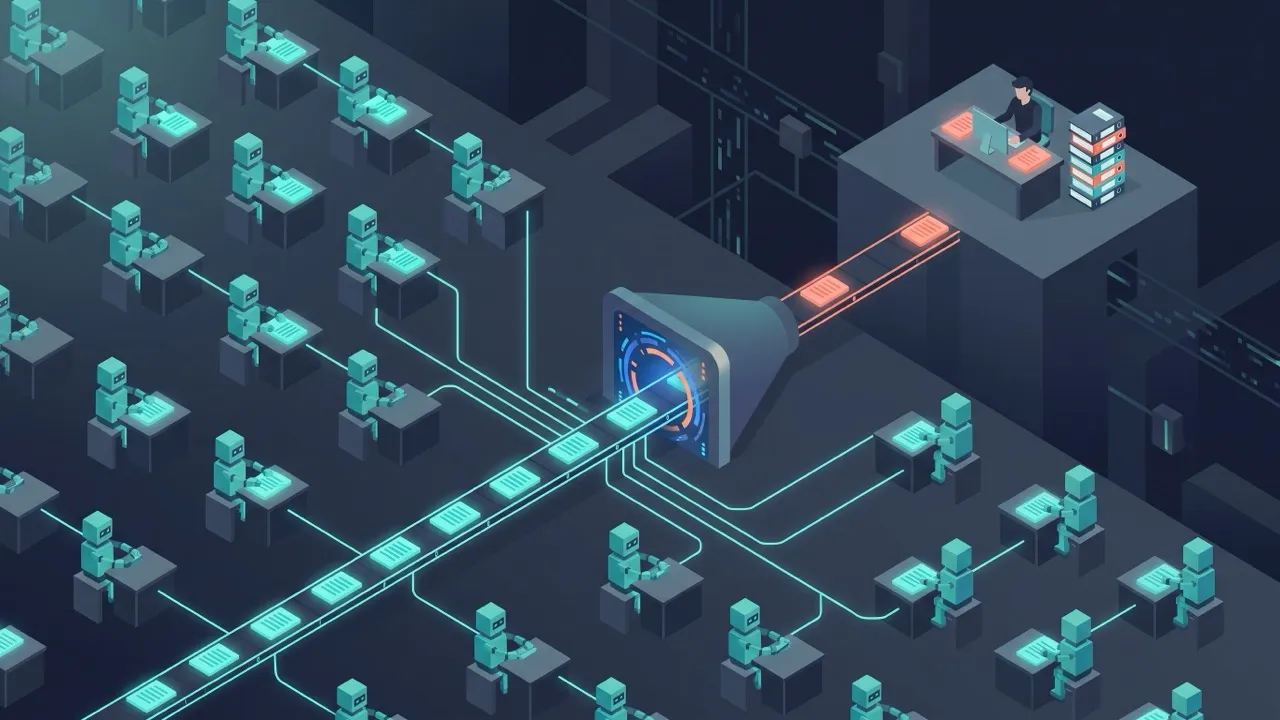
- About 80% of agent sessions were waiting for human review and input.
- As automation grows, people’s work moves from execution to attention and judgment.
A company where agents work six times more hours than people
A unique scene plays out every day on the internal computer screens at Anthropic, the company that builds the AI model Claude. On just one of its most widely used internal platforms, about 30,000 AI agents are doing research and software engineering work at the same time. An agent is a software program that does not stop at answering a person’s one-off prompt. It takes a complex goal, calls tools on its own, and carries out a series of tasks autonomously. By August 2026, agent work time was six times human work time. Here, agent time means the run time of interactive sessions that employees directed and of pool sub-agents (including inference and actual tool use, but excluding any wait longer than 30 minutes). Human time is an assumed value: headcount times 40 hours a week. As a separate metric, the sum of autonomous and interactive agent work hours first passed human work hours in March 2026 (a different series).
But look at the screen more closely and an unexpected bottleneck shows up. About 80% of all the time that sessions with agents were on was not time when the agent was actually computing. It was waiting time, with the agent stopped, waiting for input from a human employee. No matter how fast the agent’s processing gets, it cannot move to the next step until a person gives the next command or reviews and approves the output. One engineer confessed in an internal interview, “an army of Claudes, with every one asking for my attention.” Another engineer put it as people “bottlenecking the agents.” By the report’s calculation, even non-technical employees would need half of their work week to read all the output their own Claude agents produce.
All three sources covered here are reports and articles that Anthropic published after studying itself. They are a report that the Anthropic Institute’s economics team published on October 16, 2026, drawing on internal employment records, logs, surveys, and interviews; a measurement report on R&D data from August 2026; and an article based on a survey from August 2025. Anthropic is the company behind Claude, founded in 2021. The data in the October report also includes Slack and calendar patterns, hiring evaluation forms, and 17 employee interviews. The authors said it is a correlational study from a period when the company was expanding fast, and that the company’s setting is unusual and may not carry over to other organizations as is. Still, it shows in concrete numbers how ways of working change when agents spread through a whole organization.
The limits of delegation, more calls, and human attention as the bottleneck
Anthropic expanded rapidly. As the company grew, the abilities of its own product, Claude, also advanced sharply, and employees’ ways of working went through fierce change. At the time of a survey of 132 in-house engineers and researchers in August 2025, employees were using Claude in about 60% of their work, and their own estimate of the productivity gain came to about 50%.
But at that time, the share of work they could hand over to Claude completely stayed at around 0 to 20%. Employees mainly delegated work whose results were easy to verify, work that was low-risk even if it failed, or work that was simple and boring. One engineer said, “The more excited I am to do the task, the more likely I am to not use Claude.” Decisions about design and “taste” mostly stayed with people, but the survey noted that “this boundary is being renegotiated as models improve.”
Even so, the pace of change was fast. Looking at Claude Code records from February to August 2025, the number of consecutive tool calls an agent made without human involvement rose from 9.8 to 21.2, and “The number of human turns decreased by 33%.” One employee described a shift of “70%+ to being a code reviewer/reviser rather than a net-new code writer.” Along the way, voices grew louder worrying about skill decay and reduced mentoring for less experienced junior staff. The problem of having to supervise AI without the very skills that may be eroding was also a worry. By 2026, the question was no longer whether to use agents, but what people should do when agents work most of the time. The report put the situation clearly: “human attention is a constant bottleneck.”
Agents leading R&D, and a double monitoring net
As of August 2026, Claude “leads” 26% of AI research and development work inside Anthropic. Given that this figure was under 1% just six months earlier, in February 2026, it is a steep rise. This was measured with a prototype index, the “Anthropic R&D Automation Index,” that Anthropic built on automation levels defined by Epoch AI. Level 3 (AL3) is where AI “collaborates” on large chunks of work under close human direction. Level 4 (AL4) is where, given a single high-level instruction, AI “leads” most of the work through to the end while people only supervise. Level 5 (AL5), which needs no human involvement at all, is the fully autonomous level.
Take a failure in a data pipeline that runs every night as an example. At level 3, an engineer brings the failure logs to Claude and directs it step by step through finding the cause and fixing it. At level 4, by contrast, the engineer does not have to watch the screen throughout the work. Claude digs into the cause of the failure itself, fixes the code, finishes the tests, and submits a summary report. The engineer reviews and approves that summary document and only then goes ahead with deployment. Claude does not deploy the fix itself. More than 90% of Anthropic’s R&D work was at level 3 or higher, and no work had reached level 5.
Agents also took on this measurement process itself. In July 2026, each week the team sampled 20% of R&D department employees, and Claude research agents extracted about 15,000 tasks from Slack conversations and internal documents. Claude grouped the roughly 15,000 tasks into a tree of 542 nodes, one Claude agent per node investigated how that work is actually done, and a separate Claude judge assigned the level. The exact agreement rate between the model and human raters was 59%, actually higher than the 35% agreement among human raters themselves.
With as many as 30,000 agents running at once on just one internal platform, the company designed its oversight system in two layers, an “online monitor” and an “offline monitor.” The first, the online monitor, is a pre-execution checker. It is a safeguard to stop harm that is fast and cannot be undone, such as an agent leaking model weights outside. 100% of all agent actions pass through this monitor just before they run, and the check usually finishes within seconds. Of the more than one billion decisions processed in August 2026, 0.002% were blocked, about 1 in 47,000. Humans review any blocked actions within one week.
The second, the offline monitor, is an after-the-fact record checker. It finds risks that grow slowly but can be reversed, such as misalignment, in which an agent’s goals drift gradually from the original intent. It first flags roughly one to two transcripts in every thousand, about 100,000 a week, and then several classifiers re-examine them and send only the roughly 50 with the highest risk each week up to human reviewers. The outside evaluation group METR even ran a red-team simulated hacking evaluation on this offline monitoring platform. According to Anthropic, activity flagged by the offline monitor is used to fix safeguards, and if a large and imminent risk appears, the risky parts of the deployment are switched off. Anthropic says it has done this monitoring “for months, not years.”
Two design principles were added on top of this. Each agent is given its own individual identity, so that results handed over by another agent are not simply trusted but treated as claims that need fact-checking, which prevents errors shared across a group. And agents are barred from talking with each other privately in back rooms; they communicate only through an open messaging system that leaves an audit record.
Automation that spread to every job, and the work of people
The adoption of agents did not stay in software engineering. It spread across the company. In engineering, the number of code commits per engineer was five times what it had been six months earlier. When code written by agents was compared with code written by people, there was no meaningful difference in the share of lines of code that were later deleted or reverted. Engineers increasingly became “leaders and managers of agents.” Sessions in which non-technical employees with no development knowledge used coding agents also jumped, from 2 a month in August 2025 to 90 a month in May 2026.
Clear changes were also seen in other jobs. In the sales department, one sales rep automated about 20% of daily work, and another said they could now meet 30% more customers than before. A lawyer in the legal department built a Claude automation that scans risks and opportunities, sorts incoming legal questions, and does a first review of public-facing wording. The lawyer went further and widened the work to preparing documents so that customers’ agents can find legal material easily.
A recruiter handed candidate sourcing and history tracking to an agent and used the time saved to redesign outdated interview questions and spend more time meeting applicants face to face. A finance manager built an agent that pre-reviews purchase requests and explained, “it’s just trying to find the things that take a lot of hours so they can focus on the other stuff.” An executive assistant built an agent for scheduling and email triage and said, “I think we’ve already moved past the point of Claude augmenting away the really entry-level admin type role,” shifting the center of gravity to a chief of staff role that handles strategic coordination. In spring 2026, the content writing team built a context graph that guides agents to write compelling product content, and then moved on to writing prompts and evaluating models.
In this process, people’s labor was quickly reshaped into “meta-work.” Meta-work means management tasks: instead of doing the work itself, building Claude’s tool capabilities, drawing up execution plans for other agents, reviewing results, and documenting work processes. The share of meta-work in employees’ interactive sessions jumped from 10% in fall 2025 to 22% in spring 2026. A large part of the added share was agent management: writing specs for work that several agents carry out together, setting one agent to review another agent’s results, and monitoring pipelines. The standing instructions that the company makes agents always follow grew from a few hundred in July 2025 to 8,500 a year later.
Dashboards monitor, in real time, the fleets of agents running all over the company, and personal assistant agents keep checking employees’ calendars and messages. Agents came to take part in nearly half of Slack’s active public channels, which meant agents added to conversation rather than replacing conversation between people. Agents cannot read meetings that are not recorded or private conversations, so employees felt pressure to move work into channels that agents can see. This is because giving AI context requires that people’s judgments and decisions be observable from outside.
In practice, this monitoring queue was probably narrowed down to around 50 a week through a multi-stage filter of a light rule checker and a deep model. Front-line employees, likewise, probably stored the 8,500 standing instructions in a shared library and had agents refer to them whenever needed, instead of writing a long prompt each time. In automating non-technical jobs too, it is likely that agents did not make decisions alone but finished the sorting and drafting and passed the final approval to a person. Without that, it would have been hard to explain the calculation that even non-technical employees would need half of a work week to read all the output of their own Claude agents.
Junior hiring in technical roles fell to 9%, and autonomy and judgment became the standard
As such a system settled in, the organization’s personnel metrics and ways of working changed too. The most striking change was the makeup of hiring. Among new hires in technical roles, the share of juniors plunged from 27% to 9%. The share that juniors make up in the whole technical workforce also fell from 21% to 14% since early 2025. Over a year, the technical share of total employment dropped from 61% to 56%, and hiring in sales, finance, and recruiting grew faster. Administrative hiring grew slowly, and the report points to agent assistants, automated review, and outsourced ticket handling as the reasons.
In an April 2026 survey, about one third of machine learning managers and about one fifth of software engineering managers said they had cut back on hiring people because of AI adoption. The report does not mention layoffs. But as People Matters reported on October 19, 2026, the company’s total headcount and the absolute number of technical hires kept rising, and what changed was the makeup of hiring.
The criteria interviewers use to evaluate candidates also changed. In technical interviews, mentions of the candidate’s “autonomy and judgment” rose the most, more than mentions of expertise. In non-technical interviews too, orientation toward customers and the company’s mission was rated higher than plain ability to execute. The ratio of engineers to product managers inside the company is about 17 to 1 and has risen since 2025, and the number of code commits that managers left themselves doubled. Also, the chance that an employee with more than a year of tenure moves to another department in a given month was 50% higher in 2026 than in 2025.
But a paradoxical phenomenon also showed up. Based on calendar data, the median time employees spend in meetings rose 20% from a year earlier, and meeting time for individual contributors in development roles rose 16%. Writing things down for agents did not take the place of conversation between people. Asked whether their work processes made them as productive as possible, 44% agreed in late 2024 and 58% in November 2025. In April 2026, 75% said yes, though the question had dropped “as possible.” In the April 2026 survey, 20% of employees said their role had shifted from actually doing work to managing Claudes. In the August survey, employees expected AI to be able to do 75% of their work by 2030, far above the 28% from ordinary Americans.
Anthropic has begun building an “early warning system” that continually tracks jobs at risk of disappearing or shrinking because of AI. Its purpose is to compare each job’s staffing demand and productivity against AI capabilities and to reassign affected employees internally to other jobs that fit their skills. However, no formal job guarantee rule for this has been stated yet.
Lessons for leaders and practitioners
Anthropic’s self-study leaves realistic lessons for companies that want to adopt AI agents at scale.
First, in the age of agents, the scarcest resource is not AI’s computing power but “human attention.” The fact that about 80% of sessions waited for human input even though agent work time grew to six times the employees’ shows that the bottleneck has moved completely from machine to person. If people try to read and direct every output, the organization soon suffocates from fatigue. A clear delegation standard must come first, one that separates the areas needing human review from the areas agents take over.
Second, separate your controls by how reversible the risk is. Irreversible, fatal risks should be checked 100% before execution, while keeping the blocking rate low so the workflow is not interrupted. Reversible, gradual risks should be passed to after-the-fact asynchronous checks, with a multi-stage filter that sends only the top few risk cases up to people. The whole system works only if people are placed as final reviewers instead of as watchers of real-time work.
Third, an organization’s knowledge and ways of working must be put into writing for agents to work. Meetings held only by word of mouth and private messenger conversations are a world that does not exist for an agent. As at Anthropic, where standing instructions grew to 8,500 and work moved into channels agents can see, in an organization where people’s decisions and context are not recorded as data, agents cannot exert any power.
Fourth, the landscape of hiring and development is fundamentally being reshaped. The drop in the junior hiring share from 27% to 9% is a future that may soon appear in other industries too. As agents take simple execution and people take high-level judgment and management, the old development ladder, in which entry-level practitioners built experience through hands-on work, is shaking. How do you grow seniors with judgment without passing through the junior stage? That is now a question every business leader has to answer.
Anthropic’s experiment has limits. The numbers come from the special setting of a company that sells AI technology, and the measurement rests on a 40-hour work week assumption. The index is scored by Claude, so the same model family is both judge and subject, and the boundary between AL3 and AL4 is disputed. The 30,000-agent and monitoring figures come from one internal platform. Anthropic is a company that sells the tools its employees use, and it has more agent expertise than most employers. Even so, it shows clearly that the real problem an organization meets when automation is pushed to the extreme is not the model’s performance but how to allocate human time and attention.
Sources
- Anthropic (The Anthropic Institute, Economics team: Nathan Wilmers, Regina Catipon, Maxim Massenkoff, Peter McCrory) — How employment is changing at Anthropic — https://www.anthropic.com/research/employment-at-anthropic — 2026-10-16
- Anthropic (Marina Favaro, Phillie Wright) — Measurements for understanding the pace of AI development inside frontier labs — https://www.anthropic.com/institute/measuring-pace-of-ai-development — publication date not stated (data as of August 2026); accessed 2026-10-22
- Anthropic (Saffron Huang, Bryan Seethor, Esin Durmus, Kunal Handa, Deep Ganguli) — How AI is transforming work at Anthropic — https://www.anthropic.com/research/how-ai-is-transforming-work-at-anthropic — 2025-12-02
- People Matters (Samriddhi Srivastava) — Anthropic’s junior tech hires drop from 27% to 9% as AI use rises — https://www.peoplematters.in/news/ai-and-emerging-tech/anthropics-junior-tech-hires-drop-from-27percent-to-9percent-as-ai-use-rises-52797 — 2026-10-19