All casesNo. 055
Deutsche Telekom Lets Agents Ready Its Network for Crowds
Three agents find events, check nearby cells, and retune them; people handle the rest
- Case no.
- 055
- Primary source
- Company press release, factsheet, and investor day materials
- Source published
- 2026-02-25
1. Why this case
Deutsche Telekom runs the mobile network in Germany and in several European countries through its national companies. A mobile network is planned for normal days. When a Christmas market, a carnival parade, or a festival brings thousands of people to one place, the few cell sites around it carry far more traffic than they were planned for, and congestion can spoil the experience for everyone there.
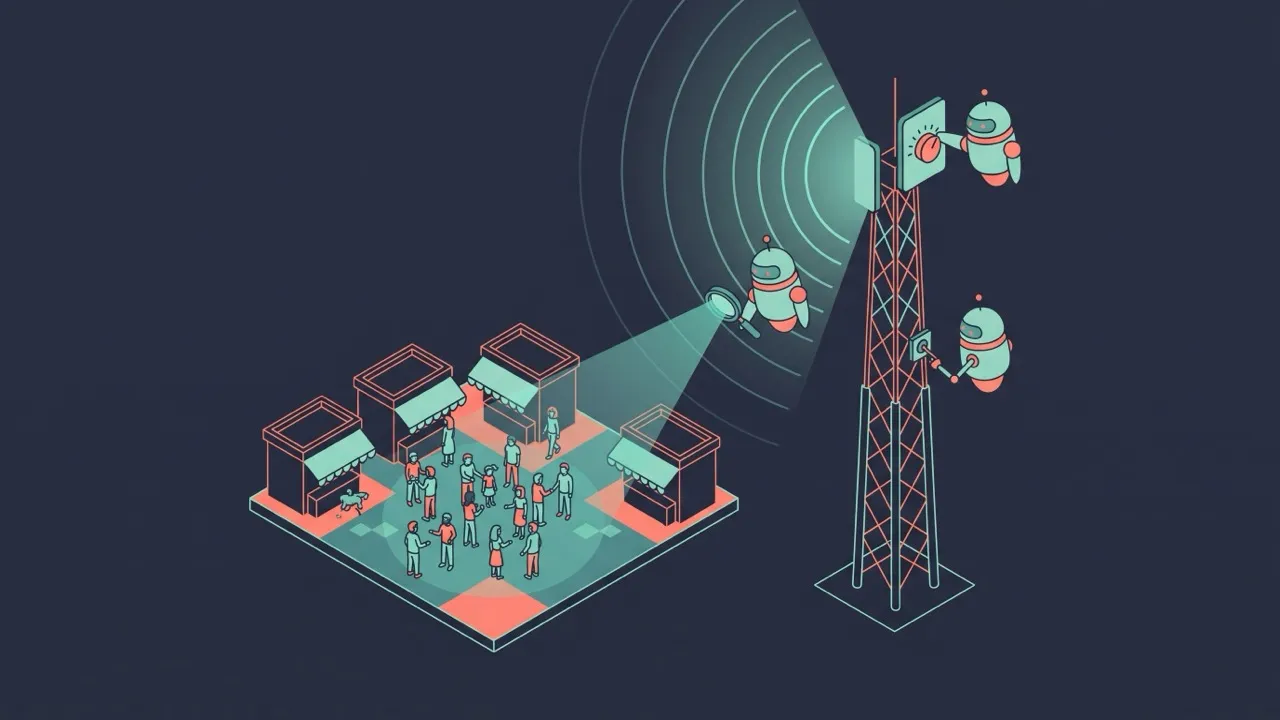
Preparing the network for these events used to be manual work. At Deutsche Telekom’s AI Investor Day on 2026-10-05, Chief Network Officer across Europe Armin Sumesgutner said the company could analyze about 1,000 events a year this way. Since November 2025, a system of three AI agents called RAN Guardian has done that work in Germany. It finds events in public sources, checks the cell sites around each one, and changes network settings before and during the event. Sumesgutner said it now covers 100,000 events a year.
The case is useful because the company describes where the agents stop. Cells in poor condition go to a technician before the agents act. Events too large for any setting change need mobile sites or extra capacity, which people bring. Some congestion still needs a person to step in. Deutsche Telekom announced in February 2026, with Google Cloud, a broader system called MINDR that applies the same approach to the whole network. At the October investor day MINDR was still a minimum viable product, and the company said a person would approve every critical change.
All figures come from Deutsche Telekom’s own press releases, factsheet, and investor day presentation. They are company figures, not independently audited results.
2. Problem
Sumesgutner described the problem at the investor day in three parts.
- Static planning falls behind crowds. Mobile networks are planned for the expected customer experience at each location. “And the most important issue is we are always behind the wave.” Events where many people gather are, in his words, “totally ruining a static planning.”
- Analysis is slow and manual. The investor day slide titled “RAN Guardian – Problems to solve” lists “Reactive & Manual operations”: “Issues are detected only after degradation, requiring time-consuming manual data correlation.”
- People could only cover a fraction of events. “We have about 1,000 events which we can do manually. So, 1,000 events where we can do all the analysis, running through all the details.” He added: “So reality is much bigger.” The same slide lists two more problems. Under “Too rigid to keep up”: “Limited number of events can be tracked and managed manually.” Under “Scalability & Awareness gaps”: “Teams cannot monitor or understand high number of events, missing critical degradation signals.”
Confirmed facts: static network planning cannot follow event crowds; issue detection came after degradation with manual data correlation; about 1,000 events a year could be analyzed manually (Sumesgutner, 2026-10-05); teams could not monitor the number of events and missed degradation signals (investor day slide).
3. Solution
3.1 Three agents, one per step
RAN Guardian is “a team out of agents,” in Sumesgutner’s words. The investor day slides and his live demo describe three.
- People Event Agent (scanning). It reads “public media, social media” and other sources “trying to bring that one into a structured format.” The slide lists its actions: it “Creates a comprehensive list of events across a country (e.g. Germany)” and will “Size, localize and categorize the event.” The slide adds that it will “Verify the list of events based on a second verification angle and store it in a confidence factor.” In the demo, Sumesgutner showed events of more than 1,000 people in Germany: “It’s 213k events which are impacting in any way, so to say, our network.” He called it “a year’s number.”
- Monitoring Agent. It “Links event locations to radio sites, analyzes data, and assesses issue severity.” Sumesgutner described it as “putting T-shirt sizes on it” and working out the technical effect on the network. In the “Preparation phase” it checks “the sites associated with an upcoming event up to 3 month in advance for: performance issues and Capacity sufficiency.” During the event it “monitors a set of KPIs” and will “Recommend the best config choice in real time.”
- Remediation Agent. It “Evaluates degradation types and executes targeted corrective actions.” The slide lists its other actions: “Notifies a human for action if required” and “Stores experience and logs all actions for future learning.”
3.2 Who handles what
The monitoring view in the demo sorts the work before any setting changes.
- Cell status. Some cells are in good shape. Others need work first: “the amber ones, you better send a technician there, make sure, so to say, this also goes into the green state before we start the remediation action.”
- Event estimate. For each event the agent estimates whether the risk can be handled autonomously. Some events are “sufficient,” with nothing to do. Events “at risk” are where “we will then see the autonomous agent taking remediation actions.” Red events need more: “we have to bring some mobile sites, we have to bring some more capacity to the site. This can’t be dealt with out of the system itself.”
- During remediation. “Most of the time, we fortunately already see congestions could be mitigated automatically, so full autonomous activity. Some of them need still some human interaction to make sure we’re going to solve it.”
3.3 What the agent changes
In the demo, one event had 24 actions executed. Sumesgutner named the levers: “we change the carrier aggregation, we change the uplink, we make sure, so to say, the tilt is the right one. We really focus capacity to the place where the event happens.” In the Q&A he added tilting and using neighboring sites to serve the congested ones. The aim, he said, is “this minimum acceptable capacity for each and every user in the footprint.”
The most visible action in the demo was switching off carrier aggregation, which combines several frequency bands to give a single phone higher speeds. Turned off during a crowd, it gives each phone less top speed but spreads capacity across more people. Sumesgutner described it as “less high-speed capacity or high-speed service delivered to the customers, less capacity, but spread to everyone.”
The demo also showed every site touched and every action taken for an event. “We always have to stay on top what’s happening in our networks.”
3.4 Built in-house on Gemini
The February 2026 release says RAN Guardian was “built with Google’s Gemini models.” At the investor day Sumesgutner said “RAN Guardian was developed in-house.” Head of Investor Relations Hannes Wittig said T-Mobile in the US runs the same concept under another name and that “each one of us is the first operators in the world to have this.” That is the company’s own claim.
The rollout sequence differs by date. In February 2026 the company said RAN Guardian “is now scaling across Deutsche Telekom’s European national companies, starting with the Czech Republic and Croatia.” In October 2026 Group Technology Officer Arash Ashouriha said it “will go live this year in Czech Republic and multiple other markets will follow next year.” Sumesgutner described the scaling principle as “We build once, we deploy many times,” with the same agent structure and data structure across the group.
3.5 Next: MINDR across the whole network
RAN Guardian focuses on the radio access network, the antennas and base stations phones connect to. The February 2026 release says that across a whole network “operational teams often rely on fragmented systems that slow root-cause analysis and resolution.” Ashouriha said in October: “Most of today’s automation is still domain-specific and addresses specific use cases.”
MINDR (Multi-Agentic Intelligent Network Diagnostics & Remediation) applies the RAN Guardian approach at the service level across the radio, transport, and core networks. It was developed with Google Cloud’s Autonomous Network Operations framework and Gemini models on Vertex AI. The MWC factsheet describes “a collaborative multi-agent system coordinated by a central orchestrator,” in which “multiple agents jointly assess and validate RC hypotheses to reduce noise and false positives.”
Ashouriha described four steps: correlate signals across the network; reason over the root cause with specialized agents per network domain and node; “execute and verify remediation within predefined guardrails”; and learn from the outcome. Low-impact fixes may run autonomously, “but for every critical change, there will be always a human in the loop, which has to approve the change before it gets executed.” In the demo, a network operations center (NOC) engineer approved a proposed change, the system executed it, and then checked whether the result matched what was agreed.
Asked whether the autonomous system had gone wrong, Ashouriha said each set of agents has an observer agent on top, and that “never, never has an agent direct access to the network element. There is what’s so-called MCP, which is a gateway.” Each agent may perform only defined actions through that gateway. He added that in testing the system sometimes behaved “differently than what we expected,” which is why it is being hardened one use case at a time.
MINDR is not in production yet. In February 2026 the company planned “first production releases” for later in the year. At the October investor day, CEO Germany Rodrigo Diehl called it “an MVP that is about to go live.” Ashouriha gave targets, together with the broader network transformation: more than 90% of tickets handled automatically, issue qualification under 15 minutes on average, incident resolution under one hour, and 30% higher productivity. He said productivity “can mean that we can handle more things or that we move network experts to other parts.” These are targets, not results.
Confirmed facts: three agents (event scanning, monitoring, remediation); events verified with a confidence factor; sites pre-checked up to three months before an event; amber cells go to a technician before remediation; red events need mobile sites or extra capacity from people; most congestion mitigated autonomously, some needs human interaction; levers include carrier aggregation, uplink, tilt, neighboring sites; all actions logged; built with Gemini models; developed in-house; MINDR in development with human approval for critical changes and an MCP gateway between agents and network elements.
4. Impact
All RAN Guardian figures are Deutsche Telekom’s own.
| Metric | Figure | Source and date |
|---|---|---|
| Time to manage major events | “from hours to around a minute, a more than 95% improvement” | Press release, 2026-02-25 |
| Response time for events | “from several hours to about one minute” | Press release, 2026-10-05 |
| Execution speed | “>95% Faster execution”, “From 1 hour to 1 min” | Investor day slide, 2026-10-05 |
| Remediation actions after launch | over 100, at Christmas market events, “during its first month” (German release: by year end) | Press release, 2026-02-25 |
| Events identified | 237,000 “For 2026” | Press release, 2026-02-25 |
| Events covered | about 1,000 a year manually → 100,000 analyzed and remediated; slide: “>100 k events with more than 1,000 attendees” | Investor day, 2026-10-05 |
| Customer minutes | “>24 mn customer minutes Protected against congestions in events”; “the avoidance of 24 million minutes of bad customer experience” | Investor day, 2026-10-05 |
Carnival 2026. During the February carnival season in Germany, RAN Guardian identified “around 130 Carnival events and parades, each expected to draw over 10,000 participants.” These were served by 611 mobile sites, “all pre-checked for issues by RAN Guardian, with most also monitored live.” “Only 5 sites experienced peak loads,” and RAN Guardian adjusted those sites during the event.
Customer quality. Mudesir said in February 2026: “With the RAN Guardian Agent, we demonstrated how Agentic AI can enhance network operations to consistently deliver the highest quality of experience for our customers.”
5. Insight
The work that moved is finding and pre-checking events. People used to do full analysis for about 1,000 events a year. The agents now find events in public sources, size them, tie them to cell sites, and check those sites months ahead, at about 100 times that number.
People keep the physical and the unsolvable. The agents do not send technicians or roll out mobile sites. Amber cells are fixed by a technician before any automated change, and red events get extra capacity from people. The agent’s own job is changing settings on existing sites, such as carrier aggregation, uplink, tilt, and load sharing with neighbors.
Healthy cells are a precondition for autonomy. The remediation agent waits until a cell is green. Cells that need a technician are brought back to green first, so automated changes start from cells in known good condition.
The next step keeps a human gate. RAN Guardian changes parameters on its own in one domain. MINDR, which works across the radio, transport, and core networks, is designed so that a NOC engineer approves every critical change and agents reach network elements only through a gateway with fixed permissions.
Limits. All figures come from Deutsche Telekom. The speed figure appears as “hours” to “around a minute” in the press releases and as “1 hour to 1 min” on the investor day slide. The event counts measure different things: events identified for 2026, events of more than 1,000 people shown in a demo, and events covered by analysis and remediation. The method behind the 24 million customer minutes is not given. The February 2026 release dates the launch to November 2025, while Ashouriha said in October 2026 that RAN Guardian has been live in Germany “since January.” MINDR is not yet in production, and its figures are targets. No cost, headcount, or staffing figures are published, and the company has not said how many people did the manual event work or what they do now.
One-line takeaway: A network operator can scale event preparation a hundredfold by letting agents find events and retune healthy cells on their own, while technicians and other network staff take the cells and crowds that a settings change cannot fix.
6. Implementation hypotheses (not in the source)
6.1 Event records with a confidence score, mapped to cells
Basis: The People Event Agent will “Verify the list of events based on a second verification angle and store it in a confidence factor,” and the Monitoring Agent “Links event locations to radio sites.”
Each event is probably stored as a record with a name, place, date, estimated attendance, size class, and a confidence value. The second verification angle likely means confirming the same event in another public source, such as an official listing as well as a social media post, and raising the confidence when both agree. Events below a confidence threshold would likely stay in the list without triggering preparation. To link an event to radio sites, the agent would geocode the location and look up which cells cover that area in the operator’s site and coverage records. Performance history for those cells would then show whether they have spare capacity for the estimated crowd. The size class from attendance would decide how many cells and how much spare capacity to check.
6.2 A gated state machine for each event
Basis: Cells in amber need a technician “before we start the remediation action.” Events are sorted as “sufficient,” “at risk,” or needing mobile sites, which “can’t be dealt with out of the system itself.” The Remediation Agent “Notifies a human for action if required.”
The workflow likely tracks each event and each of its cells through fixed states. A cell with an open fault or poor performance probably generates a field ticket for a technician and is blocked from automated changes until it returns to green. An event whose estimated demand exceeds what parameter changes can give is likely routed to capacity planning as a request for a mobile site, months ahead because the preparation phase starts up to three months before. Only events marked “at risk” with all cells green would reach the remediation agent. During the event, if the KPIs stay congested after the agent’s actions, a notification to the network operations staff is the likely fallback. That matches the description that some congestion “need[s] still some human interaction.”
6.3 A bounded action list with logging and rollback
Basis: The demo showed 24 actions for one event across carrier aggregation, uplink, and tilt, with every site and action listed. The Remediation Agent “Stores experience and logs all actions for future learning.” For MINDR, Ashouriha described a gateway that limits each agent to defined actions.
The remediation agent probably chooses from a fixed list of parameter changes rather than writing arbitrary configuration. Each change would be logged with the site, the old value, the new value, the time, and the KPIs before and after. That log is what the demo displayed. Because the changes trade peak speed for spread capacity, they are probably reverted after the event ends, using the stored old values. The before-and-after KPIs per action would form the “experience” the slide mentions: the next time a similar event at similar sites comes up, the agent can start from the set of changes that cleared congestion last time.
7. Sources
- Deutsche Telekom — Deutsche Telekom and Google Cloud Collaborate for Superior Network Experience with Agentic AI
https://www.telekom.com/en/newsroom/latest-updates/media-information/2026/2/mindr-ai-agents-in-telekom-network
2026-02-25 (accessed 2026-11-17) - Deutsche Telekom — Telekom und Google Cloud: Agentic AI für bestes Netzerlebnis (German version of 1)
https://www.telekom.com/de/newsroom/aktuelles/medieninformationen/2026/02/telekom-und-google-cloud-agentic-ai-fuer-bestes-netzerlebnis
2026-02-25 (accessed 2026-11-17) - Deutsche Telekom — MINDR: A multi-agentic system that observes, anticipates, and acts accordingly (MWC 2026 factsheet, PDF)
https://mwc.telekom.com/downloads/DT_MWC2026_Factsheet_MINDR.pdf
2026-02 (file created 2026-02-12; accessed 2026-11-17) - Deutsche Telekom — AI Investor Day transcript (PDF) and network presentation slides (PDF)
https://www.telekom.com/en/investor-relations/publications/capital-markets-days/ai-investor-day
Transcript: https://corporate-media.telekom.com/adobe/assets/urn:aaid:aem:5f06dc2a-d1c8-491d-a4ad-c2ae675f9310/original/as/DT%20AI%20Investor%20Day%20-%20Transcript.pdf
Slides: https://corporate-media.telekom.com/adobe/assets/urn:aaid:aem:a1d2d6d7-2d17-4602-ba9a-757832c1e51d/original/as/AI_Investor_Day_Network%20Rodrigo%20final.pdf
2026-10-05 (accessed 2026-11-17) - Deutsche Telekom — Deutsche Telekom boosts growth, efficiency and quality through the use of AI
https://www.telekom.com/en/newsroom/latest-updates/media-information/2026/10/deutsche-telekom-boosts-growth-efficiency-and-quality-through-t
2026-10-05 (accessed 2026-11-17)