All casesNo. 040
Why Gamma Turned Its Paused AI Support Back On
How 23 people handle 50 million users' questions while holding 84% satisfaction
- Case no.
- 040
- Primary source
- Intercom Fin customer story
- Source published
- Not stated
Summary
- Gamma restarted Intercom’s AI support agent Fin, which it had put on hold, over a holiday.
- The share of inquiries people handled directly fell from 94% to 24%, and customer satisfaction reached 84%.
- An AI tool’s success depends less on early test results than on changes in operating conditions and on routing design.
Fifty million users and a team of 23 hit a limit
Imagine a service where more than 50 million users around the world send questions day and night, in many languages. This is the story of Gamma, which uses AI to help people make presentations and websites easily. With a large global service, you might picture a big call center of hundreds of people. But the human staff who handle customer inquiries directly at Gamma number only 23: 20 outsourced agents, 2 in-house technical support engineers, and 1 community manager. How does this small organization take in inquiries pouring in from all over the world without choking?
As the service drew global attention, the volume of inquiries rose steeply. Conversations coming into the customer support channel reached 20,000 to 30,000 a month. But with a small in-house team and a structure built around outsourced agents, it was hard to cover 24 hours a day, several time zones, and many languages without gaps. Free users and paying users alike expect answers that are fast, accurate, and tailored to them, but Gamma’s support team simply could not physically keep pace.
As a result, customer experience metrics got worse quickly. The median first response time, which is the middle value of the time a customer waits for a first reply after leaving an inquiry, grew to 90 minutes. CSAT, the share of customers who said they were satisfied, fell to about 69%. Hilary Dudek, Gamma’s head of customer experience, looked back on the situation and said:
“We were getting hammered with incoming conversations.”
“Wait times were long, customers were getting frustrated, and our support agents were burning out. So we needed a way to provide instant, high-quality responses without doubling or tripling our team.”
But simply adding people and papering over the problem was not an option, because Gamma had kept to a principle of growing the organization lean from the start. Hilary Dudek stressed: “We’ve always believed in scaling leanly – not just hiring to throw bodies at problems, but using the solutions we already have at our fingertips.” Instead of the easy choice of doubling or tripling the staff, Gamma’s task was to find a system that fit the pace of the product’s growth.
Looking again at a tool it had tried once and set aside
Gamma first tested Fin, the AI support agent from the customer support platform Intercom, in early 2024. But the first impression fell short of expectations. It did not produce the results Gamma wanted. At the time, the volume of inquiries was something the team could somehow handle, so the decision to put adoption off was not hard. Hilary Dudek recalled: “Our volume was still manageable at the time, so it was easy to postpone.”
But by the end of 2024, the situation had changed. Inquiry volume kept growing and wait times got longer. The workload of worn-out agents reached its limit. On top of that, the holiday season was coming. While most of the in-house staff would be off, there were very few people to cover the customer channel. In a hurry, Gamma began looking at other vendors’ tools instead of Fin. It even started the work of moving its data into another vendor’s system.
But this attempt ran into problems with support and transparency and got stuck. Meanwhile, things also changed on Intercom’s side. It fixed the issues Gamma had pointed out early on and opened key beta features for Gamma to try. Hilary Dudek said: “They really stepped up as a partner. They addressed things we’d flagged, put us into key betas, and made it feel like they were in this with us.”
As the holidays came close, there was no one in the company to respond, and support from BPO staff, the outside firms that take over customer response work, was also limited. The flood of inquiries could not be left alone. Hilary Dudek decided to turn Fin, which had been paused after the trial, back on for the holidays.
“Gamma has a culture of experimenting quickly. We’re big believers in failing fast – so we decided to give Fin another shot, see what Fin could do during that holiday period. What did we have to lose? We had everything to gain.”
What the holiday decision proved
During the holidays, Gamma handed 100% of all incoming conversations to Fin. The result went beyond expectations.
“We set Fin live and let it run. It was handling every conversation and doing incredibly well! Right upfront, it was resolving 50% of conversations and holding a 75% CSAT. For a first rollout, that was huge.”
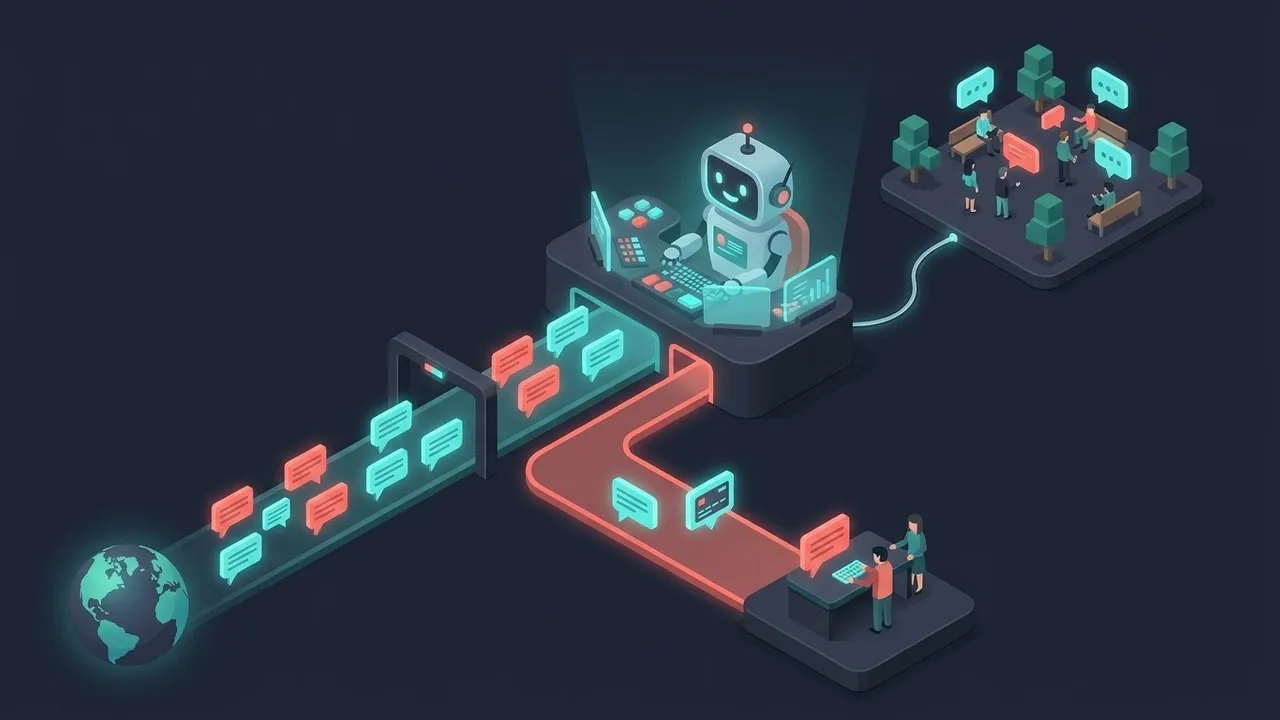
In the middle of the holiday rush, Fin read customers’ feelings, split paths to fit the nature of each inquiry, and even caught unusual cases the team had not expected. A typical example was a customer who was a free user on the account information in the system but was struggling with the payment process. Fin noticed this on its own from the context of the conversation and passed the customer to a human agent.
Through this experience, Hilary Dudek’s view changed completely. Fin earned trust as a tool that goes beyond a simple auto-reply chatbot: it learns fast, picks up subtle nuance, and gives accurate answers. Above all, the fact that the team could look back through the logic behind each of Fin’s decisions and check it gave them solid trust. Hilary Dudek said: “It more than did its job. That was definitely a turning point for me. Having full visibility into how Fin made decisions – being able to inspect the logic and retrace its steps – that’s what gave us real confidence.”
How Gamma’s support system runs now
Today, in Gamma’s support channel, Fin is involved in 100% of all conversations. And it resolves 75% of them from start to finish without human involvement. More than 18,000 inquiries a month are resolved through Fin, 24 hours a day, in many languages. The share of conversations that people had to handle by hand fell greatly, from 94% before to 24%. Even so, customer satisfaction (CSAT) has stayed steadily at a high 84%.
Behind the smooth running of this system are detailed routing rules. Routing is a way of finding the path: it analyzes a customer’s question and guides it to the most suitable handling route. By default, Gamma connects free users’ inquiries straight to Fin, in order to use limited human resources efficiently. But it does not split paths mechanically by the user’s plan alone. Gamma designed a custom escalation path that weighs the user tier, payment signals, and even the emotion shown in the conversation, and then passes the inquiry to a senior person or a human agent.
In the real operating environment, the user’s account data was likely combined with signals from the live conversation. A free user talks with Fin by default. But if the customer complains of a payment problem, such as “my card won’t go through” or “I can’t upgrade my subscription,” the system likely connected them to a human agent, putting the purchase intent shown in the conversation ahead of the account information in the system. When the customer’s frustration or complaint was detected, a rule likely sent the conversation up to the human agent desk regardless of tier.
Fin finds answers by reading Gamma’s official help center and its internal knowledge documents together. It automatically translates in real time whatever language a customer asks in, so Gamma does not need to keep separate agents who speak each country’s language.
Gamma also built custom workflows that do real work, beyond simply answering questions. They sort the unsolicited sales-pitch emails that arrive at random and close them automatically, and they detect billing problems. Through a link with the payment platform Stripe, Fin handles customers’ refund requests and payment failures directly.
Even in this money-related work, there were probably safe boundaries. Fin can handle on its own the job of using Stripe’s application programming interface (API) to check the subscription status or the reason a payment failed and to guide the customer to update card details. For refunds, which actually return money, the line was probably drawn so that Fin handles only fixed cases, such as a clear request right after payment or a duplicate charge, and tricky cases go through a human’s final approval.
Fin’s stage does not stop at the support desk. In Gamma’s Slack community, it posts answers directly to tough product questions that global users post in the middle of the night. Gamma also had Fin learn its API documentation, the specification that helps outside developers connect software features, so Fin supports developers using beta features and passes bug reports straight to engineers. Hilary Dudek said: “Fin doesn’t just respond. It acts. It adapts. And it does it at a scale we never could have imagined.”
How the role of people changed
As the support system changed, the daily work of the human team became completely different from a year earlier. Agents who used to be chased by the queue every time inquiries poured in could finally catch their breath. Hilary Dudek said: “The team breathed a sigh of relief. Fin handles so much that they finally have room to focus on interesting, challenging work, explore our product, and deliver a more thoughtful customer experience.”
New roles that did not exist a year earlier appeared in the organization. Workflow strategy, which designs how support work flows, AI training, which teaches the AI to give correct answers, and content optimization, which polishes the documents the AI refers to, became core work for the human team. Analyzing conversations that Fin guided wrongly and fixing the internal documents would likely fall here.
Gamma plans to automate more work, such as handling refunds, logging bugs, and taking in feature requests. It wants to develop proactive workflows that respond before problems arise, and to bring AI more deeply into community support. Hilary Dudek summed it up when sharing a recent experience.
“I gave a talk recently on scaling CX leanly. And this is it. Fin isn’t replacing humans – it’s making the work more meaningful, more strategic, more sustainable.”
What is worth noting even if you do not work in customer support
Gamma’s case offers some important lessons not only for customer support departments but for every business leader and practitioner who wants to run an organization efficiently.
First, one failed test does not mean a tool’s limit is permanent. When Gamma first tried Fin and it fell short of expectations, it set it aside without regret. But when the organization’s conditions changed and the technology and features improved, it gave the tool another chance without being trapped by the past judgment. When you review fast-changing new software, you need the flexibility to re-check today’s conditions and the tool’s current state, instead of dwelling only on why it did not work before.
Second, the success of AI support depends less on how well it talks than on how it reads the customer’s context. Gamma did not split paths by the content of the question alone. It also looked at the user’s status, payment signals, and emotional cues such as complaints or frustration. Thanks to this, even if the system listed a customer as a free member, it did not miss a customer who showed intent to pay and could pass them to a person. A design that did not rely only on a static data table, and split the roles of AI and people to fit the customer’s real situation, raised the efficiency of the whole system.
Third, what drives automation to settle in is not only speed of processing but transparency of the process. One reason Gamma got stuck when it tried to move to another vendor was transparency, and the reason it gained confidence after the holiday trial run was that people could see what process of judgment the AI went through. Only when people can verify a system’s reasoning can they safely hand it more authority and more work.
Gamma’s way of keeping a small team while absorbing explosive growth shows a path that widens an organization’s capacity by combining technology wisely, without hiring more and more people.
Sources
- Intercom Fin — Scaling smarter: How Gamma supports 50M users with 20 agents and Fin
https://fin.ai/customers/gamma
Published: unknown (unlisted on page; 2025-01-01 in structured data is a default placeholder across fin.ai customer stories), verified 2026-09-24