All casesNo. 074
Lowe's Governs AI Agents Before They Multiply
Four approval tests, a human in the loop first, and one platform that tracks every agent
- Case no.
- 074
- Primary source
- Trade press interview (Modern Retail Q&A)
- Source published
- 2026-03-24
1. Why this case
Lowe’s is a US home improvement retailer with about 1,700 stores. Chandhu Nair, Lowe’s SVP of data, AI and innovation, put its workforce at about 250,000 associates in a March 2026 Q&A with Modern Retail; a correction note on the article says Lowe’s website gives about 300,000.
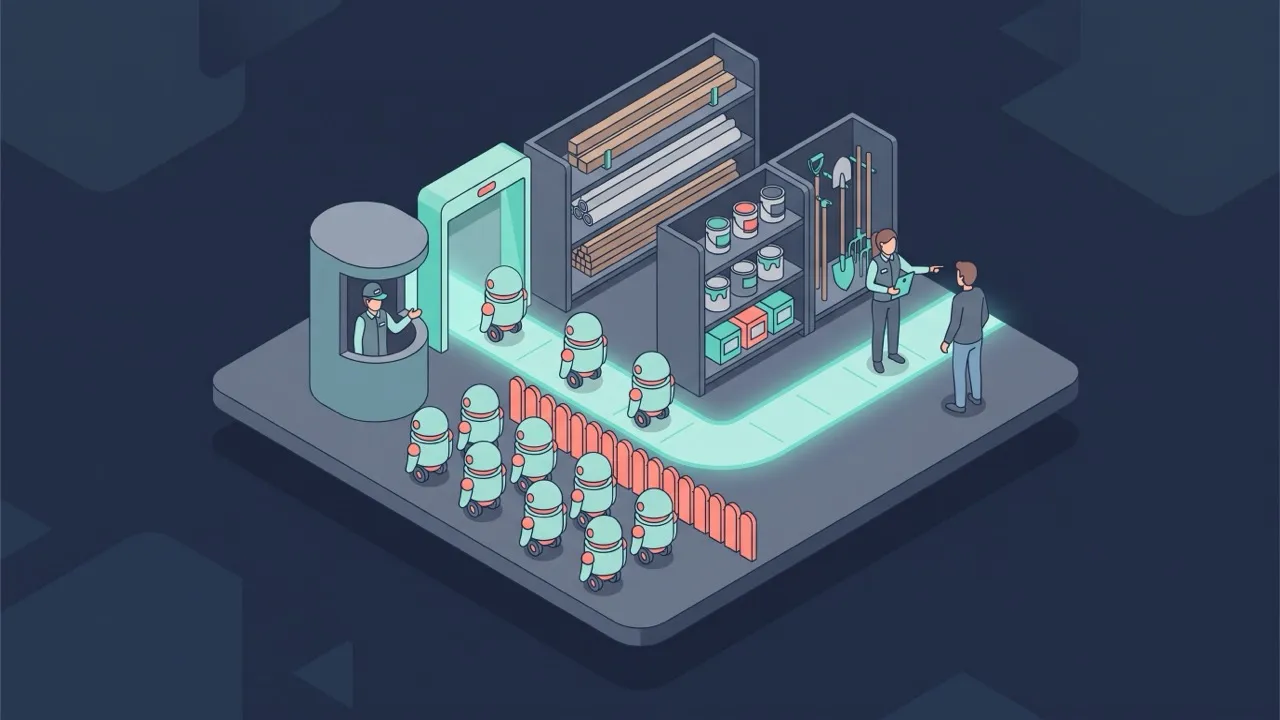
Most published AI cases describe one agent and what it did. In that interview, Nair talked about the step before that: how Lowe’s decides where agents go at all. His concern is what he calls AI sprawl, which the article describes as agents that are “narrowly focused, poorly coordinated, difficult to maintain and built in silos across an organization.” He describes it as the risk that comes with a technology that is easy to build with, and he lists what Lowe’s put in its way: one taxonomy of where agents apply, an AI transformation office that judges which areas have the right use cases, four tests for any new AI tool, a human-in-the-loop start for deployed agents, and one internal platform that every AI project runs through.
The case also shows where Lowe’s started: in its stores, with an assistant that lets any associate answer a customer’s product or project question, not only the trade specialists who know that department. Nair reports about a million questions a week across the customer and associate versions of the assistant and about 300 basis points of improvement in Lowe’s net promoter score since rollout. These are figures given by a Lowe’s executive in an interview, not audited results.
2. Problem
2.1 Agents are easy to build and hard to make consistent
Nair describes the shift in the industry as a move “from these conversational chat assistants using generative AI to many more agents.” An agent can be told a task in plain English and will use whatever tools it is given; in his words, “It can use an API, it can use an Excel sheet to solve that particular task you gave it.”
That ease is the problem he names: “The sprawl is because it’s so easy to do.” A person doing the same task carries context about what should and should not be done. An agent has to be trained “to make sure it’s consistent and it works within those boundaries and frameworks.” His summary of the risk:
“It’s fairly easy to build an agent. You could have multiple engineers build out agents, and suddenly you would have a list of agents without a purpose and not working consistently every time. It may work 20% of the time or 80% of the time; the challenge is to make sure it works 100% of the time.”
2.2 In large stores, product knowledge sat with a few people
Nair says the stores were where Lowe’s started applying AI. He describes the stores as “100,000-square-foot stores” and the knowledge problem inside them: “Because our associates are trade specialists, and the product knowledge is limited to a certain set of folks.”
Customers also bring a different kind of question than in most retail. Nair says that, “unlike a traditional grocer or any other retailers,” people come in asking how to fix a leaky faucet or what they need to build a raised garden bed, which tools, and how to put it together. Answering means knowing the project, the products, and where those products are in a very large store.
Confirmed facts: about 1,700 stores; about 250,000 associates per Nair, about 300,000 per Lowe’s website (article correction); stores about 100,000 square feet; product knowledge “limited to a certain set of folks”; customers ask project questions; sprawl described as the risk that comes with easy agent building.
3. Solution
3.1 One map of where agents go, and an office that decides
Nair’s first answer to sprawl is a map: “What we had to do was create, essentially, one taxonomy of where we apply these agents.” Next to it sits an organization: “Within Lowe’s, we’ve created this AI transformation office, which has a governance process that looks at which areas have the right use cases to apply these agents.”
Lowe’s also divides its AI work into three areas, which Nair calls “shop, sell, work”: how customers shop with Lowe’s, how stores and associates sell (including the “inside, outside sales agents” of the pro business), and how corporate functions such as tech, marketing, and merchandising work. “The sell side was the area that we started on — our stores.”
3.2 Four tests for any new AI tool
Separately, Nair describes guardrails “on the process itself” for building new AI tools. Lowe’s uses four parameters:
- Return. “What is the true ROI for the business case?” It has to be meaningful for the company.
- Capital. “the capital investment that is needed.” He calls the first two “traditional,” the same tests applied to any technology investment.
- Risk. “Does this carry any sort of brand risk? Is there a privacy risk? Is there a security risk? Is there a sprawl risk?”
- A person who redesigns the process. “Probably the most important part, the fourth parameter, is that someone has to reimagine the business process with this technology. If that person, that change management is not there, the technology is not going to be useful. It’s not going to use itself, so it’s also important that the right change leader is attached.”
3.3 A human in the loop first, and one platform for everything
On deployment, Nair says: “When you deploy these agents, there is a ‘human-in-the-loop’ framework to all these. We usually start with a human in the loop. For certain low-risk tasks, [humans are] always observing and only intervene when there is something that needs to be done.” He adds, “Certain tasks carry no risk.”
All of it runs on one internal platform: “Everything that we do goes through our Lowe’s-built AI foundry, which is a Lowe’s-based AI platform. It has observability, it has explainability to it, so I can track how these agents are performing.”
On the technology side there are two more layers of guardrails. At the model level, responses are kept to “the Lowe’s context”: the in-store assistant should not answer “questions on politics or things that are not relevant,” and should stay “very specific to home improvement and what the store associate has to do.” At the application level: “There is a whole set of security layers that we’ve built so you cannot inject artificial prompts and find there’s a way to get to our systems.” Nair also ties agent reliability to model reliability: “You can’t really have an agent act if your model is inconsistent in the way it reasons.”
3.4 Where it started: an assistant for every store associate
Lowe’s released Mylow, a virtual assistant for customers, in March 2025, and announced Mylow Companion, the version for associates, in May 2025, according to the article. Nair describes the store version as “an assistant for every associate in the store that can take any product question the customer has.”
The assistant removes the department boundary: “regardless of which department you are in or which product category you service at any store, you can ask a question on the device with the Mylow companion and service that customer.” For the garden bed example, “It will tell you not just how to build the raised garden bed, but it will also show all the products you need to buy, where they are in the store, how much is available, and whether you can get shipping on them.”
Mylow and Mylow Companion share “the same underlying technology.” The rollout took repeated passes in stores: “Obviously, it’s not an overnight switch. We had to iterate. We had to work with the store operations. We walked through every store that we could with the tool to continue to iterate and get feedback.”
3.5 An agent in the back office: invoice reconciliation
Nair’s example of an agent, as opposed to a chat assistant, works on purchase orders and invoices: “An example of an agent that we have is an invoice reconciliation agent. That can go back and look at different documents on a procurement order and invoice, and if there are discrepancies, it can understand and correct it.” He describes it as automating “a lot of the mundane processes that no one wants to do.”
Confirmed facts: one taxonomy of where agents apply; AI transformation office with a governance process on use-case areas; four parameters for new AI tools (ROI, capital, risk incl. sprawl risk, a person who redesigns the process with a change leader attached); human in the loop as the usual start, observe-and-intervene for certain low-risk tasks; all AI work runs through the internal AI foundry with observability and explainability; model-level topic guardrails and application-level prompt-injection defenses; shop/sell/work framework, stores first; Mylow (March 2025) and Mylow Companion (announced May 2025) share underlying technology; Companion answers any product question for any associate with products, store location, availability, and shipping; rollout iterated store by store with store operations; invoice reconciliation agent finds and corrects PO–invoice discrepancies.
4. Impact
Figures given by Nair in the interview published 2026-03-24.
| Metric | Figure | Basis |
|---|---|---|
| Questions handled | about 1 million per week | Mylow (customers) and Mylow Companion (associates) combined |
| Net promoter score | about +300 basis points | “Since we rolled that out”; Nair says it “correlates to sales numbers” |
| Time in stores | a little over a year | Since the first store rollout, as of the interview |
Nair said: “Since we rolled that out, we have seen about 300 basis points of improvement in our net promoter score, which correlates to sales numbers. I’m not at liberty to share the exact numbers here.” No sales figure is given. On how to read the weekly volume, he said: “Think about every engagement that AI is helping convert.”
5. Insight
When building is cheap, the scarce input is the decision about where. Nair’s account puts the controls in front of construction, not after it: a taxonomy of where agents apply, an office that judges use-case areas, and a risk test that asks directly about sprawl. The number of agents is treated as a cost, not a goal.
The most important test is a person, not a number. Of the four parameters, two are standard investment tests. The one Nair calls most important is that someone redesigns the business process and that a change leader is attached, because the tool is “not going to use itself.” The approval is for a change in how work is done, with an owner, not for software alone.
Oversight starts high and loosens by risk. Agents start with a human in the loop. For low-risk tasks, people move to watching and stepping in when needed. That only works if every agent’s behavior can be seen, which is what the single platform with observability and explainability provides.
In stores, the work that moved was product expertise. Before, a customer’s project question needed the associate who knew that department. With the assistant, any associate can give the steps, the product list, the location in the store, stock, and shipping options. The store walk-throughs show that this took repeated adjustment with store operations, not a one-time launch.
Limits. The source is one executive’s edited interview. All figures are his, the million weekly questions combine the customer and associate assistants, and the NPS gain is linked to sales only as a correlation with no figure. The interview does not connect the four tests to the AI transformation office, and it gives no count of agents in production, no number of proposals approved or turned down, and no results for the invoice agent. The associate count differs between Nair (about 250,000) and Lowe’s website (about 300,000). Nair left Lowe’s in August 2026 to become Target’s first chief AI officer, according to CIO Dive; the setup described here is as of March 2026.
One-line takeaway: Lowe’s treats a new AI agent as a business-process change that needs a return, a risk check that includes sprawl, and a named person to redesign the work, and it runs every agent on one platform where people can watch it before they let go.
6. Implementation hypotheses (not in the source)
6.1 The taxonomy as an agent registry checked at intake
Basis: Nair describes “one taxonomy of where we apply these agents,” a risk question “Is there a sprawl risk?”, and says “Everything that we do goes through our Lowe’s-built AI foundry.”
A sprawl check needs something to check against. The taxonomy most likely works as a registry: each node is a business process, and each agent on the platform is registered to one node with an owner. A new proposal would name its node, its return and capital estimates, its risk answers, and the person who will redesign the process. The sprawl question is then answered by looking at the node: if an agent already covers that process, the proposal extends it instead of adding a second one. Because all AI work goes through one platform, registration and deployment are probably the same step, so an agent that is not in the registry cannot run in production.
6.2 Oversight levels recorded per agent on the platform
Basis: “We usually start with a human in the loop. For certain low-risk tasks, [humans are] always observing and only intervene when there is something that needs to be done,” and the foundry lets Nair “track how these agents are performing.”
For the platform to support two oversight modes, each agent likely carries a setting for its current mode. In the first mode, the agent’s proposed action waits in a review queue and a person approves or edits it. The platform would log each proposal and each human decision, which gives the performance record Nair refers to. An agent would move to the observe-and-intervene mode only for tasks classed as low risk, after that record shows people rarely change its output. In that mode, actions go through, and people watch a feed of them with the ability to stop or reverse one. The invoice reconciliation agent is a likely candidate for this path: a proposed correction to an invoice is easy to queue for an accounts payable reviewer and easy to compare against what the reviewer did.
6.3 Store context and topic limits in the associate assistant
Basis: The assistant shows “all the products you need to buy, where they are in the store, how much is available, and whether you can get shipping on them,” runs on “the same underlying technology” as the customer Mylow, and is limited at the model level to “home improvement and what the store associate has to do.”
Answers that include location and stock for one store suggest the assistant knows which store the device belongs to and calls store-level inventory and location data, plus a fulfillment check for shipping, on top of the product catalog. The shared technology with the customer version probably means one service answering both, with the context switched: store ID and associate role on the floor, online customer context on the web. That shared service would also explain why the weekly question count is reported for both together. The topic limit is likely a check before the model call that turns away questions outside home improvement and store work, and the store walk-throughs would have fed specific failed questions back into that check and into the product data.
7. Sources
- Modern Retail — Lowe’s is fighting to prevent AI agent overload (Q&A with Chandhu Nair, by Mitchell Parton)
https://www.modernretail.co/technology/lowes-is-fighting-to-prevent-ai-agent-overload/
2026-03-24 (correction added 2026-03-25; accessed 2026-11-17) - CIO Dive — Target taps Lowe’s executive as first chief AI officer
https://www.ciodive.com/news/target-taps-chandhu-nair-chief-ai-officer/827613/
2026-08-11 (accessed 2026-11-17)