All casesNo. 046
A Dentist's Back-Room AI Server Protects Patient Data
Insurance lines 77% auto-confirmed, staff review only the 23% exceptions
- Case no.
- 046
- Primary source
- arca.live community post (self-reported)
- Source published
- 2026-10-13
Summary
- A solo neighborhood dentist ran AI on his own servers, with nothing leaking outside.
- 77% of the insurance paperwork matching was confirmed automatically, which greatly eased the phone and clerical load.
- AI transformation works in practice only when you set a security principle and keep a human review step.
The story of a dentist with no computer degree who put servers in the clinic’s back room
This piece is based on a post titled “A neighborhood dental clinic’s AX transition,” published on October 13, 2026, in the “AI Local Homelab” channel of the online community arca.live. The writer is a neighborhood dentist who goes by the nickname gatsbydds. He is not a developer. He studied biology at university and works alone in his clinic as a one-person dentist. He does not write code himself. How did a dentist with no computer background build such a complex AI environment on his own?
The story began with a small question. Dentistry is a typical labor-intensive trade: the dentist earns money only by treating patients with his own hands. Labor costs and prices rise every year while medical fees stay fixed, so the dentist saw the clinic as it stood as a sunset business. Administrative work, apart from treatment, also weighed heavily on the clinic. Every day the same things repeated: answering patients’ calls, frequent appointment changes, sorting the faxes that kept coming, and going around to colleagues to ask how a past treatment had been handled. The job staff found hardest was matching the payment statements that insurers sent against the clinic’s records, line by line.
The dentist did not make a grand plan. He simply started by asking ChatGPT what AI could do in a dental clinic. For convenience, the easiest route was to upload documents to a cloud AI service on the market. But he decided he could not hand call recordings or insurance claim records that hold patients’ personal information over to an outside company’s servers.
“It would be convenient to hand this to a cloud AI, but sending call recordings or insurance documents to an outside server didn’t feel right.”
Once he set the standard that not a single line of patient information would leave the clinic, the path narrowed to one. He would bring the AI computing equipment into the clinic itself. When the clinic was being built, the interior contractor’s quote for the network had been too expensive, so he ran the LAN cables and built the network himself. That hands-on skill became the foundation for building the back-room server room.
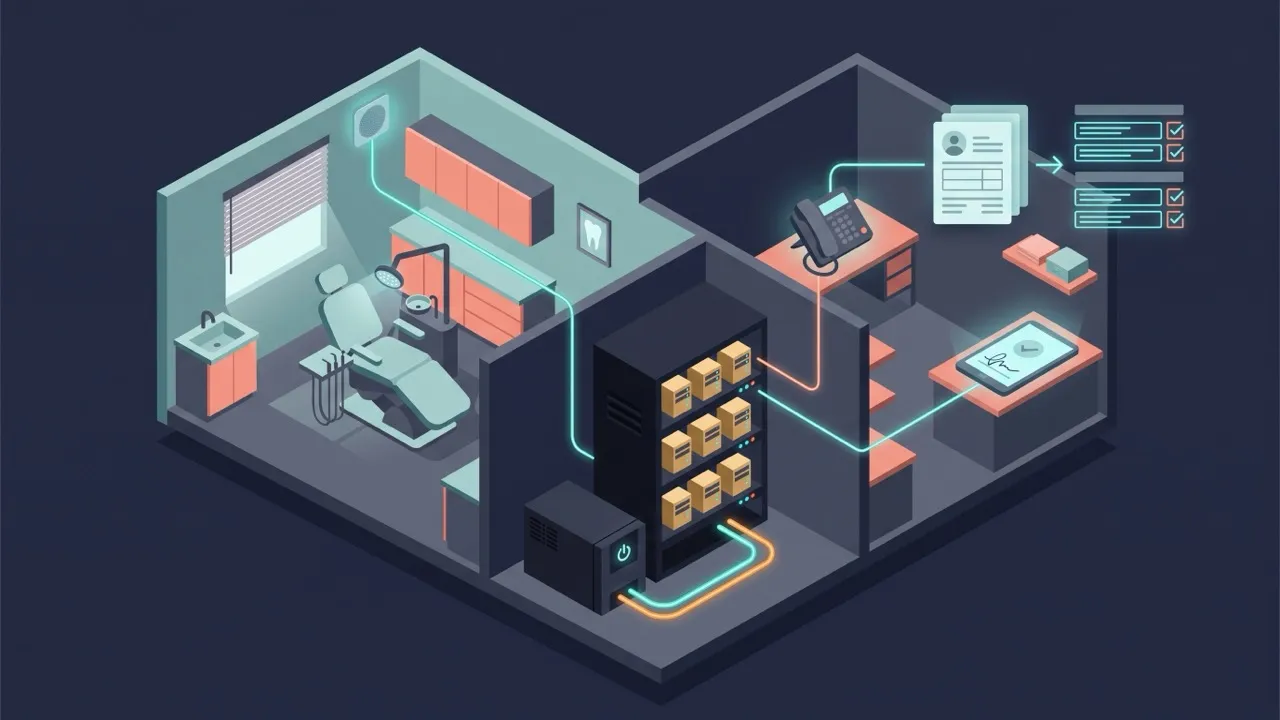
An AI server room set up in the back room of the clinic
To run models independently inside the clinic, he needed hardware. The dentist filled the space behind the treatment room with equipment one piece at a time. He unified the whole network on Ubiquiti UniFi routers, switches, Wi-Fi, and cameras so he could check its status easily from one screen.
For the model servers that act as the core brain, he brought in 12 NVIDIA DGX Spark-class machines. He also considered large GPUs such as the H200 or RTX Pro 6000, but put them aside because they were too expensive and the clinic’s electrical wiring would probably have needed to be redone. Instead, he chose to link DGX Spark-class machines four at a time with high-speed cables to run one large model. DeepSeek runs on four of them, GLM on another four, and the rest are set aside for experiments.
Speech recognition, speech synthesis, and document search and reading were handled by two Mac mini M5 Pro machines set up as a pair and one M4 Mac mini that runs the openclaw program. The M5 Pro pair was meant so that if one suddenly stops, the other takes over and treatment is not interrupted. On top of that, he attached a command-line tool called Aside cli for scheduled jobs and for handling work on insurance websites. He also placed three Proxmox virtualization servers to manage the internal portal, the dental management software, the phone exchange, backups, and monitoring separately. He connected six uninterruptible power supplies (UPS) so that equipment would not be damaged in a blackout. When the power goes out, the machines signal each other and shut down safely in order, and when the power returns they start up on their own. In all, the computers installed in the treatment rooms, front desk, consultation room, the dentist’s office, and the server room come to more than 30 across the whole clinic.
There was also a small but alarming obstacle on site. If a high-speed cable was plugged in while the equipment was powered on, the speed was limited to about one-tenth of normal. Simply rebooting the server did not fix it. He had to pull the cable out completely and wait for one minute before the speed returned to normal. The dentist ran into this problem twice and learned the equipment’s quirks the hard way.
Bringing the phone exchange and internal search into the clinic
For phones, instead of using a carrier’s business phone service, he built his own with FreePBX, free open-source phone exchange software. Only by not depending on an outside carrier could he change extension calls, call transfers, call recording, and announcement messages to suit the clinic. He also built a mobile app himself so that, even when out, he can place and receive calls on the clinic’s main number and check call summaries.
When a patient calls, an AI voice answers first. The time from picking up the receiver to the first sound is only 0.1 seconds. The conversation with the patient is turned into text in real time and appears on the front desk staff’s monitor. When the call ends, the system separates the speakers, summarizes the whole content, and pulls out a list of things staff need to do. Past call records are stored so they can be searched at any time. In actual call handling, the flow was probably this: as soon as FreePBX picks up the call, it sends the audio to a streaming speech recognizer running on a Mac mini and shows it on screen, and after the call a large model sorts out the summary and to-dos and puts them in a search index. Because of the principle that the AI never writes directly into the dental management software’s records, for jobs like changing an appointment, staff probably looked at the summarized to-dos and made the final entry in the dental management software.
He also built an internal search to find documents and past records inside the clinic. He gathered past call records, text messages, insurance documents, incoming faxes, work manuals, and even professional dental books in one place. He tested it with 28 real questions that staff often asked, and it found the right answer for 26 of them. The dentist wrote that there is still a lot to improve.
Automatic matching of insurance paperwork, which took a sigh off the staff
The area the dentist called the most efficient in the whole system is the insurance paperwork matching. A dental clinic bills the insurer after treatment and gets a payment statement some time later. Matching the numbers on this statement, which comes by paper or fax, against the clinic’s books was the job that dental staff avoided most.
The dentist tested four document-reading models on the market with real documents. On blurry scanned documents in particular, a free OCR (optical character recognition) tool got only 62% of the amounts right, while the model he finally chose read 100%.
After confirming the performance, he fed the model the 904 documents (3,389 pages in all) that had piled up in the clinic. The AI read all of them in 69 minutes, and the number of pages it failed to read was 0. The AI pulled out the amount and the reason for the reduction written on each line and compared them with the clinic’s treatment records. When a line matched the clinic’s records, it marked it “Confirmed,” and when it did not, it marked it “Needs review.”
Of the 6,928 lines compared in all, 5,319 lines (77%) were automatically marked “Confirmed.” Staff skip the 77% that matched with no problem and review only the other 23% that a person has to look at directly. This figure of 77% is not the AI’s recognition accuracy. It is the share of lines that matched the clinic’s records and were confirmed automatically. In practice, a vision model running on the Mac mini probably structured each document into patient ID, treatment date, billed amount, paid amount, and reason code, and then an ordinary program compared them with the dental management software’s claim data by rules. Because the rules were left to a simple program, the exact auto-confirmed ratio could probably be produced without the arithmetic slips that AI is prone to.
One staff member watching the demonstration asked:
“Am I getting fired now?”
People grade the answers and catch where the models disagree
So as not to trust the AI’s output blindly, the dentist built a grading screen in which people verify the results. Even if the AI summarizes a call and attaches labels such as appointment change or normal urgency, whether those are true or false in the end has to be checked by a person.
“But who knows if this is right? In the end, a person has to grade it.”
Reading the call summary, he entered the purpose of the call, the other party, the urgency, the to-dos, whether an appointment was requested or confirmed, price inquiries, complaints, and whether it was an emergency or pain, all by tapping a number keypad. Grading one call took only a few seconds.
This screen has a clever safeguard. A call on which the two models, DeepSeek and GLM, judged differently is tagged automatically with “model disagreement.” The dentist checked the calls with this tag first. If you pick out only the cases where the classification values do not match in the results the two models processed at the same time, you can concentrate review time on the ambiguous calls that people find most confusing.
He also built a blind comparison tab, which evaluates answers with the name of the model that made them hidden. The dentist read the content and chose one of “model 1 is better,” “model 2 is better,” “about the same,” or “both wrong.” The judgments people make in this way pile up as an answer key. They serve as a yardstick for comparing in numbers which model understands dental work more accurately, and he plans to use them later as material to train a dental-only model.
A management report and a changed view of the treatment room
Clinic management analysis was automated too. Every afternoon a PDF summary of the day’s management comes out, and every Monday before dawn a graph report of last week’s metrics is issued. On the first of each month an in-depth diagnostic report is produced. For this monthly report, DeepSeek writes the main text, and versions written by other models are attached for comparison. Points that all three models raise together are accepted as real problems for the clinic, and where the models’ analyses differ, the dentist digs into the cause himself.
The dentist set a strict rule when making the reports.
“The numbers are never calculated by the AI; we only use values calculated by the analysis program.”
AI language models easily hallucinate, making up plausible false numbers. So every statistic comes only from values the data analysis program produced, and the AI was given only the role of reading those numbers, interpreting the context, and putting it into words. Sentences that were estimated for lack of exact evidence had to carry the prefix [estimate].
Financial management also runs inside the clinic. It gathers bank accounts, card sales, and payment terminal data, compares them with the clinic’s internal books, and finds mismatched entries. From this it produces a rough financial statement, an income statement, and the break-even point. In a clinic-only command-line tool styled like a Bloomberg terminal, the dentist can ask right away how many insurance claims were rejected yesterday and get the answer. When a new question comes in that was not asked before, the AI makes a way of handling it (a skill) by itself, saves it, and reuses it for the next question. For receipts from card payments, he takes a photo with his smartphone and sends it to a Discord channel, and OCR reads the contents and attaches them to the accounting books automatically.
The scene in the treatment rooms and consultation room has changed too. He got rid of the staff’s KakaoTalk group chat and moved communication to the internal portal chat running in the server room. When someone presses the call button in a treatment room, a ceiling-mounted Google Nest or Chromecast-enabled speaker reads out the call by TTS (speech synthesis). Announcements calling patients come out of this speaker too. The ceiling speaker normally plays background music and sounds the hourly chime, and it reads foreign patients’ names clearly, following Korean pronunciation rules. The consultation manager does not have to run out of the consultation room to check costs, and talks with the dentist’s office by chat.
A Whisper-family speech recognition model transcribes conversations in the consultation room, and a Topaz electronic signature pad sits on the desk. For new patients’ registration and treatment consent forms, he got rid of paper and moved them to a tablet. After a staff member explains the cautions and signs first and then presses the “Send to patient” button, the patient reviews the content and signs. The signed documents are bundled into a PDF file and go into the patient’s chart automatically. The pictures the dentist draws on the screen in red, blue, and green pens while explaining a patient’s teeth are also kept in the chart. He made the screen show Korean and English side by side.
But the dentist pointed to clear limits on site. The biggest obstacle to AI transformation (AX) was digital transformation (DX) itself, and people. In a neighborhood clinic there are many elderly patients, and many of them were still unfamiliar with touching a screen or signing electronically. That is why he could not get rid of paper charts entirely and has to run them side by side.
The rules of control for a person who runs a corps of coding agents
How did a dentist who cannot write code himself build this vast system? The answer lay in using coding agents with a division of roles.
The dentist divided Claude and Codex by role, such as portal development, the phone system, the voice processing server, and infrastructure management, and used them like members of a real development team. The agents worked by exchanging messages with each other. For example, before one agent reboots a server, it asks another agent whether a call recording test is running right now, and checks.
The principle the dentist stressed most was final human approval.
“Whenever a production setting is changed, I’ve made sure it has to be approved by me directly.”
When changing the settings of the environment where the real service runs, he made sure the change would take effect only after the dentist’s direct approval. He did not accept the agents passing the word among themselves, saying “the director said it’s OK,” and handling the approval on his behalf.
The agents also caught each other’s mistakes in mutual checking. One agent missed a setting, which caused an error in which converting a patient’s name to announcement voice took as long as 6 seconds. Another agent found it and fixed it before it went up to the production server. A mistake of writing the wrong test number was also pointed out and fixed by another agent.
The dentist drew a firm line on the AI’s permissions. The AI cannot write directly into the dental management software’s records. It is allowed only up to the stage of reading documents, organizing the content, and proposing how to handle them. The final judgment and the actual entry of medical records were left in human hands.
Savings proven in numbers, and the problems left over
After building this system, the clinic’s cost structure changed greatly. By canceling its outside phone system contract, it saved 4.5 million won. Once the AI produced the management figures every day, he canceled the outside bookkeeping and accounting service. Only the areas where a tax accountant’s official signature is legally required, such as tax filing, were left to human experts, and he handled the daily organizing himself. He canceled, one by one, the call recording and summary service, document OCR, appointment reminder texts, and various paid AI subscriptions. By cutting off both the payments to a blog agency and portal search ads, marketing cost became 0 won.
Instead, he focused on search engine optimization (SEO), reorganizing the clinic’s website around the real words patients use when they search for a dentist, and on generative engine optimization (GEO), structuring information so that generative AI can read and recommend it. In fact, more new patients say they came to the clinic because ChatGPT or Gemini recommended it.
The staff’s work environment also improved noticeably. With 77% of the 6,928 lines of insurance paperwork cleared automatically, they only needed to look closely at the 23% of exceptions tagged “Needs review.” The need to listen again to call recordings from start to finish and take notes also disappeared. On the other hand, the clinic’s electricity bill went up from before, and the post does not state the up-front cost of buying the equipment.
Not everything went smoothly from the start. When he first brought in the voice bot, it often made the mistake of slurring the pronunciation of the days of the week. For the phone system too, he first built it quickly with a simple outside API, but then realized that to control the clinic’s internal phones smoothly he had to build an in-house exchange (PBX) from the ground up, and he tore it all down and started over. Along the way he also went through the ordeal of the PBX server breaking down and moving everything onto a Proxmox virtualization environment.
The question to set before the tool
In the online community, some pointed out that lining up DGX Spark-class servers and Proxmox equipment in a neighborhood dental clinic was excessive investment. The dentist himself admitted that he had gotten too absorbed in a hobby, and urged people not to follow blindly: “This post is not ‘do as I do’.”
Even so, the message this case sends to leaders in the field is clear. When bringing in AI, it is easy to start by worrying about which great tool to subscribe to. But this small clinic first drew the data security boundary, that is, where its most important data should stay. The one principle of not sending patient information outside led to the big design of a local server, its own phone network, and an internal messenger.
The dentist quietly left the lessons he gained from the AI transformation.
“Less that AI replaces people than that it takes over the work people hated.”
“Non-majors can do it too. But I have to know what to ask it to do.”
AI should be used to clear away repetitive, tiring work, and an organization stays steady only when it builds a structure in which people hold the important decisions and the handling of exceptions. More important than complex coding knowledge is a clear understanding of your own work: knowing exactly what to hand to the AI and what a person must hold on to to the end.
Sources
- gatsbydds — 동네 치과의 AX전환기 (A neighborhood dental clinic’s AX transition), arca.live AI 로컬 홈랩 channel
https://arca.live/b/aihomelab/185810092
Published 2026-10-13 (edited 2026-10-14); accessed 2026-10-14. Pseudonymous first-person post; the author states it was written with AI.