All casesNo. 079
Ryanair Runs 120,000 Daily Chats Through One AI Agent
Twelve domain agents became one, and every answer is scored before a customer sees it
- Case no.
- 079
- Primary source
- AWS customer story and PYMNTS report
- Source published
- 2026-09-15
1. Why this case
Ryanair is “Europe’s largest airline by passenger numbers,” according to an AWS customer story. It operates more than 3,900 daily flights across 36 countries, carries more than 200 million passengers a year, and supports more than 700,000 customers a day. It runs a low-cost carrier model, so the cost of each customer contact matters.
The case is useful because the airline framed customer service as a cost curve, not a staffing plan. Its Director of Customer Services, Tracy Kennedy, said the goal was a model “where customer service costs remain largely fixed as passenger volumes grow.” To get there, Ryanair moved its chat channel from a legacy chatbot with static responses to an AI assistant built on Amazon Bedrock AgentCore and Amazon Nova 2 Lite, with AWS Partner Cation Consulting. The design choices are concrete: a model picked by testing five candidates on 12,000 real customer questions, twelve domain-specific agents folded into one in February 2026, every answer scored before it is sent, and routing between chat and voice by inquiry complexity.
According to the AWS story, the assistant now handles 120,000 customer chat interactions a day across seven languages with an 80% containment rate. PYMNTS reported the story on 2026-09-15 under the headline that Ryanair’s AI “resolves 80%” of chats without humans. All figures come from the AWS customer story, a vendor publication, and are not independently audited.
2. Problem
Service volume grew with passengers. The AWS story says: “As passenger volumes grew, customer service inquiries increased proportionally. The traditional approach of scaling human agents to match demand created an unsustainable cost structure for a low-cost carrier.” It adds that “scaling agents proportionally made no sense from a cost or efficiency perspective.” The airline also expects to keep growing. In a July 2026 Amazon press release, CEO Eddie Wilson said, “As we continue to grow to 300m passengers by 2034, having the right technology partners is critical.”
Voice had moved; chat had not. Ryanair “had already achieved significant progress in voice automation, using Amazon Connect to redirect 80% of inbound calls to digital channels.” Chat was behind: “the chat channel remained largely manual, relying on a legacy chatbot that provided static responses. Customers frequently abandoned these interactions in frustration, creating downstream volume in other channels.” A failed chat did not end the work. It moved it to another channel.
Three goals. The story lists them:
- Reduce cost per contact in chat by moving routine inquiries away from human agents “without sacrificing customer satisfaction.”
- Extend AI-driven automation from voice into chat to create a unified omnichannel experience.
- Support all markets in their languages “through a single scalable architecture rather than maintaining separate systems for each language.”
Kennedy described the open question: “The question was whether AI could handle the complexity and volume of real customer inquiries across multiple languages while maintaining the service quality our passengers expect.”
Confirmed facts: 3,900+ daily flights across 36 countries; 200M+ passengers a year; 700,000+ customers a day; service inquiries grew in proportion to passengers; voice automation on Amazon Connect had already redirected 80% of inbound calls to digital channels; chat relied on a legacy static chatbot that customers often abandoned; growth target of 300m passengers by 2034 (CEO, July 2026).
3. Solution
3.1 Model chosen on the airline’s own questions
Ryanair “conducted a rigorous model evaluation, testing five foundation models against 12,000 real production customer questions.” Amazon Nova 2 Lite won. The AWS story reports “an 84% latency improvement, reducing response time from 18 seconds to 2.9 seconds, while achieving a 25% accuracy uplift,” and says “these results were validated in production within weeks of deployment.”
3.2 One agent instead of twelve
The assistant runs on Amazon Bedrock AgentCore, which AWS describes as “a platform for building and deploying AI agents for complex workflows.” It “handles all query categories including baggage, refunds, bookings, and flight disruptions within a unified architecture.”
In February 2026, AgentCore “replaced an earlier architecture of 12 domain-specific agents with a single consolidated agent.” AWS gives three effects: the change “reduced latency, simplified orchestration, and provided a more scalable foundation for ongoing development.” PYMNTS describes the same step as “folding 12 task-specific bots into a single agent.” Alan Kiernan, CTO of Cation Consulting, said: “The single-agent architecture simplified our operations while the guardrail system ensured we maintained service quality across millions of interactions.”
3.3 Every answer scored before it is sent
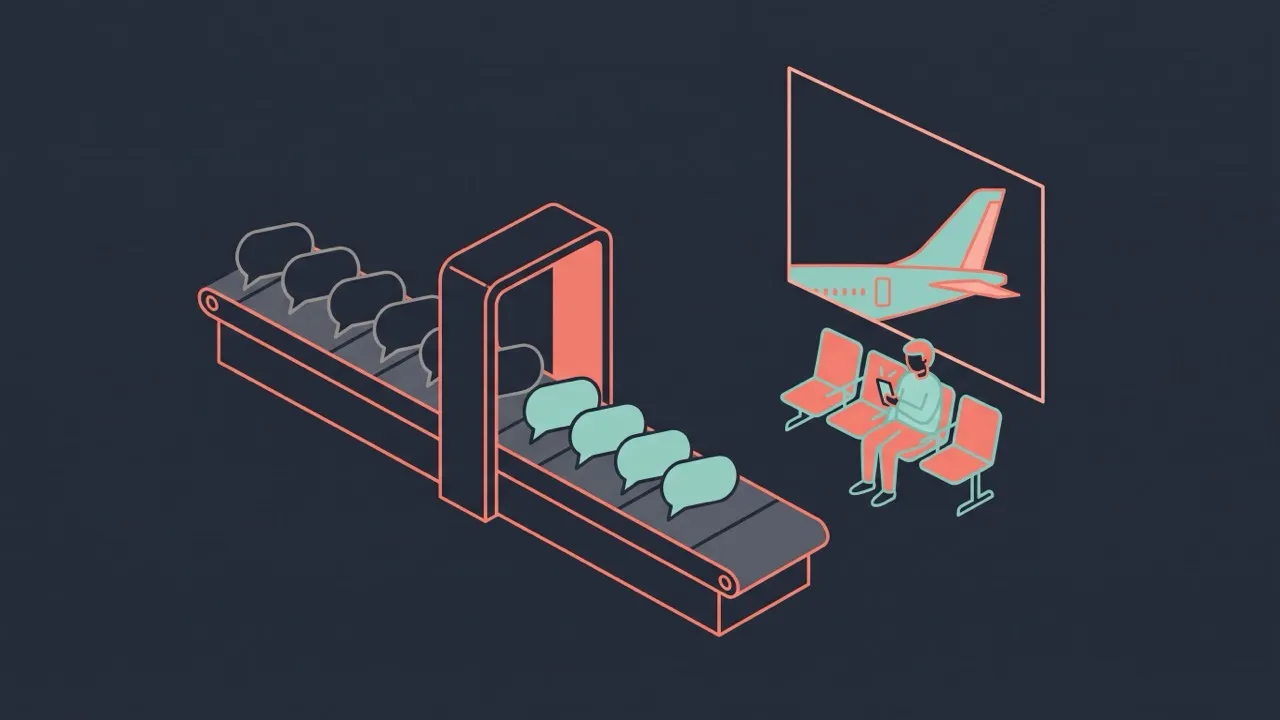
“The agent evaluates every answer through a multi-dimensional, multi-model guardrail scoring system before it reaches the customer, ensuring response quality and accuracy.” In PYMNTS’s words, “Every answer still runs through an automated scoring system before a customer sees it.”
3.4 Seven languages through one system
Ryanair “integrated Amazon Translate, a neural machine translation service, alongside Amazon Nova 2 Lite to handle six non-English languages across all European markets.” According to AWS, this “eliminated the need to maintain separate systems for each language.”
3.5 Chat and voice on one platform
The assistant integrates with Amazon Connect, which Ryanair uses for voice customer service. AWS says the integration “allows the airline to route customers between voice and chat channels based on inquiry complexity, while maintaining context across interactions.”
Confirmed facts: built with AWS and Cation Consulting on Amazon Bedrock AgentCore and Amazon Nova 2 Lite; five models tested on 12,000 real production questions; 18 s → 2.9 s (84%) and 25% accuracy uplift from the evaluation, validated in production within weeks; 12 domain-specific agents replaced by one agent in February 2026; covers baggage, refunds, bookings, flight disruptions; every answer passes a multi-model guardrail score before sending; Amazon Translate for six non-English languages; routing between voice and chat by inquiry complexity with context kept.
4. Impact
Figures from the AWS customer story, relayed by PYMNTS on 2026-09-15. The AWS page shows no publication date.
| Metric | Figure | Basis |
|---|---|---|
| Daily chat volume | 120,000 chat interactions a day, seven languages | AWS overview (“daily customer answers” in the outcome section; “chats” in PYMNTS) |
| Containment rate | 80% | AWS overview; PYMNTS reports it as resolved “without a human agent” |
| Answers since launch | 10 million chatbot answers, 94% accuracy rate | Since launch in October 2024 |
| Response time | 18 s → 2.9 s (84% less) | Model evaluation, validated in production |
| Accuracy | 25% uplift | Model evaluation; baseline not stated |
| Per passenger carried | 70% reduction | Overview: customer service agents per passenger, platform combined with voice. Outcome: Customer Services contacts per passenger |
| Agent hours saved | 500,000+ to date | Outcome: voice and chat combined. Opportunity section credits the same figure to the earlier voice automation |
On cost, AWS says the platform “allows Ryanair to scale customer service capacity without proportional headcount growth.”
“The AWS-powered solution transformed our customer service model from a cost centre that scaled linearly with passenger growth into a strategic asset that improves both efficiency and customer experience,” said Stephen Keane, Head of Business Transformation. “We’re now positioned to handle continued growth while exploring new revenue opportunities through the same platform.”
The next use is sales. AWS describes “a foundation for post-booking ancillary upselling, a net-new revenue stream currently underway,” and claims Ryanair can “convert service interactions into commercial outcomes in ways that competitor customer service platforms cannot match.” That comparison is AWS’s own claim. No upselling results are published.
5. Insight
The target was a cost curve. Ryanair did not describe the project as cutting a number of agents. It described the old model as costs that “scaled linearly with passenger growth” and measured the result per passenger carried. For an airline planning to grow to 300m passengers, the question is how much service work each new passenger adds, not how many agents work today.
The model was picked on the airline’s own traffic. Five models were tested on 12,000 real production questions, and the reported results for the winner are speed and accuracy. The legacy chatbot’s problem was that customers gave up on it, and speed is part of keeping them: AWS says the faster replies “directly enhanced customer experience.”
Fewer agents, not more. Ryanair went from twelve domain-specific agents to one. AWS credits the change with lower latency and simpler orchestration. Splitting work by domain is a common way to start, but customer questions often cross domains, such as a disrupted flight that becomes a refund request.
The quality check sits before the customer. Every answer is scored by more than one model before it is sent. An airline answering questions about refunds, bookings, and disruptions is giving answers customers will act on. Placing the check before sending means a weak answer can be stopped before the customer reads it.
Chat followed voice on the same platform. Voice automation came first and had already moved 80% of inbound calls to digital channels. The chat assistant was connected to the same Amazon Connect platform so that a customer can move between channels by complexity without starting over.
Limits. All figures come from an AWS customer story. PYMNTS relays it without independent figures. The 70% is worded two ways on the same page (agents per passenger and contacts per passenger), and the 500,000-hour saving is credited both to voice alone and to voice and chat combined, so chat’s own share cannot be separated. The 94% accuracy and the 25% uplift are not defined, and the 18-second baseline is not identified. No customer satisfaction figure is given, although satisfaction was part of the first goal. The story does not describe what human agents now handle, how the 20% of chats not contained are passed on, what happens to an answer that fails the scoring, or the separate effect of the February 2026 consolidation.
One-line takeaway: Ryanair treated chat automation as a way to stop service costs rising with passengers, and the parts that carry it are a model chosen on 12,000 real questions, one agent instead of twelve, a score on every answer before it is sent, and a shared platform with voice.
6. Implementation hypotheses (not in the source)
6.1 The scoring gate and the path to a human
Basis: “The agent evaluates every answer through a multi-dimensional, multi-model guardrail scoring system before it reaches the customer,” and Amazon Connect lets Ryanair “route customers between voice and chat channels based on inquiry complexity, while maintaining context across interactions.”
The gate likely sits between the agent’s draft answer and the chat window. One or more separate models would score the draft on several dimensions, for example whether it is grounded in the booking or policy data the agent retrieved, whether it answers the question asked, and whether it stays within what the airline allows the assistant to promise. A threshold would decide whether the answer is sent. A failed draft probably gets one regeneration attempt and, if it fails again, a handoff to a human agent through Amazon Connect with the transcript and booking reference attached, which is what “maintaining context” would require. If so, the 80% containment rate depends partly on where the threshold is set: a stricter gate sends more chats to people.
6.2 Domain knowledge moved from agents into tools
Basis: In February 2026 AgentCore “replaced an earlier architecture of 12 domain-specific agents with a single consolidated agent,” which “reduced latency, simplified orchestration.” The assistant covers “baggage, refunds, bookings, and flight disruptions.”
Twelve domain agents usually mean a router that classifies each message and passes it to one specialist. Each pass adds a model call, and a conversation that starts as a delay question and becomes a refund request has to be rerouted. The consolidated agent most likely keeps the domain logic as tools it can call within one conversation: look up a booking, check flight status, read baggage rules, check refund eligibility, start a change. The domain instructions that lived in each specialist agent would become tool descriptions and policy documents the single agent retrieves. Removing the routing hop is the most direct explanation for the latency gain AWS attributes to the change.
6.3 One reasoning language and a reusable test set
Basis: Amazon Translate works “alongside Amazon Nova 2 Lite to handle six non-English languages,” and five models were tested “against 12,000 real production customer questions,” with results “validated in production within weeks of deployment.”
The likely pattern is that messages in the six non-English languages are translated into English, the agent reasons and retrieves against one English set of policies and booking data, and the reply is translated back. That keeps one knowledge base and one scoring setup for all markets, which matches the goal of avoiding separate systems per language. The 12,000 questions were probably sampled from production chat logs across query categories and languages and labeled with expected answers. A set like that would not be used only once: it is the obvious regression test to rerun before the February 2026 switch from twelve agents to one, and before any later model or prompt change.
7. Sources
- AWS — Transforming customer service with agentic AI and Amazon Nova at Ryanair
https://aws.amazon.com/solutions/case-studies/innovators/ryanair-agentic-ai/
Publication date: not shown on page (accessed 2026-11-17) - PYMNTS — Ryanair’s AI Resolves 80% of Customer Chats Without Humans
https://www.pymnts.com/news/artificial-intelligence/2026/ryanair-ai-resolves-80percent-customer-chats-without-humans/
2026-09-15 (accessed 2026-11-17) - Amazon press release — Ryanair and AWS Extend Agreement for Another 5 Years
https://press.aboutamazon.com/aws/2026/7/ryanair-and-aws-extend-agreement-for-another-5-years
2026-07-27 (accessed 2026-11-17)