All casesNo. 076
UPS Puts Agentic AI on Customs Clearance After De Minimis
Packages cleared with no manual step rose from about 21% to 90% as daily entries surged
- Case no.
- 076
- Primary source
- Trade press interview, company press release and earnings call
- Source published
- 2026-04-06
1. Why this case
UPS is a global parcel carrier. Its June 2026 press release puts it at about 460,000 employees, $88.7 billion in 2025 revenue, and customers in more than 200 countries and territories. According to Mallory Freeman, UPS president of global enterprise data analytics and generative AI, the carrier has more than 10 million customers.
The case is useful because a policy change forced a volume problem onto a rule-heavy back-office job, on a known date. When the United States ended its de minimis exemption in August 2025, low-value packages that used to enter duty-free became subject to duties and more formal customs clearance. UPS’s customs brokerage operation had to classify and clear far more packages every day. CEO Carol Tomé said the company met this by upgrading its shipping systems for the new data requirements and “integrating Agentic AI” into its customs brokerage.
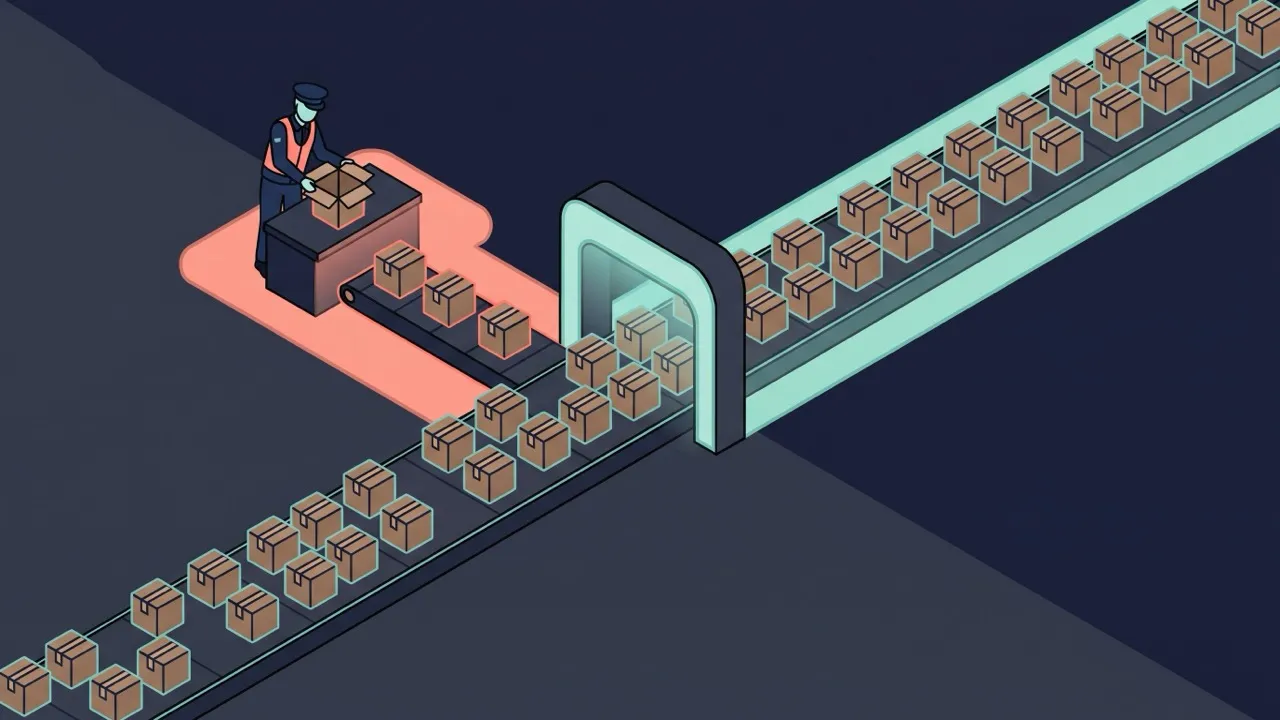
The company’s own before-and-after figures are specific. In March 2025, UPS cleared about 21% of 13,000 daily U.S.-bound packages that required dutiable clearance without manual intervention. In September 2025, it cleared 90% of 112,000 daily packages the same way.
The Supply Chain Dive article, published on 2026-04-06, covers UPS’s AI use more broadly: network planning with a digital twin, generative AI scoring in sales pricing, and employee upskilling. All figures are company statements, reported by Supply Chain Dive, PYMNTS, a UPS press release, and an earnings call transcript.
2. Problem
2.1 De minimis ended, and every low-value package became a customs entry
Until August 2025, the U.S. de minimis exemption gave duty-free treatment to shipments valued at $800 or less. PYMNTS reports that the U.S. eliminated the exemption “globally effective Aug. 29, 2025,” under an executive order signed the previous July. Supply Chain Dive describes the effect on carriers: the change “resulted in more formal customs clearance processes for low-cost packages.”
For a customs broker, each of those packages now has to be declared with a product classification and a value so that duties can be assessed. Freeman names the rule set involved. UPS uses AI and machine learning, she said, to ensure imports abide by the correct Harmonized System product classification codes, tariff rules and policies. The Harmonized System is the international product code list customs authorities use to decide which duty rate applies.
2.2 Volume grew several times over in months
Tomé described the change on UPS’s third-quarter 2025 earnings call as a “ten-fold surge in daily customs entries,” as reported by PYMNTS. The daily counts she gave, as reported by Supply Chain Dive and PYMNTS, are 13,000 packages requiring dutiable clearance in March 2025 and 112,000 a day in September 2025.
At the March 2025 level, about 21% of those packages were cleared without manual intervention. The rest needed some manual step. PYMNTS frames the old work as a person reviewing a package, classifying it, and catching errors, and argues that this kind of judgment “has historically required more people as volume grows.”
The surge also arrived at a busy time for the company. Supply Chain Dive notes UPS was handling global trade upheaval and a U.S. network overhaul driven by reduced package volume from Amazon. Freeman: “It’s extremely challenging to embark on these historic changes without compromising service,” and “But that’s really just what we do. We roll up sleeves and get after it.”
Confirmed facts: U.S. de minimis exemption ($800 or less, duty-free) eliminated effective 2025-08-29 (PYMNTS); more formal clearance for low-cost packages (Supply Chain Dive); “ten-fold surge in daily customs entries” (Tomé, Q3 2025 call, via PYMNTS); 13,000 packages a day requiring dutiable clearance in March 2025, about 21% cleared without manual intervention; 112,000 a day in September 2025; concurrent Amazon volume reduction and network overhaul.
3. Solution
3.1 Capture the data first
Tomé’s fuller statement on the Q3 2025 call, as quoted by PYMNTS, puts a systems change before the AI: “We responded swiftly, upgrading our shipping systems to capture the expanded data requirements mandated by U.S. Customs and Border Protection.” Classification and duty checks depend on the shipment data that arrives with the package, so the first step was making sure the shipping systems collected what U.S. Customs and Border Protection now required.
3.2 Agentic AI in customs brokerage
The second step was in the brokerage operation itself. Supply Chain Dive quotes Tomé: “To manage the increased volume and complexity, we enhanced our customs brokerage capabilities by integrating Agentic AI,” and “This advanced technology streamlined formal entry processes.”
Freeman describes the checking work in the same area: AI and machine learning to make sure imports carry the correct Harmonized System codes and follow tariff rules and policies.
PYMNTS gives its own description of the result. It writes that the system “handles classification, documentation and error checking as one continuous process rather than three separate steps a person used to complete in sequence,” and that the system runs “with a person stepping in only for the roughly 10% of cases the software cannot resolve alone.” The 10% is the complement of the 90% no-manual-intervention rate.
3.3 Brokerage tools offered to customers
UPS’s June 2026 press release extends the same work to shippers. It lists “next-generation brokerage services that use AI, cross-border data and human expertise to help customers accurately interpret customs requirements worldwide for shipments of all sizes.” It also names three tools: “more predictable landed costs at checkout, more accurate product classifications via UPS Export Assure and digital trade documentation via UPS Paperless Invoice – reducing errors and accelerating processing.” The release also says UPS speeds up customs clearance with AI built into its brokerage operation.
Michael Garcia, vice president of operations at hearing aid maker Audien, is quoted in the release: “When trade rules changed, we needed to adjust fast without disrupting our customers,” and “UPS helped us take a realistic, end-to-end look at how our products move so we could stay compliant and protect service.”
3.4 The same pattern in pricing and planning
Supply Chain Dive describes two other places where AI changed how UPS staff work.
- Sales pricing. Salespeople use Deal Manager, “which provides real-time pricing guidance, to boost customer win rates and draw in more revenue.” Before AI, Tomé said, the sales team relied on tribal knowledge and past experience to negotiate a deal. Now: “Today, the deal is scored through generative AI,” and “the salesperson can watch the score as they’re negotiating the terms and conditions.” Freeman calls pricing “both a science and art.”
- Network planning. UPS tests planned routing adjustments with a digital twin, simulating how a decision affects package flows before applying it. Freeman: “So it’s the right data, the right processes, and then the right ability to make decisions, simulate those decisions and make adjustments, especially as conditions change.”
On people, Freeman said UPS is investing in learning and development so employees across the company can use data analytics and AI as their roles change. Tomé tied upskilling to robot-powered sortation centers: “someone’s going to have to oversee the robots.” Alan Amling, a former UPS vice president of corporate strategy now at the University of Tennessee, Knoxville, told Supply Chain Dive the common gap is elsewhere: “They’re spending money on AI systems but not spending the money on change management, on upskilling employees, and that’s probably where I see the biggest issue.”
Confirmed facts: shipping systems upgraded for CBP data requirements; agentic AI integrated into customs brokerage, streamlining formal entry (Tomé, Q3 2025 call); AI and machine learning for HS codes, tariff rules and policies (Freeman); PYMNTS description of classification, documentation and error checking as one process; June 2026 brokerage services with AI, cross-border data and human expertise; UPS Export Assure, UPS Paperless Invoice, landed costs at checkout; Deal Manager with generative AI deal score visible during negotiation; digital twin for routing changes; company-wide upskilling.
4. Impact
| Metric | Figure | Basis |
|---|---|---|
| U.S.-bound packages requiring clearance, cleared without manual intervention | about 21% of 13,000 a day → 90% of 112,000 a day | March 2025 vs September 2025; Tomé, Q3 2025 call, via Supply Chain Dive and PYMNTS |
| Cross-border transactions processed digitally | nearly 90% | all cross-border transactions, full year 2025; Tomé, Q4 2025 call (2026-01-27) |
| Daily U.S. entries | more than 300% increase vs prior year | U.S., compared with the prior year; Tomé, Q4 2025 call |
| UPS shipments clearing customs on the first day of entry | 97% | share of shipments cleared on the day they enter; June 2026 press release |
| Deal Manager | “our win rate is higher and our discounting is lower than it was” | Tomé, via Supply Chain Dive; no figures |
On the Q4 2025 call, Tomé said UPS “leveraged artificial intelligence and our next-gen brokerage capabilities to process nearly 90% of all cross-border transactions digitally.” That figure covers all cross-border transactions for the full year and counts transactions processed digitally. The press release’s claim that UPS is “outpacing the competition” on first-day clearance is the company’s wording, not an independent comparison.
A calculation from the March and September figures. Applying the reported shares to the reported counts, packages that still needed a manual step were roughly 10,300 a day in March 2025 (about 79% of 13,000) and roughly 11,200 a day in September 2025 (10% of 112,000). These are packages, not staff or hours, and the March share is approximate. The point is the shape: daily clearance volume rose about 8.6 times, while the number of packages needing manual handling stayed in the same range.
5. Insight
Automation absorbed the growth. By the company’s numbers, the manual load in packages per day was roughly the same in September 2025 as in March 2025, while total clearance volume was several times larger. The gain was capacity: the same order of manual handling covered a much larger flow. No figures on brokerage headcount, overtime, or contractors are published, so the effect on people cannot be read from these numbers.
The data change came before the AI. Tomé’s own sequence starts with upgrading shipping systems to capture what U.S. Customs and Border Protection required, then adds agentic AI. Classification and tariff checks can only run without a person if the shipment data arrives complete. The June 2026 tools point the same way: classification help, paperless trade documents, and landed costs at checkout all move data quality to the shipper’s side before the package reaches the border.
Customs entry is rule-heavy work with a long tail. Harmonized System codes and tariff rules are explicit, which makes most packages checkable by software. The remaining tenth is the part software did not clear on its own. UPS has not described who handles those packages or how, so the human role after automation is the largest gap in the public record.
The sales change follows the same logic in a different job. Pricing moved from tribal knowledge to a score the salesperson sees while negotiating. Here the salesperson stays in the negotiation, and the score takes over part of what used to depend on individual experience. Tomé reports higher win rates and lower discounting, without numbers.
Limits. All figures are company statements, and the core before-and-after numbers describe 2025 months, reported in 2026 articles. “Without manual intervention” is not defined, and no error, rework, or customs audit rate is given. The sources do not separate the effect of the shipping-system upgrade from the agentic AI, say which steps the agentic AI performs, name any vendor or model, or say how exceptions are routed to people. The three volume statements (ten-fold, more than 300%, 13,000 to 112,000) come from different calls and use different bases. PYMNTS’s description of a continuous classification, documentation and error-checking process is the publication’s own, not a UPS statement.
One-line takeaway: When a rule change multiplied UPS’s daily customs entries, the company fixed the shipment data first and then put agentic AI into brokerage, so that about nine in ten packages needing clearance cleared without a manual step and the manual load stayed near its earlier size.
6. Implementation hypotheses (not in the source)
6.1 Customs fields captured when the label is created
Basis: Tomé: “upgrading our shipping systems to capture the expanded data requirements mandated by U.S. Customs and Border Protection.” The June 2026 release lists classification via UPS Export Assure and digital documents via UPS Paperless Invoice.
The cheapest place to collect customs data is when the shipper creates the label, not at the border. The shipping system upgrade most likely added required fields for low-value international shipments that used to skip them: a product description detailed enough to classify, declared value, country of origin, and the parties to the shipment. Shippers who already supply a tariff code would have it validated against the code list at entry time. Commercial invoice data from Paperless Invoice would arrive as structured fields rather than a scanned page, which lets later checks read values directly. Shipments with missing or vague fields would be flagged before departure, so a data gap becomes a request to the shipper rather than a hold at the U.S. border.
6.2 Classify, check against tariff rules, then route the remainder
Basis: Freeman says AI and machine learning ensure imports abide by the correct Harmonized System codes, tariff rules and policies. Tomé says agentic AI “streamlined formal entry processes.” In September 2025, 90% of packages requiring clearance were cleared with no manual intervention.
A likely shape is three passes for each package. A classification model proposes a tariff code from the description, value, and shipper history, with a confidence score. A rules layer then checks the code against current duty rates, country-specific tariff measures, and restricted-goods lists, and computes the duty. The agentic part would handle the steps between these checks: pulling missing details from the shipper record or invoice, retrying classification with the extra data, and assembling the entry for filing. A package passes straight through only when confidence is high and every rule check is clean. Low confidence, conflicting data, restricted goods, or high-value items would go to a licensed customs broker’s queue, with the model’s proposed code and the failed check attached. Broker decisions on those cases would likely be fed back as training examples, which is one way the straight-through share could keep rising while volume grew.
6.3 A deal score computed from past deals and updated as terms change
Basis: Tomé: “Today, the deal is scored through generative AI,” and “the salesperson can watch the score as they’re negotiating the terms and conditions.” Deal Manager “provides real-time pricing guidance.”
For the score to move during a negotiation, Deal Manager most likely recalculates it each time a term changes: discount level, service mix, volume commitment, or contract length. The inputs would be the customer’s shipping profile and the outcomes of comparable past deals, which is the experience that used to sit in individual salespeople’s heads. Generative AI is probably used to read unstructured inputs, such as the customer’s request or notes from the sales conversation, and to explain the score in plain language, while the price guidance itself comes from models trained on deal history. Higher win rates with lower discounting suggest the score shows salespeople where a smaller discount is enough, so they stop conceding price by default.
7. Sources
- Supply Chain Dive (Max Garland) — How UPS is using AI, from shipper pricing to customs clearance
https://www.supplychaindive.com/news/ups-ai-employee-upskilling-network-changes/816412
2026-04-06 - PYMNTS — UPS Automates 90% of Daily Customs Clearances With AI Agents
https://www.pymnts.com/news/delivery/2026/ups-automates-90-of-daily-customs-clearances-with-ai-agents/
2026-08-17 - UPS via Business Wire — Proof Over Promises: UPS’s Bold AI Initiatives Enhance Products, Services and Customer Experience (press release)
https://www.businesswire.com/news/home/20260618712848/en/ (text read from the Stockwatch copy: https://www.stockwatch.com/News/Item/U-b20260618712848-U%21UPS-20260618/U/UPS)
2026-06-18 - UPS — Q4 2025 earnings call, transcript via The Motley Fool
https://www.fool.com/earnings/call-transcripts/2026/01/27/ups-ups-q4-2025-earnings-call-transcript/
2026-01-27