All casesNo. 059
Yum! Brands Automates Its Restaurants Step by Step
Pizza Hut ovens wait for drivers, and each new tool must pass a franchisee ROI test
- Case no.
- 059
- Primary source
- Fortune interview
- Source published
- 2026-08-19
1. Why this case
Yum! Brands owns KFC and Taco Bell, and Pizza Hut, which it agreed in June 2026 to sell for $2.7 billion. Jim Dausch, the company’s chief digital and technology officer, oversees restaurant technology across about 63,000 locations, which around 1,500 franchisees operate. He described his approach to Fortune’s John Kell in August 2026: “We are sort of step-by-step going through what it takes to run our restaurant and finding every way we possibly can to automate those things.”
The case is useful because the changes are small, concrete restaurant jobs, not a single AI launch. A system now decides when a Pizza Hut kitchen starts a delivery pizza. Kiosks and a voice AI take orders. An automated system on a single platform, Byte, handles inventory ordering. District managers and franchise leaders are trained to build AI assistants. Each of these has to pass a test set by the franchisees, who run the restaurants and have had to spend more on technology. Dausch states that test plainly, and he names the technologies that did not pass it.
The figures come from Dausch in the Fortune interview. None of them is independently audited.
2. Problem
2.1 Pizza that waited for a driver
Dausch joined Yum! in December 2024 as Pizza Hut’s global chief digital and technology officer. One of his first tasks was “to ensure Pizza Hut’s food was delivered as hot as possible.”
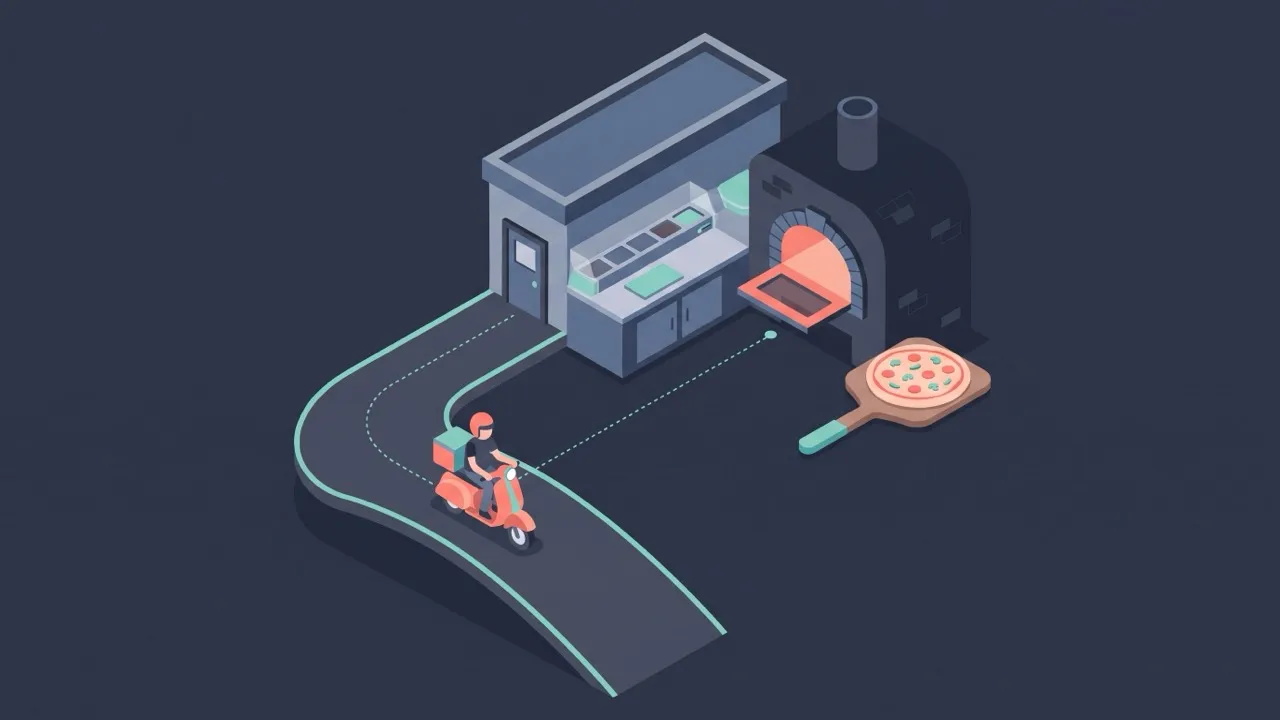
The software that connected Pizza Hut’s kitchen and fleet systems handled orders in “a rudimentary ‘first in, first out’ flow.” According to Fortune, “An order would come into the restaurant and a ticket would immediately be generated to tell the kitchen to put the pizza in the oven.” Often the finished order then sat idle until a driver was free.
2.2 Up to 30 vendors and no common view
Before Byte, “A typical restaurant location was managing up to 30 software vendors, and it could take a day or longer to pull insights from some of those systems.” Dausch described the effect: “The challenge was that the restaurants often did not have a common line of sight across all of those systems to how their business was doing in real time.”
Stockouts were another cost. Fortune defines them as “when a restaurant would run out of ingredients, resulting in lost sales when menu items aren’t available.”
2.3 Franchisees who pay and push back
For franchisees, food and labor have traditionally been the largest expenses, and they have had to spend more on technology. Fortune reports that they “have little appetite to just accept every new tool without a clear return on investment.” Dausch put the condition this way: “If we can’t prove that what we’re putting in place is either going to meaningfully improve the customer experience in a way that drives higher same-store sales growth, or meaningfully reduce food waste in a way that is going to ultimately pay for itself, obviously the franchisee is going to kind of resist.”
Confirmed facts: about 63,000 locations operated by around 1,500 franchisees; Pizza Hut kitchen and fleet software ran first in, first out, with a ticket generated as soon as an order arrived; a typical restaurant managed up to 30 software vendors, and some insights took a day or longer to pull; franchisees resist tools without a clear return on investment.
3. Solution
3.1 The kitchen waits for the driver
Dausch’s team built what Fortune calls “a data-forward automation layer that changed the workflow, telling cooks not to make the pizza until the system knew with greater certainty that further down the chain, a driver would be available for pickup.” The waiting moved from the finished pizza to the order before it is cooked. The cook still makes the pizza. The system now decides when to start it.
3.2 One platform with one data source
Dausch also oversees Byte, “a proprietary SaaS restaurant technology platform that was designed to consolidate online and mobile app ordering, point of sale, kitchen and delivery, menu management, inventory, and labor management tools and systems.” Where a restaurant once dealt with up to 30 vendors, “Byte operates as a single platform with just one data source.” Dausch credits former CEO David Gibbs with setting the vision that Yum! would need to prioritize technology and AI to compete.
Byte is currently “completely an internal platform.” The intent is that Pizza Hut, once sold, will be an external customer.
3.3 Automated inventory ordering
Fortune names inventory ordering as “one example of how Byte has helped improve restaurant operations,” and credits the result to “Yum’s automation system.”
3.4 Kiosks and voice AI take the order
Digital kiosks have been rolled out to around two-thirds of restaurant locations globally. Dausch added a step where customers can enter their loyalty program information, “so that kiosks can make more personalized offers based on the data the restaurant has from past orders.”
An automated voice AI ordering system is in more than 900 Taco Bell U.S. restaurants. Fortune says it was rolled out “with the intention of boosting order sizes, while also improving accuracy and increasing customer satisfaction.” Dausch called it a “learning journey” that required Yum! to make tweaks to the system “so that the handoff between the AI and human workers is smoother.”
3.5 AI training for district managers and franchise leaders
Yum! “has authorized enterprise licenses for OpenAI’s ChatGPT for district managers and franchise leaders, who are also mandated to take courses through an ‘AI Academy’ that teaches them how to understand prompting, create digital executive assistants, and encourage the development of more than 400 AI agents.”
3.6 What did not pass the test
“With ROI in mind, there are times when Dausch has to say no,” Fortune writes. “Robotics have generated buzz among franchisees, but no single prominent use case has emerged that Yum deems worthy of chasing.” Dausch is also cautious about “the AI capabilities pitched by software-as-a-service vendors,” saying higher chip and infrastructure costs have made the pricing of these features “too frothy.”
Confirmed facts: automation layer holds the kitchen start until a driver is more certainly available (Pizza Hut); Byte consolidates ordering, point of sale, kitchen and delivery, menu, inventory, and labor tools on one data source; Byte is internal, with Pizza Hut intended as an external customer after its sale; inventory ordering automated on Byte; kiosks in around two-thirds of locations, with a loyalty login step; voice AI ordering in more than 900 Taco Bell U.S. restaurants, adjusted for smoother AI-to-human handoff; enterprise ChatGPT licenses and a mandatory AI Academy for district managers and franchise leaders; robotics and vendor SaaS AI features declined.
4. Impact
| Change | Reported result | Source and basis |
|---|---|---|
| Pizza Hut kitchen timing | Hotter food deliveries and a “meaningful” increase in customer satisfaction scores | Dausch, Fortune, 2026-08-19; no figure given |
| Automated inventory ordering | 85% reduction in stockouts | Fortune, 2026-08-19; brand, restaurant count, and period not stated |
| Kiosks | Kiosk orders “consistently produce higher check averages than in-person orders” | Fortune; around two-thirds of locations globally |
| Voice AI ordering | No results published; rollout to 900+ Taco Bell U.S. restaurants | Fortune; goals stated as larger orders, accuracy, satisfaction |
Dausch keeps the technology in proportion: “I don’t know anyone that has ever just selected a restaurant to go to based on the technology.” He adds, “It’s important for us that we don’t lose the plot.”
5. Insight
The first automation changed timing, not staffing. The Pizza Hut change did not remove a cook or a driver. It moved one decision, when to start cooking, from the order ticket to a system that watches driver availability. First in, first out gave way to starting when a driver is likely to be ready.
One data source came before automated ordering. A restaurant juggling up to 30 vendors, with some insights a day or more away, cannot let software reorder stock. Byte put ordering, kitchen, inventory, and labor on one data source, and inventory ordering is the example Fortune gives of what that enabled.
The franchisee sets the bar. Franchisees operate the restaurants and have been spending more of their own money on technology. So a tool has to raise same-store sales through a better customer experience or cut food waste enough to pay for itself. The same test is behind the refusals: robotics without a clear use case, and vendor AI features whose price did not fit.
Voice ordering is still a handoff problem. Fortune states no results for the voice AI. What Dausch did say is that the work was making the handoff between the AI and human workers smoother. In a restaurant, the AI and the crew share the same order, so the point where one passes it to the other is the part that needs tuning.
Manager AI training is mandated. District managers and franchise leaders get ChatGPT licenses and must take AI Academy courses. The training goes beyond prompting to building digital executive assistants and agents.
Limits. The source is an interview, and every result comes from Yum! or its executives. The 85% stockout figure has no stated scope or period. The Pizza Hut satisfaction gain has no number. The voice AI has stated goals, not results. The “more than 400 AI agents” are what the AI Academy encourages, not a count of agents in use. Yum! has agreed to sell Pizza Hut, where the kitchen timing change was made.
One-line takeaway: In a franchise system, AI spreads one restaurant task at a time, and each task gets automated only when the franchisee can see it in sales or waste.
6. Implementation hypotheses (not in the source)
6.1 A release gate between order intake and the kitchen
Basis: The old flow generated a kitchen ticket as soon as an order arrived. The new layer tells cooks “not to make the pizza until the system knew with greater certainty that further down the chain, a driver would be available for pickup.”
The likely design is a hold queue between order intake and the kitchen display. For each delivery order, the layer would estimate when the next driver will be back at the store, using the fleet system’s view of drivers on the road and their expected return. It would compare that time with the order’s prep and bake time and release the ticket to the kitchen when the two line up. Carryout orders would not need the gate, since no driver is involved. To keep orders from sitting too long when the estimate is wrong, the layer would probably have a maximum hold time after which the ticket goes to the kitchen anyway. Because the gain was measured in customer satisfaction scores, the store would likely track food-ready-to-pickup time per order to tune how cautious the estimate is.
7. Sources
- Fortune (John Kell) — How KFC and Taco Bell’s top technologist is embracing AI and automation across 63,000 restaurants
https://fortune.com/2026/08/19/how-kfc-and-taco-bells-top-technologist-is-embracing-ai-and-automation-across-63000-restaurants/
2026-08-19