Essays2026-11-11
Why Cooks Never Disappeared
What matters is the kind of work you do, not your job title.
- Published
- 2026-11-11
Summary
- Convenience food has spread so far that anyone can put restaurant food on the table at home, yet people choose to buy their meals rather than make them.
- At work, jobs like cook or lawyer do not disappear as such; what shrinks, in the kitchen and the office alike, is the work done by the book.
- AI will grow demand for knowledge work rather than shrink it, but the new work lies beyond the by-the-book part, so the real threat is that work grows while your own work is the part no one wants.
Restaurant food is made in factories, and anyone can buy it
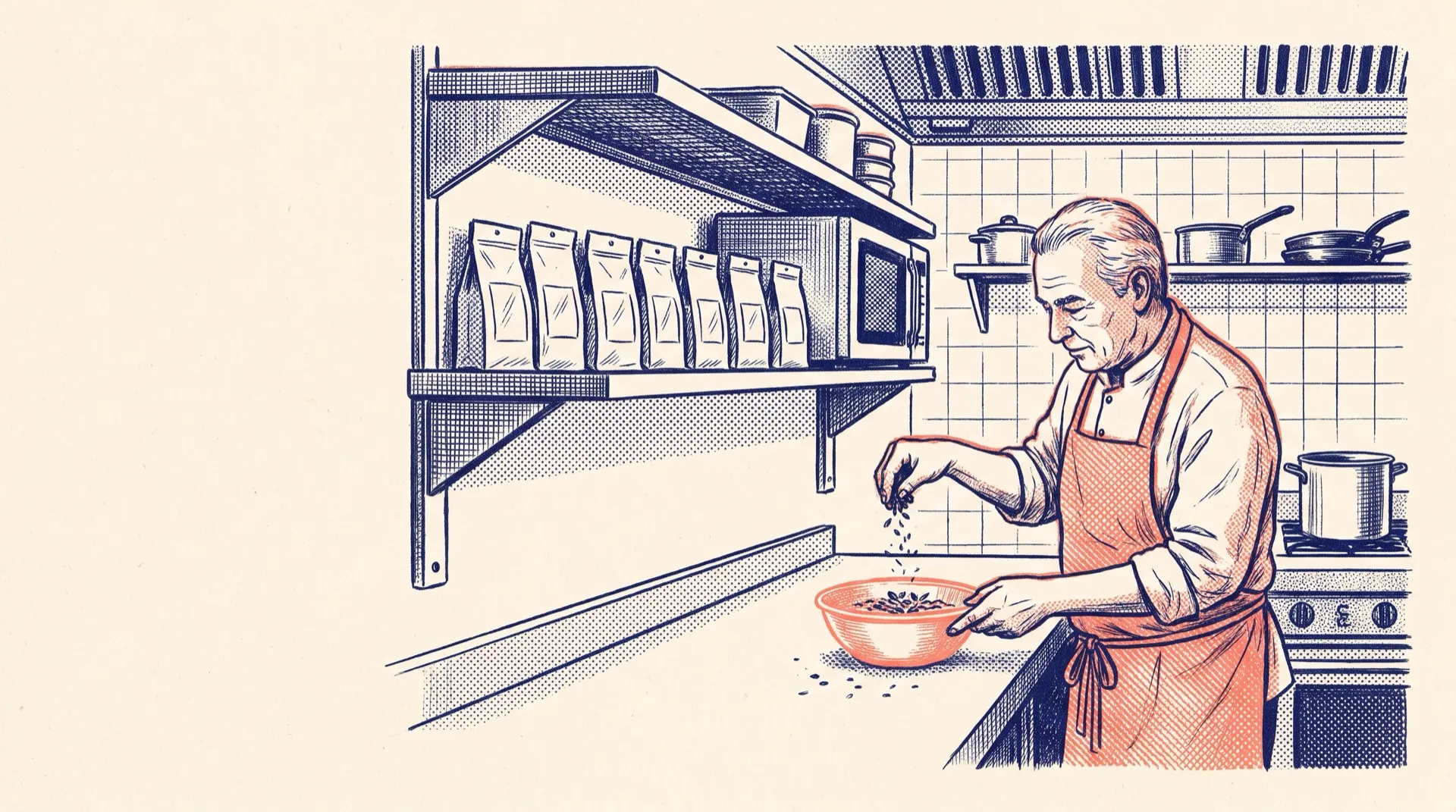
A good deal of the food restaurants sell now arrives in the kitchen already cooked in a factory, and anyone can buy that same food. In Korea in 2025, a delivery-only porridge shop was found, after a delivery rider’s tip, to be reheating packaged retail porridge and selling it for about 13,500 won. Shop-in-shop outlets, where one operator lists several brand names on delivery apps, work the same way. A 2022 report counted 117 shop-in-shop brands on a single franchise comparison platform; most of these brands, selling braised short ribs, braised chicken, hot pots and tteokbokki, supplied “one-pack” products that only need to go into the pot and be cooked, the reporter wrote.
Kitchens abroad look the same. In a 2025 report, a Chinese restaurant-industry figure said that using pre-cooked dishes is very common in large chains. Figures from an industry association put restaurants’ share of pre-cooked food consumption at 80%, and a 2023 article described restaurants whose menus were more than 80% pre-cooked dishes. Some stores of one Chinese chain posted signs saying their dishes were made in-house while they only microwaved finished dishes, and drew fierce criticism when it came out. In Japan, a former president of the family restaurant chain Saizeriya explains that moving part of the cooking to the company’s own factories let it shrink store kitchens and add more tables for customers.
Restaurants are not the only buyers of this food. The porridge the Korean delivery shop reheated sells online, to anyone, for 2,000 to 3,000 won each. At Gyomu Super, Japan’s best-known wholesale food chain, about 90% of customers are ordinary consumers despite the name. Anyone can now make most restaurant dishes at home, and even mix sundae-gukbap and tonkotsu ramen into a new dish. If making food were all a cook did, cooking jobs would have disappeared long ago. Yet cooks still run kitchens.
Knowing how to cook, people buy more meals anyway
People reach for convenience food to save money, not only effort. In a 2024 Korean survey, the top reason given for eating convenience food was that it costs less than buying ingredients and cooking. In Korea, fewer households now go out to restaurants, while more use delivery and takeout.
Being able to make food did not make people cook every day. They began buying more food that someone else prepared. In the US in 2025, 56.3% of all food spending went to food away from home, and even after adjusting for inflation, that spending grew from $818 billion in 1997 to $1.41 trillion in 2025. In Korea, the share of households saying they cannot eat normally without eating out, delivery or takeout doubled, from 7.1% in 2022 to 14.3% in 2024. Knowing how to cook and taking the trouble to cook every meal turned out to be very different things.
Restaurants turned to factory food because they could not hire cooks
If factory food is filling restaurant kitchens, why are cooks not disappearing, and why are there to be more of them? My view is that restaurants did not bring in factory food to let their cooks go; they started using it because they could not find cooks. The number of people buying prepared food grew fast, cooks could not be hired at the same pace, and restaurants filled the gap with factory-processed food. What the factory took over was the work done by the book. The kitchen still needs people who cook beyond it.
What restaurants handed to factories was by-the-book work. According to US Foods, a large American food distributor, in 2022, restaurant operators looking for labor-saving frozen products want to cut prep time, the cooking skill required and the number of kitchen staff. In 2025 a Chinese restaurant-trade outlet wrote that at some restaurants using pre-cooked dishes, what young cooks do is no longer cooking that relies on experience but labor that heats, mixes and plates to a standard. Recruitment articles for Korean franchises carry brand copy saying no professional head cook is needed because headquarters supplies packaged ingredients.
Restaurants brought in factory food because cooks were hard to hire. In a 2023 survey of Korean restaurant businesses, the hardest job to fill was cooking (kitchen) staff, at 48.1%, ahead of floor service. In 2022 a Tokyo restaurant owner said that the labor shortage left fewer staff to prep ingredients, so the restaurant relied on frozen food, and that frozen food let inexperienced staff produce the same taste. In 2026 a Hong Kong restaurant-industry figure described pre-cooked dishes as a response to the labor shortage and the lack of skilled chefs. Small restaurants in Chengdu, Sichuan, reported by Chinese media in 2025, offered Sichuan cooks 7,500 to 8,000 yuan a month and still struggled to hire.
Even as kitchens take in factory food, cook jobs are projected to grow. The US Bureau of Labor Statistics projects that from 2025 to 2035 restaurant cooks will grow 12% and chefs and head cooks 7%, while short-order cooks will fall 5%. These are projections, but they mean restaurant cooks and the people who lead kitchens are expected to grow, unlike short-order cooks.
What separates the work that leaves the kitchen from the work that stays is the kind of work. Unable to hire, restaurants replaced by-the-book work with factory food. Cooks who cook beyond the standard are still prized in the kitchen.
People who can do it themselves still hire professionals
In the 2026 US filing season (through early May), self-prepared e-filed returns rose 1.7%, faster than returns prepared by professionals (0.6%). In US federal civil courts, the share of cases filed by people representing themselves without a lawyer rose to 16.8% in 2025. In the UK, 39% of 2,000 people said they would consider asking AI instead of a solicitor.
Even so, people still pay professionals. Professionals still filed about 10 million more returns than self-preparers, and in fiscal 2024 more than half of US individual taxpayers paid a preparer to file. Self-represented litigants still won fewer than 1% of cases, as they did before AI. In 2025, US law firms saw the fastest growth in demand for legal work since the global financial crisis, and grew headcount while investing heavily in AI.
Just as restaurants took in factory food because they could not find staff, the arrival of AI law firms does not mean everything existing firms did is being replaced. AI law firms take on by-the-book work, do it cheaply, and serve people who could not afford a lawyer before. Garfield, an AI law firm authorized by the UK regulator, handles only small debt claims of £10,000 or less; letters start at £2 and filing a claim starts at £50. Garfield’s CEO said that the cost, time and stress of litigation made chasing these debts uneconomic, so businesses had been forced to write them off. In June 2026, a freelancer who had failed to recover money on their own used Garfield and won about £7,000 at trial. The freelancer said Garfield made it possible to pursue the claim, and the barrister who argued the freelancer’s side in court said the documents the AI wrote were more than sufficient for the trial. My view is that AI law firms can grow the whole market by serving people who never reached existing firms, rather than taking existing firms’ clients, and that those firms still need lawyers.
Not jobs, but by-the-book work is what shrinks
When knowledge work loses jobs, it is not a whole occupation that disappears but the work done by the book. This shows up inside a single occupation. In the US, employment of workers aged 22 to 25 in occupations highly exposed to AI was 19% lower than that of their peers in less-exposed occupations, while experienced workers in the same occupations showed no such decline. The hit was concentrated in occupations where AI substitutes for workers’ tasks; in occupations where AI complements workers, employment held steady or grew.
Work with simple, by-the-book outcomes is the typical case. US customer service representative jobs are projected to fall 5% by 2035 as simple inquiries are automated and more customers solve problems themselves.
Sometimes the split falls between occupations. The US Bureau of Labor Statistics projects lawyer employment to grow 5%, while paralegals and legal assistants are projected to see little growth, citing technology including AI. New automation tools have played out this way before. As NPR explained it, after the electronic spreadsheet appeared around 1980, 400,000 bookkeeping and accounting clerk jobs disappeared while 600,000 accountant jobs were added. Computers took the by-the-book calculation, and jobs grew among the accountants who used the tool. Economist James Bessen’s 2016 work likewise shows that as graphic designers who used computers became more productive, typesetting moved from typesetters to designers; typesetters declined while graphic designers and desktop publishers grew. Bessen described it not as machines replacing humans, but as humans using machines replacing other humans.
Knowledge work does not shrink, it changes
When making food got easier, people did not cook more; they bought more food made by others. Inflation-adjusted US spending on food away from home grew from $818 billion in 1997 to $1.41 trillion in 2025. I think the future AI brings to knowledge work looks the same. AI will not shrink market demand for knowledge work; it will grow it. US law firms in 2025, seeing the fastest growth in legal work since the financial crisis while investing in AI, show this well.
But the new work does not go to the work done by the book. People want the professional judgment beyond it. So the real threat facing knowledge workers is not that work shrinks, but that work grows while no one wants the work they themselves were doing.
References
- 머니투데이, 「쿠팡 2000원짜리 죽 데워 1.3만원에 배달…’배달 전문점’ 충격 실태」 (2025-08-13) https://v.daum.net/v/20250813161645777
- 서울경제, 「“조리된 걸 데우기만 했는데, 이 가격에 판다고?”…결국 논란 터졌다」 (2025-09-16) https://www.sedaily.com/article/14118122
- 비즈한국, 「“떡볶이 시켰더니 치킨집에서 오네” 배달앱 ‘숍인숍’ 정책의 양면성」 (2022-02-02) https://bizhankook.com/articles/23225.html
- 新京报, 「“预制菜”话题备受关注 讨论背后我们在关心什么?」 (2025-09-13) https://www.bjnews.com.cn/detail/1757764263129442.html
- 人民日报海外版 (中新网), 「餐厅吃到”预制菜”,消费者咋看?」 (2023-06-20) https://www.chinanews.com.cn/cj/2023/06-20/10027999.shtml
- 文春オンライン, 「〈サイゼリヤ〉480円で販売し始めた「ミラノ風ドリア」を300円に値下げ…いったいなぜ?」 (2024-05-30) https://bunshun.jp/articles/-/70994?page=2
- 神戸新聞 ひょうご経済プラス, 「兵庫発「業務スーパー」拡大 常識破りの店舗運営」 (2021-01-26) https://www.kobe-np.co.jp/news/keizai/gyomu/
- USDA ERS, Charts of Note: food-away-from-home spending (2026-06-11) https://www.ers.usda.gov/data-products/charts-of-note/114212
- 아시아경제, 「“외식 없이 정상적 식생활 어려워” 14.3%」 (2024-12-23) https://view.asiae.co.kr/article/2024122315410301177
- Korea Rural Economic Institute, 2024 Food Consumption Behavior Survey results (2024-12-13) https://www.krei.re.kr/krei/page/24?cmd=view&pst=165157&pageIndex=1
- U.S. Bureau of Labor Statistics, Occupational Outlook Handbook: Cooks; Chefs and Head Cooks; Customer Service Representatives; Lawyers; Paralegals and Legal Assistants (2026) https://www.bls.gov/ooh/
- Restaurant Business, “Operators are sourcing more frozen foods to meet labor, supply and waste challenges” (2022-11-02) https://www.restaurantbusinessonline.com/operations/operators-are-sourcing-more-frozen-foods-meet-labor-supply-waste-challenges
- 澎湃新闻 (红厨网), 「火爆的川菜,孤独的后厨:谁来接管下一勺?」 (2025-11-17) https://www.thepaper.cn/newsDetail_forward_31982297
- 동행미디어 시대, 「고정 비용 최소화로 수익률 높은 아이템 ‘각광’」 (2016-02-09) https://www.sidae.com/article/2016020710288071784
- フードリンクニュース, 「“冷凍食品”売れるお店はこう使う」 (2022-03-22) https://www.foodrink.co.jp/foodrinkreport/2022/03/22110054.html
- 香港01, 「预制菜|青协调查指逾九成受访者难分辨 倡推行餐厅自愿认证计划」 (2026-03-20) https://global.hk01.com/社会新闻/60332681/预制菜-青协调查指逾九成受访者难分辨-倡推行餐厅自愿认证计划
- Korea Rural Economic Institute, 2023 Restaurant Business Management Survey: key results https://www.krei.re.kr/namo/binary/files/000025/2403_Leflet_4.pdf
- U.S. GAO, “Paid Tax Return Preparers” (GAO-26-108723) (2026-02-24) https://www.gao.gov/products/gao-26-108723
- eDiscovery Today, “A Spike in Pro Se Filings is Not Leading to Success in the Courtroom” (2026-08-19) https://ediscoverytoday.com/2026/08/19/a-spike-in-pro-se-filings-is-not-leading-to-success-in-the-courtroom-artificial-intelligence-trends/
- Thomson Reuters Institute and Georgetown Law, 2026 State of the US Legal Market (2026-01-07) https://www.thomsonreuters.com/en-us/posts/legal/state-of-the-us-legal-market-2026
- Legal Cheek, “AI law firm wins court case in UK first” (2026-06) https://www.legalcheek.com/2026/06/ai-law-firm-wins-court-case-in-uk-first/amp/
- PYMNTS, “For $500, an AI Beat 2 Lawyers in UK Court” (2026-06-22) https://www.pymnts.com/news/artificial-intelligence/2026/for-500-an-ai-beat-2-lawyers-in-uk-court/
- Law Society Gazette, “First litigation win for AI law firm” (2026-06-24) https://www.lawsociety.ie/gazette/top-stories/2026/june/first-litigation-win-for-ai-law-firm/
- Erik Brynjolfsson et al., “Canaries in the Coal Mine?”, Stanford Digital Economy Lab (2026-08) https://digitaleconomy.stanford.edu/app/uploads/2026/08/Canaries_August2026.pdf
- NPR Planet Money, “Episode 606: Spreadsheets!” (2015-02-25) https://www.npr.org/transcripts/389027988
- James Bessen, “How computer automation affects occupations: Technology, jobs, and skills”, VoxEU (2016-09-22, republished by RIETI) https://www.rieti.go.jp/en/special/p_a_w/076.html