All casesNo. 070
Mercy Nurses Chart by Talking at the Bedside
Ambient AI turns bedside talk into flowsheet entries; nurses review, correct and file them
- Case no.
- 070
- Primary source
- Microsoft customer story and Mercy chief nurse executive article
- Source published
- 2026-08-14
1. Why this case
Mercy is a US health system with more than 50 hospitals and nearly 1,000 care sites across Arkansas, Illinois, Kansas, Missouri, and Oklahoma, and about 15,000 nurses. Its nurses relied heavily on flowsheets for charting: the rows of structured fields in the electronic health record where vital signs, assessments, and checks are recorded. That charting was manual, often done after the care itself and sometimes after the shift had ended.
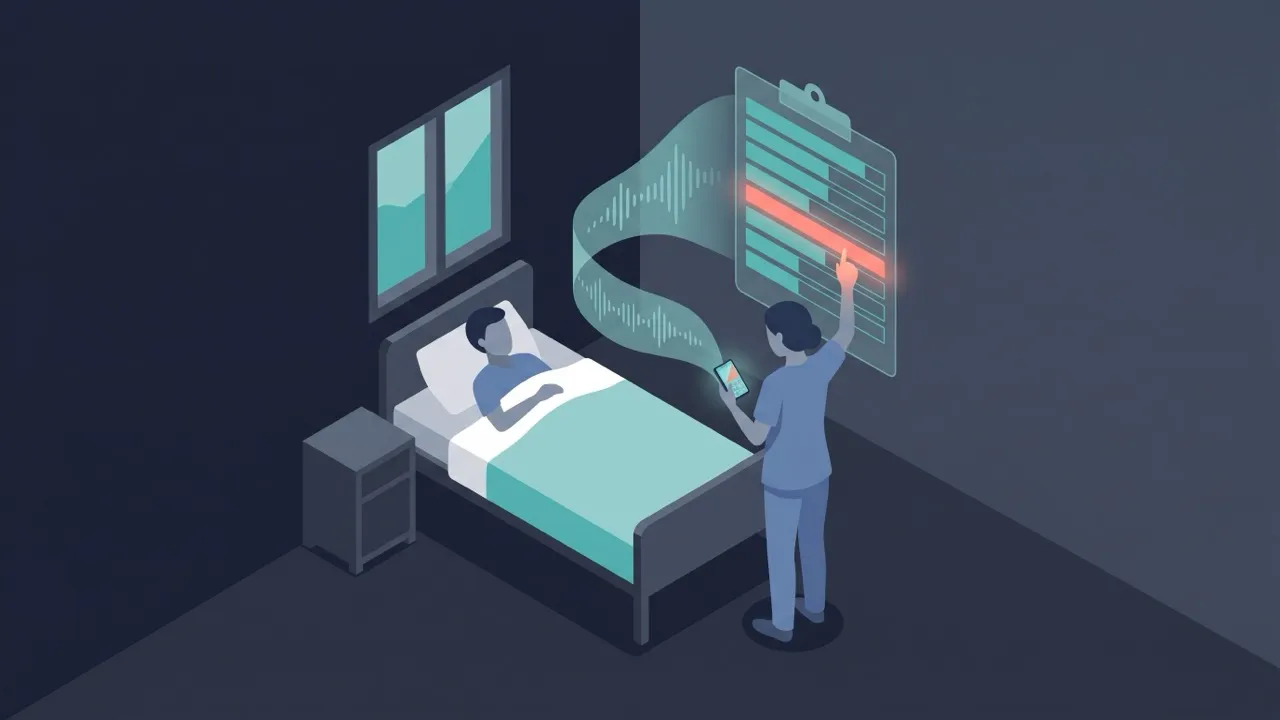
The case is useful because the change sits inside a single, very common task, and the division of work is stated plainly. With Microsoft Dragon Copilot, the nurse switches on ambient listening, assesses the patient while talking, and the AI turns that conversation into flowsheet entries. The nurse then reviews, corrects, and files them. In the words of Mercy’s chief nurse executive, the charting workflow “becomes activate ambient; assess and talk; review, correct and file.”
It is also a case where every result in the Microsoft story comes with a footnote that names the unit, the number of nurses, and the measurement window. That makes it possible to read the results at their actual scale: single units of 46 or 55 nurses and a survey of 85 nurse users, not the whole system. The figures are from a Microsoft customer story published on 2026-08-14 and from Mercy’s own reporting, not from an independent study.
2. Problem
According to the Microsoft customer story, “Mercy nurses relied heavily on traditional flowsheet documentation within EMRs.” The process “often required nurses to spend significant portions of their shifts documenting patient care and navigating multiple systems, sometimes staying beyond the end of their shifts to complete charting tasks.”
As documentation requirements grew, so did the cost. The story lists cognitive burden, workflow friction, and overtime, and says the charting pulled nurses away from direct patient interaction. Stephanie Clements, SVP and Chief Nurse Executive at Mercy, put it this way: “Documentation has been one of the biggest sources of friction for our nurses.”
Mercy concluded that “incremental improvements would not solve the issue.” Before choosing a tool, it defined success as “reducing administrative workload and returning nurses’ focus to patient care.” It wanted documentation in real time at the point of care, and it treated workforce sustainability (nurse satisfaction and burnout) as an equal goal. One constraint was firm: “Any solution would need to enhance—not disrupt—existing processes.”
Confirmed facts: 50+ hospitals, nearly 1,000 care sites, five states, about 15,000 nurses; charting done in EMR flowsheets across multiple systems; nurses sometimes stayed past shift end to finish charting; success defined before selection as less administrative work and more focus on patients; constraint = no disruption to existing processes.
3. Solution
3.1 Why this tool
The story gives the selection criteria. The tool had to reduce workload rather than add to it. It had to work inside Mercy’s existing EMR and workflows “without requiring nurses to fundamentally change how they delivered care.” Mercy already used Dragon Copilot for physicians and wanted to extend it to nurses, and it valued Microsoft’s commitment to building nurse feedback into the product. Microsoft describes Dragon Copilot as an “AI clinical assistant” that works “through a combination of natural language speech, ambient listening, and advanced AI.”
Mercy was not only a buyer. Clements writes in Health Progress that Mercy “became one of only nine health systems nationwide to codevelop and trial Dragon Copilot,” and that nurses were invited into the development process because “They wanted technology that helped, not hindered, their workflow.” Microsoft made the nursing version generally available in December 2025.
3.2 How charting works now
Clements describes the mechanism: Dragon Copilot listens “to the natural conversation between the nurse and the patient during care activities” and converts “that speech into structured flow sheet data within Epic Rover,” Epic’s mobile app for nurses. “Nurses simply care for the patient, vocalize the vitals as they’re taken and speak naturally, and the system uses AI to extract clinical details and prepare documentation for nurse review and filing.”
The split of work is three steps:
- Activate ambient. The nurse turns on listening, for example on the way into the room, as Clinical Nurse Educator Christine Dupire describes: “Being able to activate Dragon Copilot as I’m walking into that patient’s room ensures that everything is captured accurately in the moment, which really reduces the stress of wondering, ‘Hey, did I remember to chart this detail later on in my shift?’”
- Assess and talk. The nurse does the assessment and says what they observe. The AI extracts the clinical details and maps them to flowsheet fields.
- Review, correct and file. The nurse checks the prepared entries, fixes what is wrong, and files them into the record.
The Microsoft story describes the change nurses noticed: “Instead of documenting care after the fact, nurses saw their work captured in real time.”
3.3 Rollout: one unit first, then feedback every day
The two sources date the start differently. The Microsoft story says Mercy “began implementation in a single innovation unit in August 2025.” Clements writes that work with Microsoft and Epic started in fall 2024, that the first location went live in February 2025, and that the first launch was in the innovation unit in St. Louis. Microsoft’s own footnotes fit the earlier date: they cite a post go-live survey of nurse users in St. Louis in June 2025. The footnotes then give two more go-live dates: Fort Smith, Arkansas on 2025-08-05 (46 nurses) and Springfield, Missouri on 2025-10-06 (55 nurses). In the Spring 2026 issue of Health Progress, Clements says three units were using the tool, in St. Louis, Springfield, and Fort Smith.
The Microsoft story names what made the rollout work:
- Leadership alignment and active participation from nurse leaders, who worked with front-line staff, “reinforcing expectations and providing support throughout the transition.”
- Hands-on simulations before go-live, which “demonstrated the system’s ease of use and helped reduce anxiety associated with change.”
- Super users who “provided real-time support across all shifts.”
- Daily feedback loops. “One of the most impactful strategies was the use of daily feedback loops.” Nurses said what worked and what did not, and “Mercy and Microsoft acted on this feedback quickly.”
Clements ties the tool’s improvement to nurse feedback. She writes that “The tool learns from nurse feedback to refine its accuracy and tone,” and that “When we first launched it in our innovation unit in St. Louis, there was a 30% accuracy rate and now, less than a full year later, it’s up to 90% accurate.” She does not define how accuracy was measured.
3.4 What comes next
The Microsoft story says Mercy is expanding Dragon Copilot “to additional units, including all med-surg units across the organization” (medical-surgical units, the general inpatient wards). Lessons from each unit are meant to shape the next.
Confirmed facts: selection criteria = less workload, works inside the existing EMR and workflow, prior physician use, nurse feedback; Mercy one of nine co-development health systems; nursing version GA December 2025; speech → structured flowsheet data in Epic Rover → nurse review and filing; three-step workflow (activate ambient; assess and talk; review, correct and file); work started fall 2024 and first location live February 2025 (Health Progress) vs single innovation unit in August 2025 (Microsoft body); Fort Smith go-live 2025-08-05 (46 nurses), Springfield go-live 2025-10-06 (55 nurses); simulations, super users on every shift, daily feedback loops; accuracy 30% → 90% in under a year (Mercy, definition not given); expansion to all med-surg units.
4. Impact
The Microsoft story introduces its results as observed “Within the first 12 weeks of deployment (August 2025 to October 2025).” Its footnotes show that each figure comes from a specific unit and window, and only the Fort Smith figures fall in that period.
| Metric | Result | Basis (from the story’s footnotes) |
|---|---|---|
| Flowsheet documentation time per shift | −22% | Fort Smith unit, 46 nurses; 12 weeks before vs 12 weeks after the 2025-08-05 go-live; Epic nursing efficiency data |
| Documentation latency | −11.7% | Same unit and window as above |
| Incremental overtime | −29% to −56% | Springfield, 55 nurses; Jul–Sep 2025 vs Oct–Dec 2025; Mercy HR data on “late out” and “cancelled deduction” (missed lunch) |
| Pain assessment / mobility / skin check documentation | +17% / +11% / +13% | Springfield, 55 nurses; 12 weeks before vs 12 weeks after the 2025-10-06 go-live; completion of key flowsheet fields |
| Nurse communication composite score (HCAHPS patient survey) | +20% | Springfield (55) and Fort Smith (46); Oct–Dec 2025 vs the same period a year earlier |
| Nurse-reported cognitive load | −65% | Microsoft survey of 85 nurse users, St. Louis, June 2025 |
HCAHPS is the standardized US national survey that asks recently discharged patients about their hospital stay. The story also reports gains in patients’ sense that nurses listened and explained, without numbers, and “a similar improvement in perceived timeliness” in the nurse survey, also without a number. The overtime footnote defines “Above Average Utilizers” as nurses who used the tool in more patient interactions than their department’s average, but it does not say which end of the 29–56% range applies to which group.
Two further data points come from Mercy. The accuracy figure, 30% at first launch and 90% less than a year later, is from Clements. One nurse, Hannah Lambert, RN, gave her own estimate: “Ambient dictation has saved me on charting time, hands down. I bet I’m cutting 20 minutes of charting time on each patient.”
The story describes what the time went to without measuring it: “from taking proper lunch breaks and leaving work on time to spending more time at the bedside with patients.”
5. Insight
What moved was the typing, not the judgment. Before, the nurse assessed the patient and then, later, translated that assessment into flowsheet fields across several screens. Now the AI does the translation from speech to fields while the nurse is still in the room, and the nurse’s charting work becomes checking and filing. The AI prepares the entries; filing them into the record stays with the nurse.
The timing of documentation changed, and the overtime measure tracks exactly that. The problem statement was not only that charting took long, but that it happened after the fact and sometimes after the shift. The overtime measure counts late clock-outs (“late out”) and missed lunches, the same spill-over the problem statement described. Real-time capture targets that spill-over, not only the minutes spent typing.
Accuracy was built on the floor, not bought. The tool started at 30% accuracy in Mercy’s first unit, by Mercy’s account, and reached 90% in less than a year, which Clements attributes to the tool learning from nurse feedback. The Microsoft story names the daily feedback loops, acted on quickly, as one of the most impactful parts of the rollout, alongside super users on every shift.
The results are unit-sized. Each figure comes from one unit of 46 or 55 nurses, from those two units combined (the patient survey), or from a survey of 85 nurse users, over windows of 12 weeks to three months. None of them is a system-wide result across 15,000 nurses.
Limits. All figures come from Microsoft and Mercy. Mercy co-developed the product, so its setup is not a standard deployment. The body text’s “first 12 weeks” framing does not match the footnotes, and the start date differs between the two sources. The cognitive load figure is self-reported, the accuracy measure is not defined, and the overtime range is not explained. No staffing, cost, or clinical outcome figures are published.
One-line takeaway: In nursing documentation, the split that worked at Mercy is that the AI listens and fills the flowsheet fields while the nurse assesses, then reviews, corrects, and files, so charting happens during care instead of after the shift.
6. Implementation hypotheses (not in the source)
6.1 Prepared entries held until the nurse files them
Basis: Clements writes that the system “extract[s] clinical details and prepare[s] documentation for nurse review and filing,” with the workflow “activate ambient; assess and talk; review, correct and file,” inside Epic Rover. Microsoft’s product blog says flowsheets are “large, hospital-specific” and that critical details “are often implied or never spoken aloud.”
The likely shape is a recording tied to one patient, started from Epic Rover when the nurse enters the room. After the recording ends, the service transcribes it, extracts values, and maps each to a row in Mercy’s flowsheet templates for that unit. Those values would come back to Rover as proposed entries, not filed data, so the nurse sees a list of rows with values to accept, edit, or delete. Rows the nurse did not mention would stay empty rather than be guessed, since a filled-in skin check that was never done would be worse than a blank one. Filing would then write the accepted values into the flowsheet under the nurse’s name, the same way a typed entry is filed. That keeps sign-off on the record the same as before, which fits Mercy’s requirement that the tool not disrupt existing processes.
6.2 Nurse corrections as the feedback signal
Basis: Microsoft reports “daily feedback loops” that “Mercy and Microsoft acted on … quickly.” Clements says the tool “learns from nurse feedback to refine its accuracy and tone” and went from 30% to 90% accuracy. Microsoft’s product blog says it “analyzes correction patterns with clinical context, enabling calibration at the institution, department, and even individual user level.”
Two channels probably ran side by side. One is implicit: every edit a nurse makes between the proposed and filed value is a labeled example of where the extraction or the field mapping went wrong. The other is explicit: super users on each shift collecting complaints and examples, passed to Microsoft in a daily review. The second channel would sort the first, separating a wrong value from a nurse’s personal charting preference and from a Mercy-specific flowsheet row the model mapped badly. An accuracy number that moves from 30% to 90% suggests a simple measure such as the share of proposed values filed without change, though Mercy does not say how it measured it.
6.3 Usage logged per patient interaction and joined to unit data
Basis: The footnotes define “Above Average Utilizers” as nurses who use the tool “in more patient interactions than the departmental average,” and measure overtime from HR “late out” and “cancelled deduction” data for the whole department.
To define that group, Mercy needed a count of recordings per nurse per patient interaction, likely from the tool’s own usage logs matched to Epic’s assignment of nurses to patients. Those counts could then be joined to timekeeping records by nurse and shift. That is a lightweight measurement design: no new data collection on the floor, just usage logs, Epic’s existing efficiency reporting for documentation time and latency, and HR timekeeping. It also explains why each metric comes from a different unit and window. Each unit’s go-live date sets its own before-and-after split.
7. Sources
- Microsoft — Mercy nurses use Microsoft Dragon Copilot to help advance patient-centered care
https://www.microsoft.com/en/customers/story/27030-mercy-microsoft-dragon-copilot
2026-08-14 (accessed 2026-11-17) - Stephanie Clements, Health Progress (Catholic Health Association) — Making Things Better: Mercy Transforms the Nursing Experience
https://www.chausa.org/news-and-publications/publications/health-progress/archives/spring-2026/making-things-better—mercy-transforms-the-nursing-experience
Spring 2026 issue (accessed 2026-11-17) - Microsoft Tech Community — Why nursing needs a different kind of AI—and how Dragon Copilot delivers
https://techcommunity.microsoft.com/t5/healthcare-and-life-sciences/why-nursing-needs-a-different-kind-of-ai-and-how-dragon-copilot/ba-p/4499564
2026-03-05 (accessed 2026-11-17)