All casesNo. 051
Paraform Flips the Order of Hiring
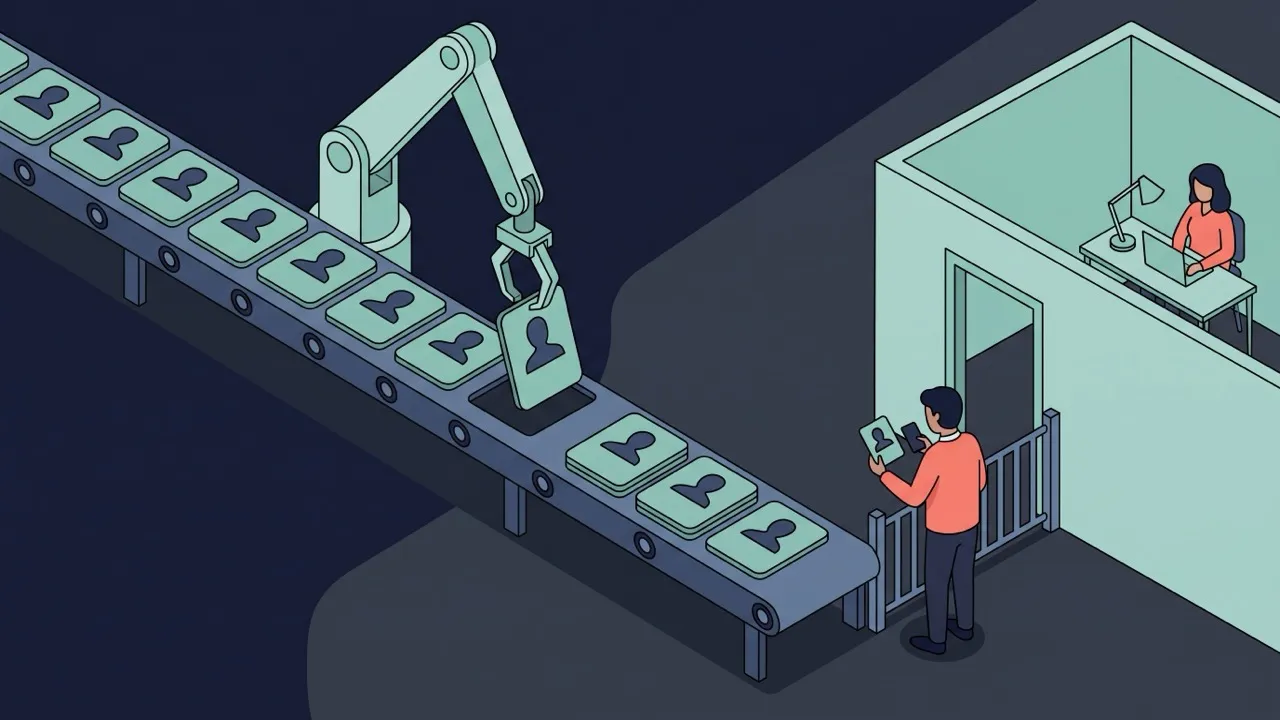
Hiring managers see candidates first, and AI only makes the first-pass call
- Case no.
- 051
- Primary source
- Paraform blog and help center
- Source published
- 2026-03-02
Summary
- Paraform has ParaAI put 5–10 candidates per role in front of hiring managers first, every day, and leaves the first-pass call to the AI.
- Candidate consent, the recruiter’s phone or video screen, and the hiring manager’s final review stayed with people.
- To avoid chaos, the extra submissions that AI creates have to be tied to recruiters’ interview rates and quality rules.
Why a hiring marketplace flipped the order of work
Paraform, a hiring marketplace in San Francisco, works in an unusual way. A company posts a role it finds hard to fill. Independent recruiters and specialist agencies then find candidates and submit them. The company pays a fee only if a hire actually happens, as a success fee. Most details in this post come from Paraform’s official blog, help center, and knowledge-base articles. Its early days come from two TechCrunch articles, and the 2026 founder interview comes from an EO article.
AI was not at the front from the start. According to TechCrunch on March 27, 2023, Paraform was a bounty board where companies put up a reward for each role, and about 90% of its users were professional recruiters. The product description did not mention AI anywhere. In the April 15, 2024 article, Paraform still saw hiring as “a very human-to-human process,” and chief executive John Kim said only that AI would someday be a tool to help recruiters.
In 2026, though, the way the company describes itself changes completely. The About page defines its first product as “an AI-native recruiting firm, where expert recruiters and custom AI agents work together.” On August 5, 2026, founders John Kim and Jeffrey Li introduced Hiring Intelligence and called it “the data layer that powers every agent across our platform.” The company says it passed $100 million in annualized revenue as of July 2026. The About page lists 120 people.
This case is worth a look because of what the working documents show, not because of any flashy marketing line. Compare the archived 2024 and 2025 help-center articles with the current knowledge base, and you can see how the job of finding and reviewing candidates moved. Three changes stand out.
First, the direction of matching flipped. Recruiters used to pick an open role and then go looking for people. Now an agent called ParaAI scans the whole candidate network every day and shows the strongest 5–10 candidates per role to the hiring manager first. Second, AI handles only the first-pass selection and does not make the final call. It scores fit and drafts submissions, but it cannot approve a final submission or replace an interview screen. Third, the points where people check things directly were kept. Only their position moved.
Five bottlenecks for recruiters and hiring managers
For Paraform’s marketplace to work, recruiters have to spend their time on the right roles and the right candidates. Before AI, though, the old setup had several practical bottlenecks.
First, finding the right role for a candidate was all manual. According to a post by engineer Harry Gao on July 12, 2025, recruiters “often have hundreds of open roles to choose from, and manually searching for the perfect fit wastes time and energy.” Digging through the list by hand cost them time and energy.
Second, a candidate who was rejected once vanished from the system. The old flow, as described in the March 2, 2026 ParaAI announcement, was this. A recruiter might submit an excellent candidate, but if that hiring manager said no, “the candidate is lost - even if they’d be perfect elsewhere.”
Third, it was too hard to get feedback from hiring managers. In the 2024 help center, the Calibration feature let a recruiter get early feedback from the hiring manager before a formal submission. It allowed at most three candidates at a time. The article even carried an explicit warning to recruiters “not to spam” hiring managers.
Fourth, every new role needed a staff review before a recruiter could work on it. In the August 2025 help center, a recruiter’s request to take on a role went to a shared inbox used by Paraform’s Talent Partners and Recruiter Success teams. Staff typically reviewed it within 24 hours.
Fifth, as AI spread, recruiting outreach got noisier. In a May 3, 2026 EO interview, John Kim passed on one recruiter’s estimate. To hire one engineer, a recruiter had to contact 500 to 700 candidates five years ago and 1,500 two years ago. Recently it has shot up to 5,000. Kim pointed out that “AI is actually making hiring a lot noisier.”
The six-step baseline flow done by people
Paraform did not choose to get rid of recruiters. In the EO interview, John Kim said “we made the deliberate decision to work with recruiters rather than replace them.” Instead of tearing down the existing workflow, it added technology at specific steps.
The “Submitting your First Candidate” help article, dated August 6, 2025, shows the recruiter’s six-step manual flow from before the AI features took off.
- The recruiter browses open roles and applies to take one, and Paraform staff approve it.
- The recruiter reads the written brief from the hiring manager and the role’s rejection reasons.
- The recruiter finds candidates in their own network or on LinkedIn Recruiter and saves them with a Chrome extension and a CRM.
- The recruiter screens the candidate by phone or video, gets explicit consent, and fills out the submission form.
- Once the candidate confirms consent by email, the hiring manager reviews and sets up interviews.
- At the final interview or offer stage, a Paraform Talent Partner on staff joins to help coordinate.
The article of that time said, “There are many ‘automated’ recruiting solutions like AI screening etc but at Paraform, we believe that recruiting is fundamentally human.” The General Submission feature from August 2024 also used a matching algorithm to pass along profiles not tied to a specific role. But the documents read do not say AI was used for sourcing, screening, or review at that stage. The announcement of the $20 million Series A on June 24, 2025 does not mention any AI feature either.
AI tools that arrived on the recruiter’s desk
After that, Paraform added tools one by one to take routine paperwork off recruiters.
Parascribe is an AI note-taker that joins candidate calls. It records the call, makes a transcript, and writes a structured summary. This transcript data connects directly to the system’s role matching.
Draft for me writes a draft submission by combining the call transcript, the role requirements, the earlier notes, and the hiring manager’s preferences. It also flags likely concerns in advance, such as a gap in experience or a mismatch in pay.
Paraform Search turns a job description written in plain sentences into search filters, which helps recruiters find new candidates. Parabot drafts outreach emails to candidates, but it sends nothing until the recruiter starts the send step.
On July 12, 2025, Paraform Matches arrived, described as “our AI-powered matching tool.” It ranks open roles for a candidate by comparing the candidate’s LinkedIn profile, resume, private notes, and Parascribe transcripts with the open role’s intake call (a call that gathers the role’s requirements from the hiring manager), Calibration feedback, and rejection history. One job for staff shrank at this point too. The rules changed so that if a candidate had been interviewed through Paraform before and the match score was high enough, submission approval came automatically, even for a role the recruiter was not working on.
ParaAI and the hiring manager’s screen
ParaAI Matches, announced on March 2, 2026, handed the lead in matching to the hiring manager’s side. Paraform calls ParaAI “our custom AI hiring agent for every role on the marketplace.”
Every day, for every open role, ParaAI analyzes five kinds of data. They are the job description and requirements, the transcript of the intake call with the hiring manager, data on people the hiring manager has interviewed so far, the people they rejected and why, and every candidate registered in the network.
From this data, ParaAI picks the 5–10 best-fitting candidates for each role and shows them directly to the hiring manager. The hiring manager can review them first and express interest. The recommendation pool is not scraped from anywhere. It is strictly limited to candidates who already have a relationship with a Paraform recruiter. By default, that means candidates a recruiter submitted in the last 40 days. People who are at the final or offer stage elsewhere on the platform are left out. Before showing a profile, ParaAI also estimates whether that candidate is likely to be open to that role.
This flipped the order of work. When the hiring manager sees a candidate they like and clicks interest, the request goes to the recruiter who registered that candidate. On screen, the recruiter chooses Pass or I’ll reach out. After choosing I’ll reach out and talking with the candidate, “confirming they’re a strong fit,” the recruiter picks Quick Submit or Reject.
A match expires after 7 days. A recruiter who lets 3 matches expire without a reply has ParaAI temporarily switched off on their account. When several recruiters know the same candidate, priority goes by how long each has known the candidate, the interview rate they recorded with that candidate, whether they keep preference information up to date, and whether they answer requests steadily. When a hiring manager rejects a candidate and leaves a reason, the reason goes into the system and automatically updates the candidate’s preferences.
In the real system, this matching probably ran in two stages each day. First, a first-pass lookup probably ran to quickly cut out unsuitable profiles, using things like whether the candidate was submitted in the last 40 days, desired salary, and work location. Then an agentic large language model (LLM, an AI model trained on large amounts of text to understand and generate human language) ranker probably compared the surviving profiles with the job description and the interview records to pick the final 5–10. If a hiring manager shows interest first and the recruiter does not answer, the customer experience is ruined. That is probably why the company set strong rules, a 7-day expiry and a feature shutoff after 3 misses.
AI checks at submission and weekly submission limits
Two AI checks now sit in front of the hiring manager’s inbox.
The first is AI Calibration. In 2024, it let a recruiter send up to three candidates at a time to the hiring manager for feedback before a formal submission. Now AI returns a verdict of Good fit, Maybe, or Bad fit, with its reasons, within seconds, and with no limit. The feature where the hiring manager gives feedback in person still exists, but it can be used only within a budget the hiring manager sets. The guide tells recruiters to “Lead with AI calibration to filter the obvious yes/no calls” and to “Save HM calibration for ambiguous cases.” A July 2026 update made AI Calibration take hiring-team behavior, pipeline conditions, and rejection patterns into account. Even so, Paraform’s documents draw a clear line: “AI Calibration is not an approval to submit or a replacement for screening the candidate.”
The second is an initial screen on submissions. The guide for hiring companies says, “ParaAI runs an initial screen on all recruiter submissions, and gives them a chance to provide additional rationale.”
In practice, this screening probably worked less like a wall that forcibly blocks submissions and more like a soft gate. For a candidate who scored low, the system probably showed a prompt asking the recruiter to explain the shortfall. When the recruiter typed in extra explanation, that note probably went along to the hiring manager. If a hiring manager passed a candidate that had been screened out as unqualified, that data probably went back in as training material to improve the next model’s evaluation performance.
The Candidate-First update of July 30, 2026 changed how recruiters pick roles. For each candidate, roles were sorted into Recommended roles, Possible fits, and Other Roles. When a recruiter submits a candidate to an outside role they were not assigned, the weekly limit on single submissions is set in strict tiers by the interview rate over the last 30 days.
A recruiter with an interview rate of 0–19% can submit only 2 a week. At 20–35% the limit is 3, and at 36–49% it is 4. New recruiters start at 5. At an interview rate of 50–59% it rises to 8, at 60–69% to 10, and at 70–89% to 13. At 90–100%, it reaches 18 a week. A recruiter with a first-stage interview rate of 50% or more, or a mid-stage interview rate of 25% or more, can submit to Recommended roles and Possible fits with no limit at all.
This submission limit was probably a speed governor against the spam-like applications that AI could cause. When AI makes matching easy and unqualified candidates pour in, the hiring manager pays the cost. The system probably re-graded recruiters each week from the interview results it settled, reset the limits, and opened the door to AI-recommended roles wide only for trustworthy recruiters who produce interview conversions.
Where people still check
Across its operations, Paraform left the points where a person judges in place.
A recruiter’s access to a role is reviewed by hand by the Talent Partners and Recruiter Success teams from a shared queue, mostly within 24 hours. Automatic approval is an exception that applies only to very high-scoring matches. As for whether a role is worth recommending to recruiters, the account management team checks in with the hiring team within 7 days and then attaches a Qualified mark.
A candidate’s fit and interest must be checked in a phone or video call the recruiter runs in person, and the candidate’s explicit consent is needed for every submission. The candidate also has to confirm consent by email before the hiring manager reviews. For a match that ParaAI pulled out, the hiring manager first shows interest and the recruiter confirms fit again before a formal submission is made.
Recruiter quality control is also tied to human standards. Under the charter rules, over the last 10 submissions a recruiter needs an interview rate above 25% and an average candidate rating of at least 2.5 out of 4. At most one candidate may have received a rating of 1. The company can halt new activity through periodic activity reviews. At the last stage, offer and coordination, a dedicated Talent Partner joins in person. On the client side, a dedicated talent strategist is assigned, and the in-house Delivery and Sales teams handle intake calls, diagnosing stuck roles, and managing submissions.
Results and changes on the hiring floor
By the numbers the company has released, growth was steep. In announcements from July and August 2026, annualized revenue reached $100 million. Revenue growth in 2025 was given as 10x in the interview and as 8x for the previous year in job-posting wording. Cumulative fees the platform paid out to recruiters grew from $26 million on June 24, 2025 to more than $50 million on March 18, 2026, and passed $72 million on August 5, 2026. A job posting reads “20 engineers and more than $100M in ARR.”
The time to hire was also published. According to an August 2026 post, it takes about 12 days for a company to first meet the person it ends up hiring, and then another 27 days to reach a signed offer. The homepage gives an average time to hire of 27 days, so the two use different measurement bases.
The AI features’ own performance was also shown with data. In the July 12, 2025 announcement, Paraform Matches produced more than 1,000 interviews and more than 20 hires in a month, and more than 60% of recommended candidates received interview requests. In a backtest of the evaluation system announced on January 27, 2026, run across hundreds of roles, an LLM evaluator raised P@5 (the share of actual good fits among the top five recommended candidates) by 19.2% over embedding similarity (a method that turns words or sentences into number vectors and measures how close their meanings are). An agentic LLM ranker added another 7.2%. A context engine that learns from past rejections improved accuracy at firmly weeding out unsuitable candidates without missing suitable ones.
There is also a real company case. Grace Turner at Pallet was both Head of Talent and the company’s only recruiter. Turner had to make as many as 95 intro calls to land one hire. Before ParaAI, she got only 3 to 6 candidate applications a week. After adopting ParaAI, she got “five highly aligned profiles every day.” Turner set a daily calendar reminder to review these profiles. Of the 4 people Pallet hired through Paraform, 2 came directly from candidates recommended by the ParaAI hiring agent. Paraform said this let Pallet absorb the sourcing function and keep its recruiting team small without adding people.
But the sources do not say everything. No figure has been released for how much of all matching, screening, or submission work AI handles. The phrase “automation rate” appears only in an October 2026 job posting, listed with match quality and hiring velocity as outcomes the AI Platform team is accountable for, and it has no clear definition. There is also no figure on how many submissions ParaAI’s initial screen actually blocked, or on how much staff time automatic approval of high-scoring matches saved.
Lessons for business leaders
Three preconditions let Paraform settle AI into its hiring process.
First, the marketplace itself had piled up a huge amount of outcome data over several years. It held structured feedback on which candidates were submitted, who reached interviews, why hiring managers rejected people, and who was finally hired. According to the evaluation post, the context engine treats a hiring manager’s decisions as nuanced signals, not hard filters, and ParaAI reads rejection reasons every day.
Second, the pool the AI searched was not information scraped at random from the web but a network of candidates that people had already vetted. ParaAI ran matching only over people a recruiter had talked to, screened, and submitted within the last 40 days.
Third, it tied the speed that AI produces to people’s quality measures. If matching gets faster and submissions are made carelessly, hiring managers get worn out. Through the weekly submission limit linked to interview rate, the 7-day expiry, and the quality standards in the charter, the company forced recruiters to submit candidates carefully on their own.
On the operations side, there are limits and contradictions too. The current “Submitting your First Candidate” article still stresses that, “Unlike fully automated screening tools, Paraform’s marketplace model is built around personal, human recruiting at scale,” yet the document for hiring companies says ParaAI screens every submission in advance. A job posting also advertises that the agent system takes work off the operations team too, but the only change visible in the documents is automatic approval for high-scoring matches. Approving role applications, reviewing Qualified roles, assigning extra slots, and imposing activity sanctions are all still done by hand by staff.
The company does not state a launch date for its agents. The earliest date for an AI matching product found in the sources is July 2025, and the word “agent” appears in 2026.
Paraform did not hand hiring over to AI as a whole. It gave AI the jobs of calculating fit, drafting, first-pass selection, and, by flipping the order, showing candidates to the hiring manager first. The key lines of verification stayed with people: the candidate’s consent, the recruiter’s phone or video screen, and the hiring manager’s final decision. Raising the speed of automation matters, but so does carefully designing the gates and rules that people must keep. That design decides whether the system succeeds.
Sources
- Paraform (Karan Parikh) — ParaAI Matches: a second placement engine for your candidates
https://www.paraform.com/blog/passive-placements — 2026-03-02 - Paraform Knowledge Base — ParaAI Candidate Matching (hiring side)
https://knowledge.paraform.com/articles/2430127816-paraai-candidate-matching — accessed 2026-10-22 (“Last updated 2 months ago”); also archived at paraform.com/help/article/para-ai-matches, captured 2026-04-12 - Paraform Knowledge Base — ParaAI Matches (recruiter side)
https://knowledge.paraform.com/articles/6254741269-para-ai — accessed 2026-10-22 - Paraform Knowledge Base — Using the Calibration Feature
https://knowledge.paraform.com/articles/6831841482-calibration-feature — accessed 2026-10-22; 2024 version at paraform.com/help/article/calibration-feature, Wayback capture 2024-12-02 - Paraform (Harry Gao) — Paraform Matches: High-Quality Role Matches For Your Candidates In Seconds
https://www.paraform.com/help/article/matches — 2025-07-12 (read via Wayback capture 2025-08-08) - Paraform Help Center — Submitting your First Candidate
https://www.paraform.com/help/article/submitting-your-first-candidate — 2025-08-06 (Wayback capture 2025-08-10); current version https://knowledge.paraform.com/articles/5253208160-submitting-your-first-candidate — accessed 2026-10-22 - Paraform Knowledge Base — Recruiter Submissions Guide, Paraform Calls, Paraform Search, Qualified Roles, Primary Role Slots and Single Submissions
https://knowledge.paraform.com/articles/4422829426-recruiter-submissions-guide · https://knowledge.paraform.com/articles/2937616055-paraform-calls · https://knowledge.paraform.com/articles/7495128606-paraform-search · https://knowledge.paraform.com/articles/4438020387-qualified-roles · https://knowledge.paraform.com/articles/7961984700-primary-role-slots-and-single-submissions — accessed 2026-10-22 - Paraform Help Center — Paraform Recruiting Charter & Guidelines, Paraform Recruiter Activity Reviews (Wayback captures 2026-04-19); Maintaining Proper Quality on Paraform (Wayback capture 2025-06-19)
https://www.paraform.com/help/article/charter-and-guidelines · https://www.paraform.com/help/article/account-activity-reviews · https://www.paraform.com/help/article/maintaining-proper-quality-on-paraform - Paraform (Karan Parikh) — Work Candidate-First on Paraform
https://www.paraform.com/blog/candidate-first — 2026-07-30 - Paraform — Building Reliable evals to solve hiring
https://www.paraform.com/blog/building-reliable-evals-to-solve-hiring — 2026-01-27 - Paraform (John Kim) — How Pallet uses ParaAI to hire high-bar engineering talent
https://www.paraform.com/blog/pallet — 2026-03-18 - Paraform (John Kim and Jeffrey Li) — Introducing Paraform Hiring Intelligence
https://www.paraform.com/blog/hiring-intelligence — 2026-08-05 - Paraform — Paraform crosses $100M in annualized revenue — https://www.paraform.com/blog/100m-annualized-revenue — 2026-07-16; Announcing Paraform’s Series B — https://www.paraform.com/blog/series-b — 2026-03-18; Announcing Paraform’s $20M Series A — https://www.paraform.com/blog/series-a-announcement — 2025-06-24; General Submission recruiter story — https://www.paraform.com/blog/general-submission-feature — 2024-08-06
- Paraform — homepage and About page
https://www.paraform.com/ · https://www.paraform.com/about — accessed 2026-10-22 - Paraform job postings (Technical Lead Manager, AI Platform, 2026-10-14; Founding Enablement Leader, GTM, 2026-08-25), Ashby public job board API
https://api.ashbyhq.com/posting-api/job-board/paraform — retrieved 2026-10-22 - EO — interview with John Kim, The $65M Bet Against AI Recruiting
https://www.eomag.io/article/paraform-john-kim — 2026-05-03 - TechCrunch (Catherine Shu) — Paraform
https://techcrunch.com/2023/03/27/paraform/ — 2023-03-27 - TechCrunch (Kate Park) — Paraform raises $3.6M seed round to connect startups with recruiter networks
https://techcrunch.com/2024/04/15/paraform-a-recruiting-platform-that-connects-recruiters-and-startups-raises-funding — 2024-04-15