All casesNo. 050
Insilico Keeps the Robots, Agents Handle Coordination
Five agents plan the experiments and researchers confirm at only three points
- Case no.
- 050
- Primary source
- Company press release
- Source published
- 2026-05-06
Summary
- Insilico launched LabClaw, an agent system that runs an automated lab.
- Five agents coordinated the experiments, and researchers confirmed decisions at three points.
- Even when automated machines already exist, you have to add a coordination layer between them to free up people.
Why were people still busy in a lab where the robot arms never stop
When liquid handling equipment that moves fluid between test tubes, high-throughput screening platforms, and automated cell culture systems that grow cells at a steady temperature and humidity come into a lab, you would think researchers’ workload would drop a lot. In fact, such automation did raise experimental throughput greatly and reduced the systematic errors that came from people holding pipettes and repeating the work by hand.
But however precisely the machines moved, researchers in the lab were still busy on their feet. Machines had multiplied, but manual work stayed around them: stepping in when an intermediate step failed, coordinating and tracking work across functional islands, and bridging equipment and data that did not connect. The machines moved only by fixed rules, and the data each instrument produced was scattered.
Insilico Medicine, listed on the Hong Kong stock exchange (HKEX: 3696), describes itself as “a clinical-stage, generative AI–driven drug discovery company.” According to Longevity.Technology, the company, founded in 2014, carried out Hong Kong’s largest biotech initial public offering (IPO) in 2025 by amount raised. Its company page stresses that it is an “end-to-end generative AI-driven biotech company” built on its Pharma.AI platform. In other words, finding drug candidates with AI models was the backbone of this company even before this change.
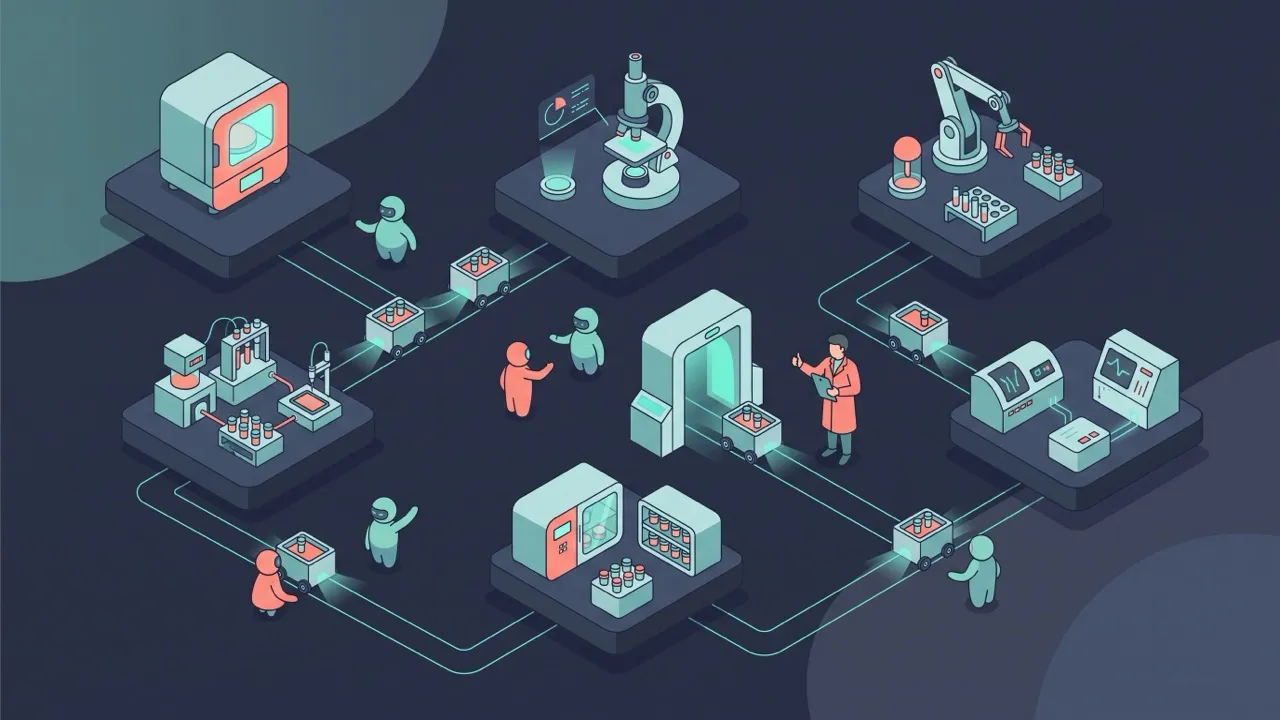
The fully automated lab it had already built, LifeStar2, ran six functional islands with different roles, including cell culture, high-throughput screening, and next-generation sequencing (NGS, a technology that reads genetic information quickly in bulk), along with dozens of instruments. Automated guided vehicles (AGVs) busily carried samples between the functional islands. But even in an environment where AI predicts candidate compounds and robots handle reagents, running the whole experiment as one flow still needed human hands.
In a press release on May 6, 2026, Insilico announced LabClaw, an intelligent lab operating system to solve this problem. The press release described the change as a step “from Automation to Autonomy.” Without changing the lab’s hardware, the company handed the authority to coordinate robots and data to five AI agents at the software layer.
Three bottlenecks left between the automated machines
Insilico named three bottlenecks as the reasons that biotech companies that already have automated labs cannot move to truly autonomous operation. These were not problems of one lab but structural friction across the industry.
The first problem was workflow rigidity. Existing automated labs ran on fixed procedures that people had programmed beforehand. But many environmental variables act in a biology experiment. When an unexpected error occurred at an intermediate step, or an anomaly appeared in quality control (QC) readings, a system that could not respond flexibly would stop and wait for a researcher to step in and handle it by hand.
The second problem was data silos. The huge amount of result data that the instruments poured out was locked inside the analysis devices. With no feedback path that interprets experimental results automatically and sends them back up to the AI hypothesis-generating models, the data could not connect in real time with downstream statistical analysis or upstream AI inference. The machines were pulling out data, but the data sat unused when it was needed.
The third problem was high coordination cost. A lab has several functional islands that exist independently. People still had to design and track by hand multi-step experiments that cross different functional islands, and as a result a lot of time went to non-research work. The time researchers should have spent on scientific thinking was being consumed by scheduling and errands outside research.
In the past, to find drug candidate targets, people had to review countless papers and literature by hand and organize the evidence. Lin Sha, Insilico’s senior director of IT, pointed out that the core meaning of LabClaw lies in reshaping researchers’ focus. The starting point was the idea that the system should take over time-consuming standard work and tedious scheduling coordination and act as a “tireless research co-pilot.”
It added an operating system without changing the hardware
Instead of buying new machines for the lab, Insilico chose to tie existing equipment together with software. According to the press release, LabClaw was designed to complement the company’s fully automated lab, LifeStar2, and it connects four existing layers into one.
The first layer is PandaOmics, the company’s own AI target discovery platform. The second is LifeStar2’s automated experiment hardware mentioned earlier, which covers six functional islands, dozens of instruments, and the automated guided vehicles that travel between the islands. The third layer is LIMS, the lab information management system that records the status of materials and samples, and the fourth is a multi-dimensional data analysis pipeline.
The company summed up this design in three pillars: “AI thinking, automated execution, and human supervision.” The AI platform does the thinking with the head, robots do the moving as hands and feet, and people watch the overall direction and decide. It is a division of labor.
The actors that actually move on this system are five collaborating AI agents and the twenty-eight specialist skill modules they use. The agents split fixed roles.
- Science Analyst: searches PandaOmics and several knowledge bases and proposes drug targets with sound evidence.
- Experiment Coordinator: turns the selected targets into work procedures that can be carried out in a real lab and directs the whole run.
- QC Inspector: monitors environmental parameters and cell states throughout the process.
- Orchestration Expert: only the name appears in the press release, and no specific role is described.
- Data Specialist: only the name appears in the press release, and no specific role is described.
The press release did not detail how the Orchestration Expert and the Data Specialist work beyond their names, and it did not disclose which large language model the agents run on. But the company built a structure in which the five agents mesh like gears and take over from literature search through physical execution to quality monitoring.
The way experiments are designed also changed. Researchers do not have to write complicated programming code. When they enter a research goal in everyday natural language, the agents understand the goal and put together the whole workflow, from target selection through reagent preparation, instrument operation, and data analysis. The workflow is made of twenty modular steps that can be fitted together like Lego blocks. These steps cover five areas: AI and computing services, sample and material preparation, automated experiment execution, data analysis and report generation, and notification and collaboration.
Eight standard templates were also prepared for frequently used experiments. They are target validation, biomarker validation using CRISPR (a gene editing technology), high-throughput screening, hit molecule discovery, phenotypic safety assessment, LifeStar2 operation, a LIMS material readiness check, and a data analysis template. Researchers can also make their own new templates by talking with the system, and can keep them private or share them with colleagues.
Safeguards that protect human decisions inside autonomous operation
When you hand the conductor’s baton of a lab to AI agents, the biggest worry is losing control. Reagents and cells cannot be restored once contaminated or mishandled, and the cost of losses is large. To prevent this, Insilico said it applied a lightweight Agent-Guard architecture. The company called it “the pharmaceutical industry’s first laboratory autonomy system.”
The basic principle of this structure is to let agents act autonomously only within safe boundaries. Every state change must first be checked for validity by the backend system and is designed to be confirmed by a human researcher. Through built-in checkpoints placed throughout the system, researchers can bring in their own expertise or fine-tune the parameters of virtual screening and the numbers in experimental protocols. By placing a Human-in-the-Loop approval mechanism at each important juncture, the design is meant to meet scientific rigor and regulatory requirements.
In the real system, this probably ran as detailed permission management. The agent was probably free to research material and draft an experiment plan, but when moving to a step that consumes physical resources, the backend likely checked LIMS material stock and the protocol’s allowed range and waited for the researcher’s approval signal.
Lin Sha pointed clearly to the essence of this safeguard. “Here, the Human-in-the-Loop mechanism ensures scientists remain at the center of decision-making. It frees brilliant minds from repetitive pipetting, allowing them to devote their most valuable energy to generating scientific hypotheses, extracting insights from complex data, and designing innovative strategies.” It is not that robots and agents replace people. They clear away the dirty work so that people can focus only on decisions.
An anti-aging target project where agents and researchers actually worked together
The anti-aging target discovery case in the press release shows at a glance how this system actually runs. The project ran in three stages.
The first stage is target selection. The research team entered the research purpose on screen through a conversational interface. The Science Analyst agent immediately searched PandaOmics and several knowledge bases. The agent picked out the top twenty most promising targets, and for each target it laid out the score, an assessment of novelty compared with existing research, and information on links to known drugs on a single screen. The researcher looked at the screen and gave the final confirmation of the proposed list of twenty targets.
The second stage was experiment design and execution. Once the list was fixed, the Experiment Coordinator agent automatically drew up a standard operating procedure (SOP) of seven steps and began directing it. It started with checking whether the necessary materials were ready in LIMS and went on in order through cell culture, gene editing, and operating high-content imaging equipment. While these instruments ran, the QC Inspector agent kept watch without pause over the environmental readings inside the instruments and the health of the cells.
What if a sign of trouble had been found in this process? In real operation, when the QC Inspector detected a reading outside the threshold, it probably paused the work at once and reported the problem and the alternatives to the researcher through the notification and collaboration module. Instead of a researcher pacing in front of the incubator and noticing a failure late, as in the past, it likely became a flow in which the system sums up the cause of the anomaly and reports it, and the researcher approves whether to rerun the experiment.
The third stage is analysis and feedback. After the equipment finished plating, transfection, and imaging, the system began its calculations. It automatically calculated gene editing efficiency and the cells’ phenotype scores, sent them to the database in real time, and immediately re-ranked the importance of the drug candidate targets.
In all this process, the moments when a researcher stepped in and made a decision were only three critical points. The first was the moment of approving, on screen, the list of twenty targets that the system proposed. The press release does not say specifically where the other two approval points were, but they were presumably the step of approving the experiment procedure just before physical reagents are put in, and the step just before the finished analysis data is reflected in the final database. While the researcher nodded three times, the many other coordination and execution tasks were finished by agents and machines.
Lab data teaches the AI again
The part of this system most worth noting is the closed loop in which results from the lab flow straight back into the AI models.
Before, even after a robot finished an experiment, the results were left in a corner of a computer as files. But in the LabClaw system, CRISPR editing efficiency analysis, RT-qPCR calculations (a quantitative PCR test that measures gene expression levels), and NGS quality control data analysis are finished automatically. And this validated data is sent back without delay to PandaOmics, the target discovery platform upstream.
In practice, an agent like the Data Specialist probably picked out only the data that passed the quality criteria from the results that went through the analysis pipeline and updated PandaOmics’s target database. It is a way of correcting the record through a verification step so that a promising target’s rank is not unfairly cut down by data from a failed experiment.
The company described this as a cycle “from computational prediction to wet-lab validation and model optimization.” It is a process in which hypotheses are made inside a computer, verified in a wet lab that uses real reagents and cells, and the results are then used to refine the model again. As AI learns from the real physical feedback that comes back from the lab, next time it can pick out more promising drug targets and molecules with higher accuracy. Data that machines produced and people organized has become food that trains the AI model itself.
How did researchers’ daily work change
According to the company’s explanation, after LabClaw was adopted, the roles in the work divide as follows.
In gathering evidence for drug candidate targets, researchers no longer leaf through countless papers by hand and note down evidence. When the Science Analyst agent searches the platform and knowledge bases and posts a clean report, the researcher reviews the list and presses the confirm button.
How experiment workflows are built also changed. They moved away from following a fixed, pre-programmed procedure and having people run over to clean up when an error occurred midway. Now the researcher states the goal in natural language, the agents build the flow themselves, and the QC Inspector watches the run in real time.
Logistics and scheduling coordination between functional islands also left human hands. Work that people used to design and track by hand across different functional islands has changed into a way where agents call and control LIMS, the instruments, and the transport vehicles directly.
The same goes for data handling after the experiment. Unlike the past, when the generated data was scattered and cut off from the upstream AI models, now the analysis results are calculated automatically, sent to PandaOmics in real time, and the priority of targets is updated in real time.
As a result, the researcher’s role has risen from a manager who ran lab equipment and coordinated schedules to a final decision maker who decides at the critical points and fine-tunes parameters.
Alex Zhavoronkov, founder and chief executive officer (CEO), stated the weight of this change: “LabClaw delivers not only enhanced R&D efficiency but represents an upgrade in research paradigm: scientists are liberated from heavy experimental orchestration and process coordination to focus their energy on more creative scientific judgment and research.” He added that going forward the company will strengthen its framework for collaboration across several labs, its ability to optimize adaptively as conditions change, and its compliance systems.
What to keep in mind when looking at this case
The LabClaw case is impressive, but when reading the press release you need to point out some limits and context.
Above all, no specific performance metrics were published. Objective quantitative figures such as the amount of time saved, the cost savings, the overall rise in throughput, the reduction in experimental errors, and the total number of projects that have gone through the system were not included in the announcement. The only efficiency-related statements the company gave are the phrase, in the target discovery case, “compressing weeks of biological background research into minutes,” and the explanation that quality monitoring is “significantly reducing data fluctuations from experimental operations,” and no specific measurement basis was given.
Also, this system is not magic built from scratch. For it to work, the fully automated robotic lab LifeStar2, LIMS that tracks materials and samples, the automated guided vehicles that link functional islands, and its own AI target discovery platform PandaOmics all had to exist already. An organization without advanced hardware infrastructure and base software would have nothing ready to coordinate right away, even if it brought in agents.
Further, the relationship between the two sentences in the press release that explain human approval is a little vague. One side says “all status changes are validated by the backend and confirmed by a human,” while the other, in the case study, explains that decisions are made “at three critical junctures,” so how the specific operating rules divide is not fully clear. What detailed steps are actually taken when the QC Inspector catches an anomaly, whether the system is applied outside Insilico’s own lab, and how many research teams use it were also not in this announcement.
Hints for companies outside the lab
Even a company that does not develop drugs itself can take clear insight from Insilico’s experiment.
Many companies bring in automation tools to make work more efficient. They attach a customer service chatbot, install robotic process automation (RPA) that tidies data, and tune up the internal enterprise resource planning (ERP) system. But however smart individual machines and software get, staff fatigue does not ease easily. Copying the result of machine A and pasting it into software B, watching that no error occurs in between, and coordinating processing schedules across several departments all remain with people. The real bottleneck arises not from the speed of individual tasks but from the coordination cost of linking one task to another.
Instead of bringing in more expensive robot arms, Insilico put one coordination layer, agents, on top of its existing equipment. It gave software the role of a conductor that takes commands in everyday language, arranges the order of work, allocates resources, and gathers results and returns them to the upper-level system. And rather than have people cling to the whole process, it designed things so that people press the approval button only at the few gateways where resources are committed and direction turns.
In your organization too, aren’t there already excellent systems that stand isolated from one another while people run around on foot to fill the gaps between them? Before adding more machines, how will you build a coordination layer that ties those machines into one and lets them run on their own? The autonomy of the lab that Insilico showed is also the next question facing every office and workplace.
Sources
- Insilico Medicine — Advancing Drug Discovery from Automation to Autonomy: Insilico Medicine Announces LabClaw the Intelligent System (press release)
https://insilico.com/news/tmikccj2f1-advancing-drug-discovery-from-automation
Published 2026-05-06; accessed 2026-10-22 - Insilico Medicine — About
https://insilico.com/about
Accessed 2026-10-22 - Longevity.Technology — Insilico Medicine lists on Hong Kong Stock Exchange in 2025’s largest biotech IPO
https://longevity.technology/news/insilico-medicine-lists-on-hong-kong-stock-exchange-in-2025s-largest-biotech-ipo/
Published 2026-01-02; accessed 2026-10-22