Essays2026-10-02
A Day in the Life of a Driver Assigned 100 Buses
The unseen strain, responsibility, and fatigue left for frontline workers when AI takes over daily routines.
- Published
- 2026-10-02
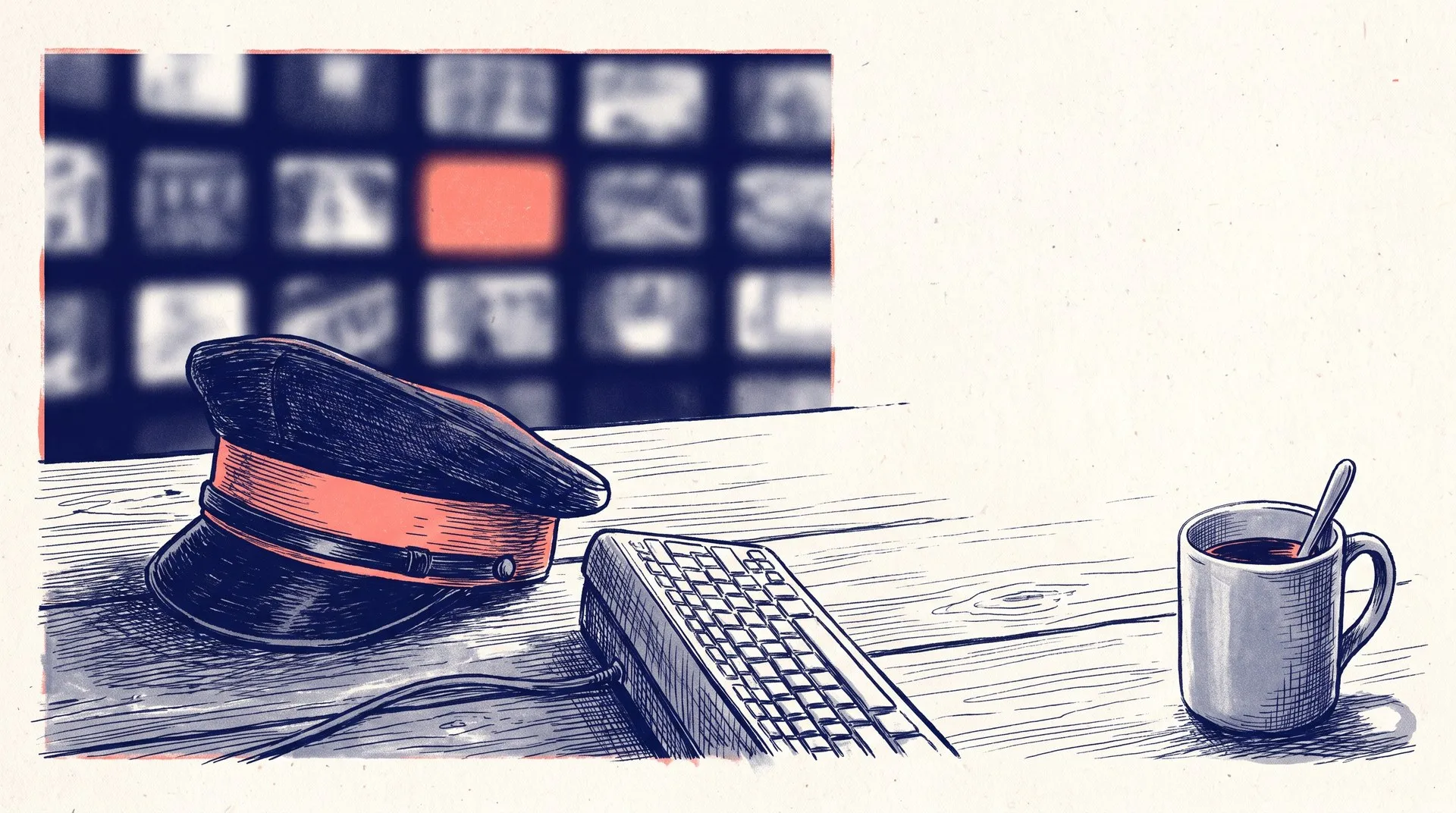
Consider bus driving. Originally, it is one driver to one bus. Most of the shift is monotonous and dull. You drive the same route, pull into stops, and wait at red lights. Very rarely, something dangerous happens: a car cuts in without warning, the wheels slide on snow, or a passenger loses their footing. Even so, the driver is sitting right behind the wheel. They already feel through their whole body how slick the road is, how the car ahead is drifting, and what the mood in the cabin feels like. They react by reflex.
Then one day, autonomous buses arrive. The driver no longer sits in the cab. Instead, they report to an office and watch screens to monitor a fleet of 100 buses. Whenever a bus runs into a situation it cannot resolve on its own or an emergency crops up, their new job is to log in remotely and take over.
From the company’s perspective, this is a massive win, slashing labor costs. On paper, it looks good for the driver, too. The hours remain the same, but they no longer brave the weather, and instead of bumping along rough roads, they work in a comfortable office. Working conditions seem to have improved considerably.
Yet the reality is just the opposite. The driver faces a level of stress they have never experienced before. I feel that what many frontline practitioners go through after AI is introduced closely mirrors this bus driver’s situation. Behind the claim that work has become easier lies a quiet, specific strain—and that is what I want to talk about.
The Tense Strain Beneath the Boredom
On the surface, the driver’s day looks quiet. Across the screens, 100 buses mostly run smoothly on their own. The real issue is that an incident could happen at any moment, anywhere. For eight straight hours, the driver cannot let their guard down. The boredom of driving a bus yourself at least kept your hands and feet engaged. This new boredom is the dull agony of waiting for a bomb to go off.
The human brain is poorly suited for monitoring tasks like this. During World War II, the British Royal Air Force sought to understand why radar operators were missing signals toward the end of their shifts. Psychologist Norman Mackworth designed an experiment using a clock hand that occasionally jumped two ticks instead of one. The results were clear: after just thirty minutes, observers began missing those rare jumps. Staring at an uneventful screen for hours to catch an infrequent event is the hardest kind of labor for human attention to sustain.
Yet in those rare moments, the driver cannot afford a single mistake.
Inheriting Hard Problems Without Context
An alarm sounds somewhere. Bus 73 is in trouble. The driver scrambles. They have no idea what road the bus was traveling on just seconds ago, what the weather is like outside, or how many passengers are on board. Their attention was divided among ninety-nine other buses until that very second. When you drive a vehicle yourself, you are immersed in the situation and hold the surrounding context. Now, without any grasp of the scene, they must pull up the feed and instantly solve a crisis that the autonomous system threw its hands up on.
In a 1983 paper, cognitive psychologist Lisanne Bainbridge called this the “Ironies of Automation.” Automation takes over routine, easy tasks first. What is left for humans are only the thorny, edge-case problems the system cannot handle. Yet because the human operator has been hands-off, their intuitive feel for the work has atrophied. The more sophisticated the system becomes, the less often humans intervene; paradoxically, the rarer those interventions become, the less capable humans are of handling the crisis when it arrives. That warning from more than forty years ago is the daily reality for practitioners remotely supervising AI systems today.
Credit to the System, Blame to the Human
When ninety-nine buses finish their runs safely, the company praises the brilliance of autonomous technology. The effort of the driver who spent the entire day watching them on edge is pushed off-screen. But if a single bus crashes, every eye turns to the driver. People demand to know why they failed to take remote control in time.
Sociologist of technology Madeleine Clare Elish described this phenomenon with the concept of the “moral crumple zone.” Just as the crumple zone at the front of a car absorbs impact to protect passengers, the human standing next to an automated system absorbs the blame when things go wrong, shielding the system itself from scrutiny. Little thought is given to whether the person actually had meaningful control over the machine in the first place.
The 2018 pedestrian fatality involving an Uber autonomous test vehicle in Tempe, Arizona, is a clear example. The National Transportation Safety Board (NTSB) identified the safety driver’s failure to monitor the roadway due to looking at a mobile phone as the immediate cause of the crash. At the same time, the NTSB pointed to Uber’s inadequate safety culture and the lack of mechanisms to prevent “automation complacency”—the state of inattention drivers slip into—as contributing factors. Yet prosecutors declined to file criminal charges against Uber. Only the safety driver was indicted, eventually pleading guilty years later. The point is not to excuse the driver’s error. The point is that the structural failure of a system that demanded unending vigilance from a human while leaving them vulnerable to complacency fell entirely on the shoulders of an individual worker.
Remote Control Rooms in Knowledge Work
The bus driver’s story is only a product of my imagination. But today, remote control rooms are already set up across the landscape of knowledge work. Software developers spend their energy reviewing diffs generated by AI coding assistants rather than writing code from scratch. Customer support agents inherit only the inquiries from furious users after an AI has failed to resolve them. Marketers sift through dozens of drafts churned out by AI, hunting for plausible-sounding errors. Workers sit before quiet monitors waiting for an invisible defect to surface, only to inherit the most frustrating edge cases stripped of context. When things run smoothly, it is chalked up to the technology; when something breaks, it is blamed on the reviewer who missed it.
On top of that, the sense of accomplishment from seeing a job through disappears. In the past, there was satisfaction in writing a proposal from start to finish, staying up late to build a feature, or driving passengers safely to the final stop. Now, a practitioner’s day is filled with cleanup—hunting for flaws in outputs produced by something else. The workload has not shrunk; the way we work has simply been distorted, and that distortion wears down the human spirit surprisingly fast.
Questions Managers Need to Confront
This strain cannot be resolved by telling workers to focus harder. It is not a matter of individual weakness, but a breakdown in the structure of the work itself. The managers who design and direct these systems need to change the setup first.
Assign work based on human limits, not labor savings. Assigning 100 buses to a single driver reflects the cost savings a company wants to achieve, not the boundaries of human cognition. The appropriate ratio will differ by task, but it should be set at a level where one person can sustain attention and respond steadily. Trivial notifications that the system can filter out should be stripped away, forwarding only the critical alerts that genuinely require human judgment so workers do not burn out.
Hand over work when early signs appear, not after the crisis breaks. For a system to hold on until the edge of disaster and then dump control onto a human is not asking for help; it is offloading the blame for failure. The system needs to flag issues early, as soon as its confidence begins to degrade. And when handing over control, it must convey what happened leading up to that point, what the system attempted, and where it got stuck. Practitioners need enough breathing room to grasp the context and make a considered judgment.
Leave room for hands-on work. Bainbridge pointed to direct, hands-on experience as a way to preserve operational feel. To keep practitioners sharp, a portion of the workload should still be handled end-to-end by humans without AI, or rotated through manual duty. This builds the competency needed to handle emergencies while protecting the sense of accomplishment that comes from finishing a task.
Hold people accountable only for what they could actually control. When a practitioner misses an AI error, the response should not be to demand why they failed to catch it, but to question whether one person could realistically cover all those blind spots to begin with. This is why aviation, medicine, and critical operations investigate flaws in system design before assigning blame to individuals. Conversely, interventions that head off an accident should be carefully tracked and rewarded. Behind ninety-nine buses running safely on schedule lies the sustained vigilance of someone watching screens all day with every nerve taut.
What Doesn’t Show on the Balance Sheet
When evaluating the success of AI adoption, companies look first at the balance sheet: labor costs cut, processing speeds multiplied. But those spreadsheets never record the strain on the person sitting in a quiet office, spending the day on edge while monitoring 100 buses alone.
Bringing AI into an organization does not automatically complete a transformation. A transition is only complete when the workplace is shaped so that the people monitoring these tools and dealing with the fallout do not burn out, do not lose their operational feel, and are not left to take the fall for a system’s failures alone.
References
- Norman H. Mackworth, “The Breakdown of Vigilance during Prolonged Visual Search”, Quarterly Journal of Experimental Psychology 1 (1948)
https://doi.org/10.1080/17470214808416738 - Lisanne Bainbridge, “Ironies of Automation”, Automatica 19(6) (1983)
https://doi.org/10.1016/0005-1098(83)90046-8 - Madeleine Clare Elish, “Moral Crumple Zones: Cautionary Tales in Human-Robot Interaction”, Engaging Science, Technology, and Society 5 (2019)
https://estsjournal.org/index.php/ests/article/view/260 - NTSB, Tempe Uber Autonomous Test Vehicle Pedestrian Crash Investigation (HWY18MH010)
https://www.ntsb.gov/investigations/Pages/HWY18MH010.aspx - NPR, “Backup driver of an autonomous Uber pleads guilty to endangerment in pedestrian death” (2023-07-28)
https://www.npr.org/2023/07/28/1190866476/autonomous-uber-backup-driver-pleads-guilty-death