Essays2026-10-07
Incompetent Manager, Incompetent Human
You've handed your work to AI. What kind of boss are you?
- Published
- 2026-10-07
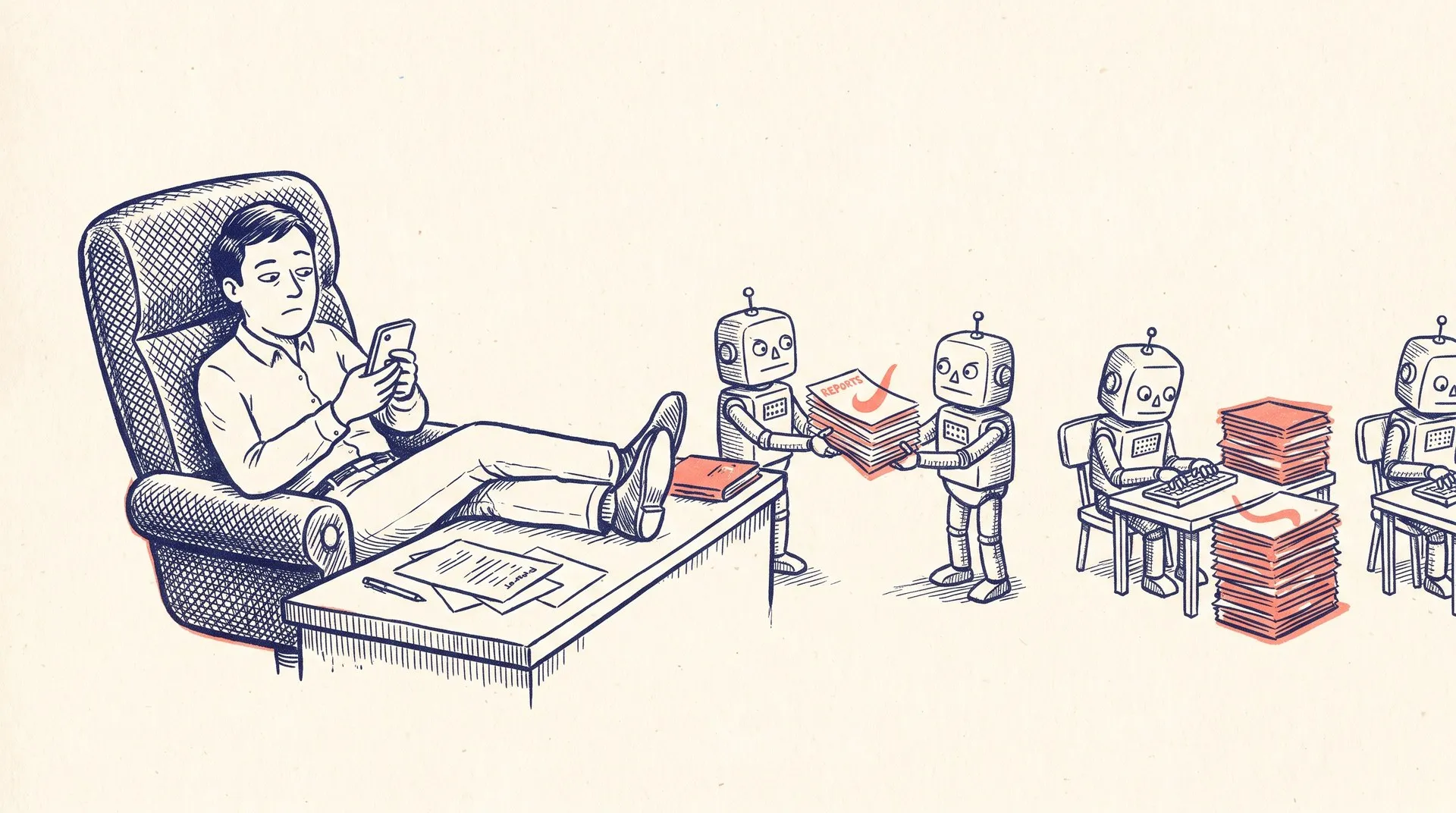
The Manager Behind the Monitor
Picture an imaginary figure. A department manager, seen from across the room through the eyes of one of his direct reports.
This manager doesn’t really understand the actual work. He has little sense of how the technology works or where the market is heading. When a team member hands him a proposal drafted over several sleepless nights, he cannot follow the core argument and latches onto trivia instead. He complains that the font looks off, that a table border is too loud, or that the tone of a sentence ending feels unpolished. Unable to grasp the substance, he fusses with the cosmetic surface.
Having announced that his review is complete, he returns the draft and disappears behind his monitor. Hear the quiet clatter of his keyboard, look over, and you will find him reading comment sections on news portals or browsing online stores for golf clubs. But the moment he picks up the portfolio and heads into the executive suite, his demeanor shifts entirely. He packages the analyses and ideas his team sweated over all night and presents them as his own.
The reckoning arrives during the presentation to the CEO. Armed with the slides and script his team painstakingly built for him, he stands at the podium and reads smoothly enough. But the moment the CEO points to a figure tucked in a corner of a slide and asks for the context, the manager freezes. Because he never dug into the material himself, he doesn’t even grasp the premise of the question. Sweating through his collar, he fumbles and sputters out irrelevant excuses.
Watching from the sidelines, the team members can only burn with quiet frustration.
Human Managers Directing Agents
Watch people working with AI agents today, and you will see uncanny echoes of that fictional manager. Now that AI agents can be directed like junior staff, users have settled into the manager’s chair and started acting the exact same way.
Without understanding the underlying logic or factual claims in the agent’s output, they pass it directly to the next person. What passes for a “review” amounts to tweaking the tone of a few sentences or adjusting the formatting. Having fired off a prompt, they spend the run time watching YouTube or slacking off in another browser tab. Then they slap their own names in large print on the resulting report. And when a colleague or supervisor in the meeting room asks, “Where did this figure come from?”, they freeze, unable to answer.
The fallout from this habit is already showing up in hard numbers and real incidents.
In a September 2025 article for Harvard Business Review, researchers from the Stanford Social Media Lab and BetterUp Labs introduced the concept of “workslop.” The term refers to AI-generated output that looks polished on the surface but does not move the work forward by a single inch. According to their survey, roughly 40% of U.S. desk workers had received workslop in the previous month, wasting nearly two hours on average per incident just cleaning it up and sorting through it. What is more, about half of the respondents viewed the people sending this material as less competent and less trustworthy colleagues. Just as junior staff end up working late to clean up after a sloppy manager, colleagues are left holding the bag for carelessly tossed-off workslop.
A 2025 MIT Media Lab study titled “Your Brain on ChatGPT” illustrates what happens inside the brain of someone working through an intermediary. Out of 18 participants who used ChatGPT to write an essay, 15 could not even accurately cite the content of the piece they had just finished. They also showed the lowest sense of ownership over the work they produced. They were no different from that imaginary manager mindlessly reading aloud a script someone else wrote for him.
Far more serious problems have spilled into real courtrooms and contracting disputes. In the 2023 Mata v. Avianca case before the U.S. District Court for the Southern District of New York, attorneys submitted a brief citing six bogus judicial decisions invented by ChatGPT. When opposing counsel and the court pointed out that the citations could not be found, rather than verifying the material, the lawyers submitted more fake excerpts generated by the AI. The judge ultimately imposed a $5,000 sanction on the lawyers and their firm. The manager sweating and rambling under the CEO’s scrutiny was re-enacted word for word in a federal court.
There is also the case of Deloitte’s Australian arm. In 2025, a AU$440,000 report submitted by Deloitte to the Australian Department of Employment and Workplace Relations was found to contain a fabricated quotation from a Federal Court judgment and references to academic papers that did not exist. Only after an academic researcher flagged the issue did an amended version of the report acknowledge the use of generative AI (Azure OpenAI), and Deloitte agreed to refund the final installment of the contract.
How a Good Manager Actually Works
What kind of manager should we be, then? It is worth looking at how a competent manager actually operates.
A competent manager understands the core of the work inside out. Even if he does not handle every detail with his own hands, he possesses the judgment to tell whether the output is heading in the right direction.
In his 1983 book High Output Management, former Intel CEO Andy Grove wrote: “Delegation without follow-through is abdication.” Handing a task off to a subordinate does not absolve you of accountability for the result. The responsibility remains entirely with the person who delegated it. That is why Grove advised delegating activities you are familiar with first—tasks you can easily monitor and verify.
His approach to delegating is fundamentally different. When a good manager assigns work, he sets out the purpose, the context, and clear standards. When the draft comes back, he ignores superficial trivia like fonts or line spacing and examines the backbone. He interrogates the logic, checks that the numbers add up, and presses on whether the supporting evidence holds true. If a source looks dubious, he tracks down the primary data and cross-checks it himself.
Before bringing the work upstairs, he thoroughly digests the material until he owns it. He only picks up the report once he is confident he can field any question the CEO might throw at him, from any angle. When things go well, he gives the credit to the team members who did the legwork; when things go wrong, he steps forward and takes the blame. Nor does he idle while his people are working. He uses that time to steer the team, make critical decisions, and focus on the high-leverage work only a manager can do.
What Kind of Manager Will We Be?
The moment we bring AI agents into our work, we become managers, whether we like it or not. We have acquired a tireless team member who churns out drafts and code at the command of a single prompt.
Sitting across the screen from that direct report, how are we behaving? Will we stay the incompetent manager—passing time, tinkering with cosmetics without grasping the core, and fumbling when put on the spot? Or will we become the competent manager who grasps the essence of the work, rigorously stress-tests every output, and owns the outcome? As our tools grow more capable, the divide between humans comes down to whether we actually qualify to manage them.
References
- Kate Niederhoffer et al., “AI-Generated ‘Workslop’ Is Destroying Productivity”, Harvard Business Review (2025-09-22)
https://hbr.org/2025/09/ai-generated-workslop-is-destroying-productivity - Nataliya Kosmyna et al., “Your Brain on ChatGPT: Accumulation of Cognitive Debt when Using an AI Assistant for Essay Writing Task”, arXiv:2506.08872 (2025)
https://arxiv.org/abs/2506.08872 - Mata v. Avianca, Inc. (S.D.N.Y. 2023-06-22)
https://en.wikipedia.org/wiki/Mata_v._Avianca,_Inc. - AP, “Deloitte to partially refund Australian government for report with apparent AI-generated errors” (2025-10)
https://www.ctvnews.ca/business/article/deloitte-to-partially-refund-australian-government-for-report-with-apparent-ai-generated-errors/ - Andrew S. Grove, High Output Management (1983)