AI NativesNo. 13
Jooba: One Dedicated AI Agent for Every Role
How per-role AI agents and people split the work of recruiting
- AI Natives no.
- 13
- Published
- 2026-10-22
Key points
- A person reviews and approves the pipeline before any message goes to a candidate.
- Outreach goes out in the name of the client’s founder, not Jooba.
- Jooba says it charges a flat monthly fee per role instead of a fee per hire.
Finding talent that is not knocking on the door
A growing tech company always needs great people. But the people it needs most often do not see a job posting and send in an application. The company has to find candidates first, talk to them, and persuade them. In the recruiting industry, this is called outbound search, because instead of waiting for applications, you go out and look for people.
Companies either give outbound search to in-house recruiters or pay an outside recruiting agency to do it. Robert Half, a publicly listed US staffing company, explains its permanent placement fee structure in its annual report. The employer pays only when a hire is made, and the fee is “generally a percentage of the new employee’s annual compensation.”
This success-fee model is a heavy burden per hire. According to Jooba’s website, traditional recruiting agencies charge a fee of 20% to 30% for each placement. In a press release, Troy Kirwin, a partner at a16z speedrun, which invested in Jooba, said agencies charge startups “$30,000 to $50,000 a hire.”
Another option is for a company to adopt a self-serve AI recruiting tool and run it directly. But in its press release, Jooba points out that such tools “push the entire operational burden back onto the company.” If you only buy software, someone inside still has to type the search queries and sort the candidates.
Jooba is not a company that sells software. It is a recruiting firm that does the hiring work itself. It was founded in 2025, aimed at tech companies and startups, by CEO Mark Benliyan and Burhan Drak Sibai. Benliyan built software at Netflix and Figma and gathered a large following on LinkedIn, the social network, by writing about recruiting. According to his a16z speedrun profile, he left Figma “to shadow a major recruiting agency and learn everything about how they operate.” Jooba announced its general launch on October 20, 2026, and said it had raised a $4 million seed round from a16z speedrun, Scribble Ventures, and Genius Ventures.
One dedicated agent for every open role
The workflow Jooba has made public begins at intake, where a person talks with the client. The client talks to a Jooba talent engineer by phone and explains the hiring needs. A talent engineer is the person who runs the intake call and reviews the candidate list the agent builds. In two customer stories Jooba published, intake took a single 30-minute call. On the website, the goal of this call is described as learning the client’s hiring goals together with “what exceptional looks like for your team.” In the Netpreme story, the client did not even have to write a detailed job description.
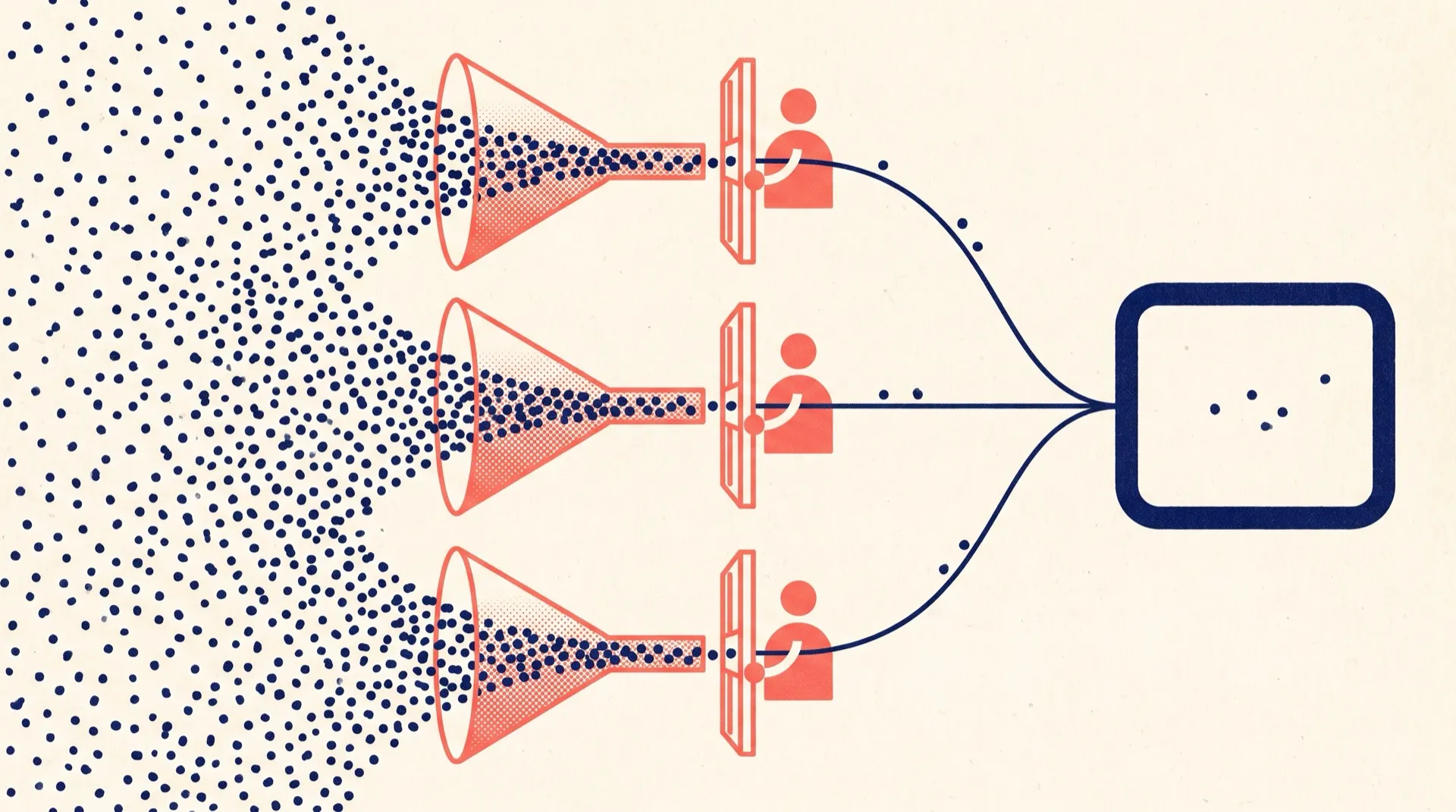
Once intake is done, Jooba builds a custom AI search agent for that role alone. According to the press release, for every open role the company makes “a dedicated AI agent calibrated to the exact technical and cultural requirements” of the position. This agent searches “through millions of potential candidates.” The website puts it as “Trains custom AI agents that think like you.”
Even after the agent finds candidates, no outreach message goes out right away. According to the press release, Jooba’s talent engineers “manually review, refine, and approve the pipeline before messages are sent.” The Jooba website states clearly how the work is divided: “AI helps us crush timelines, fly through profiles, and research at scale,” while the human recruiting experts “make every judgment call, and own the outcome.”
The messages sent to candidates go out in the name of the client’s founder or hiring manager, not Jooba. In the Guard Owl story, the actual outreach was sent “from the founders’ own LinkedIn profiles.” The engineering role went out in the name of one co-founder, and the sales role reached candidates in the name of the CEO. From an outside candidate’s point of view, it looks as if the company’s own leadership found them and reached out directly, not a recruiting agency.
Candidates who show interest are connected to a dedicated channel in Slack, the work messenger. The client does not need to learn a separate hiring dashboard. In Slack, the client sees the introduced candidates and only approves whether to hold a first interview. Jooba handles replying to candidates, scheduling interviews, follow-ups, and updating the data in the applicant tracking system (ATS). The Abundance story records the client’s whole effort as: “approve intros in Slack and take first calls, nothing else.”
The feedback gathered as hiring moves forward is used to sharpen the search criteria again. In the Invoca story, Jooba and the hiring managers “worked profiles together, live,” looking at the screen together and judging profiles in real time. The managers’ criteria for telling a developer who had really built AI from a candidate who had only stuffed résumé keywords carried into the next search. In the Gridwise story, one search grew into five roles, and each new search got a “Talent Engineer already calibrated on the company.”
According to the a16z speedrun page, Jooba has six team members. Their backgrounds mix experience building AI agents at Essential AI and Resolve AI with experience learning how large recruiting agencies run. Jooba says it has helped more than 100 companies hire. The company announced that, across all roles it handled in 2026, the median time to introduce the first candidate was 22 hours. But it did not say specifically how that time was calculated.
Three ways it differs from a traditional agency
Jooba’s approach differs from a traditional recruiting agency at three clear points.
The first is what the client pays for. As Robert Half’s annual report explains, a traditional agency collects its fee when a candidate accepts a job offer. A cost arises with each successful hire. Jooba, by contrast, says it charges “a flat monthly fee per role for unlimited hiring.” It puts a price on the search capacity that keeps running whether or not a hire is made. Jooba’s frequently asked questions (FAQ) page calls this “flexible pricing” and says it offers an unlimited-hiring subscription for larger hiring needs. The actual price has not been made public. The company claims that cost per hire falls eightfold and that recruiting fees drop 90%, compared with the old way.
The second is who the candidate builds a relationship with. A traditional agency stands between the company and the candidate and keeps the relationship. According to the comparison list on Jooba’s website, traditional agencies “Own the candidate relationship as a middleman,” while at Jooba, “Candidates hear directly from you, not us.” The agency organization called Jooba stays out of sight. Jooba adds that traditional agencies recycle the same candidate pool between clients, while it runs a fresh, customized search for every role. This is Jooba’s description of its competitors.
The third is where people step in. The large-scale search across many profiles is the agent’s job. The talent engineers, who are people, focus on taking in requirements, refining the list the agent builds, and giving the final approval before sending. Jooba put the human review at exactly the point where a judgment error would reach an outside person under the client’s name. For the client, too, unlike a self-serve tool where you run the software yourself, just answering approve or not in Slack lowers the day-to-day operating burden. However, how many open roles one talent engineer handles at once has not been made public, so it is hard to convert the improvement in work efficiency into a number from the outside.
A change in fee structure, and what organizations can take from it
If Jooba’s operating model lasts, the long-standing fee structure of the recruiting industry could be shaken. Traditional agencies’ revenue is tied to completed hires. If a small team can run several searches at once with per-role agents, it becomes possible to charge a subscription based on search capacity instead of a success fee. Kirwin criticized agencies for already using AI internally “to do less work while still charging” the same fees. If clients start comparing a flat monthly fee per role directly with a fee that is a percentage of the hire’s salary, traditional agencies may have to prove why the high fee is justified.
The boundary between software and staffing services could also blur. Jooba works on top of software, but at its core it sells a recruiting service. For companies that do not want to run talent-sourcing tools themselves, a service with agents built in could replace both a software tool and a traditional agency.
Companies in other industries can also learn a few standards from Jooba’s work design.
Put a human review where errors leave the company. Jooba’s check happens just before a message goes to an outside candidate in the client’s name. In an agent workflow that faces outsiders, this is the most natural spot for a person to give approval.
Treat the calibration process as a core asset. In Jooba’s stories, value carries over to the next hire because the talent engineer and the agent have already learned the company’s standard for talent. The ability to define what great talent looks like and feed field feedback back into the system may matter more than plain search technology.
Work inside the environment where the client already is. Jooba does not make clients use a new management system. It has them make decisions inside Slack, where they already work.
The fee structure decides who carries the risk of failure. A fee per hire makes the agency carry the risk when a hire fails. A flat monthly fee per role, by contrast, passes part of the risk of not finding a candidate to the client that ordered the work.
What is still not confirmed
Most of Jooba’s way of working and its results rest on material the company published itself. The main sources are the official website, the press release, and seven customer stories. The industry articles so far stop at relaying this press release. Reporting that independently verifies the workflow through outside research is still hard to find.
Some of the performance figures the company gives do not match each other. The press release says hiring got 50% faster. But the official website and the speedrun page give the hiring-time reduction as 52%. The website says hiring costs fall eightfold, while the press release claims recruiting fees can be cut by 90%.
Key operating information has not been disclosed either. It is not public which databases the agents search to find candidates, whether the agent writes the draft messages sent to candidates, or how many talent engineers work inside the company. The actual monthly subscription fee charged per role is also private. The customer stories made public so far are all success stories Jooba wrote itself, so it is hard to tell how many searches failed or ran late.
Sources
- Jooba — Homepage (How we work, Why Jooba, FAQ) — https://www.jooba.com/ — accessed 2026-10-22
- Jooba via WebWire — Jooba Raises $4M to Build the AI-Native Recruiting Firm to Help Fast Growing Companies Hire Top Talent — https://www.webwire.com/ViewPressRel.asp?aId=363059 — 2026-10-20
- a16z speedrun — Jooba (company page) — https://speedrun.a16z.com/companies/jooba — accessed 2026-10-22
- a16z speedrun — Mark Benliyan, Jooba — https://speedrun.a16z.com/companies/jooba/mark-benliyan — accessed 2026-10-22
- Founders Future — Jooba (portfolio page) — https://www.foundersfuture.com/en/portfolio/jooba — accessed 2026-10-22
- Jooba — How Cal.com filled every open engineering role with Jooba — https://www.jooba.com/customer-stories/calc — accessed 2026-10-22
- Jooba — How Guard Owl hired a full sales team and a top tier engineer in 1 month with Jooba — https://www.jooba.com/customer-stories/guard-owl — accessed 2026-10-22
- Jooba — How Invoca advanced their AI hiring with Jooba — https://www.jooba.com/customer-stories/invoca — accessed 2026-10-22
- Jooba — How Gridwise grew their Finance and Engineering teams with Jooba — https://www.jooba.com/customer-stories/gridwise — accessed 2026-10-22
- Jooba — How Delphi built a cross-functional outbound recruiting engine with Jooba — https://www.jooba.com/customer-stories/delphi — accessed 2026-10-22
- Jooba — How Abundance made a founding hardware hire in 15 days with Jooba — https://www.jooba.com/customer-stories/abundance — accessed 2026-10-22
- Jooba — How Netpreme filled a People Operations role in 19 days with Jooba — https://www.jooba.com/customer-stories/netpreme — accessed 2026-10-22
- The AI Journal — Jooba raises $4M led by a16z Speedrun to offer startups a new recruiting model. — https://aijourn.com/jooba-raises-4m-led-by-a16z-speedrun-to-offer-startups-a-new-recruiting-model/ — 2026-10-21
- Robert Half Inc. — Form 10-K for fiscal year 2025 — https://www.sec.gov/Archives/edgar/data/315213/000031521326000006/rhi-20251231.htm — accessed 2026-10-22