AI NativesNo. 14
Periodic Labs: Automating the Reading of Results First
How lab results become training data for the company's own model
- AI Natives no.
- 14
- Published
- 2026-10-22
Key points
- Periodic automated results analysis first, not experiment selection, and shares the choice of the next experiment between people and AI.
- Technicians record what they actually did at the bench, not what the recipe said.
- An AI judge, built to match the 77.2% agreement among human experts, scores the model.
A lab with working furnaces and instruments, but too few people to read the results
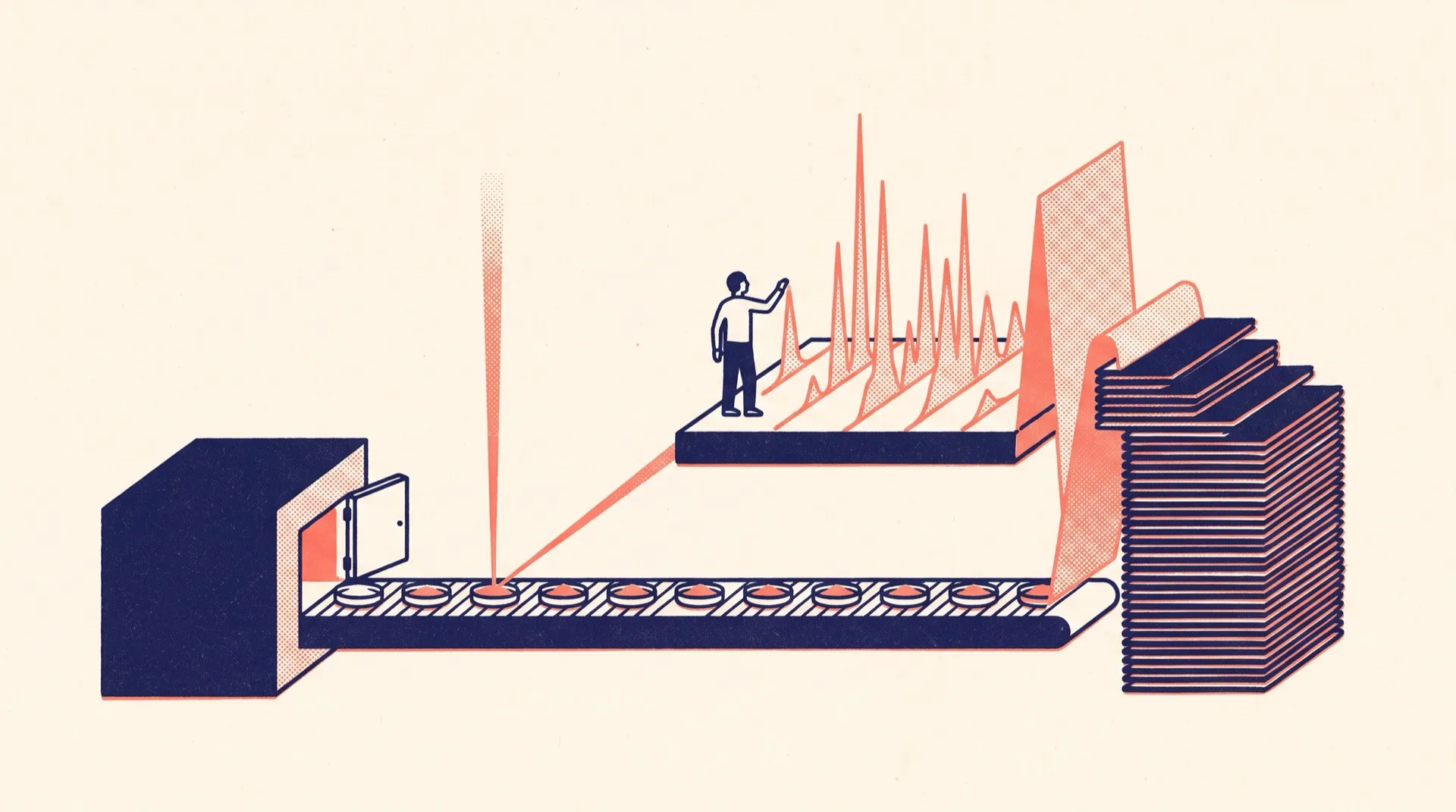
The daily routine of a lab studying new materials is, despite appearances, closer to repeated decoding. Researchers think about what to make, work out how to synthesize it, and run furnaces and deposition equipment to get a sample. But a finished sample does not come out with a label on its surface. To check whether the material you wanted actually formed inside a powder or thin film, you have to measure it with precision instruments and then analyze complex signal data piece by piece. The most widely used test, X-ray diffraction (XRD), shines X-rays at a material and reads the unique pattern of bent beams to work out what it contains. When the pattern is complex and several phases are mixed together, even a skilled materials expert may spend hours reading a single sample.
In Periodic’s view, the speed of a whole lab is set not by how fast you can start the furnace but by how fast people can read the test results pouring out of the instruments. Even if simulations predict countless candidates, the next experiment cannot even begin if people cannot analyze the synthesized material in time. Periodic Labs, which launched on September 30, 2025, aims right at this point. It was founded by Liam Fedus, a former OpenAI vice president of research who helped build ChatGPT, and Ekin Dogus Cubuk, who led materials research at Google DeepMind. According to TechCrunch, it raised a $300 million seed round with investors including a16z, DST, Nvidia, and Accel.
In its launch post, Periodic Labs declared, “Our goal is to create an AI scientist.” At the same time, it said, “Intelligence is necessary, but not sufficient.” However brilliant the intelligence running inside a computer, no new scientific knowledge can come out unless it is tested against reality. So the company began building not only an AI scientist model but also the autonomous labs where the model can work directly. The first target is to find superconductors that work at higher temperatures and new magnet materials. It is also supplying the tools it develops here to industry, including semiconductor makers.
Why it handed results analysis to AI before choosing the next experiment
According to a post Periodic released on September 15, 2026, its research flow runs in three main steps. The first is predicting what to make, by simulating the stability and properties of materials. The second is predicting the specific process to synthesize it. The third is the results analysis step, which works out what actually formed in the synthesized sample and whether it has the physical properties wanted. In an interview on the Latent Space podcast on October 8, 2026, Liam Fedus explained that a finished sample does not come out labeled, so the company narrows candidates by simulation and then calibrates them through its own experiments.
When people talk about bringing AI into research, it is easy to start by letting a model choose what experiment to do next. But Periodic did not follow that order. Co-founder Ekin Dogus Cubuk saw from the start that the bottleneck in research was results analysis. He said, “it’s not that hard to mix powders,” and pointed out that without fast analysis, you cannot decide the next step on solid grounds. In fact, as the lab grew, the speed at which experts analyze XRD results by hand could no longer keep up.
Periodic’s answer to this bottleneck is Periodic Neon, a model with one trillion parameters. The company built it by training the open-weight model Kimi K2.6 further on scientific literature and its own lab data. It is now deployed directly in the Menlo Park lab and analyzes test results. Freed from matching complex diffraction patterns, scientists could move up to supervising more experiments. Checking electron microscope images was the same. When technicians and scientists could not keep up with checking the shapes, the team first brought in simple automation scripts, but in Liam Fedus’s words they were “a little too dumb.” In the end, the team connected an AI model directly to the measuring instrument, one that understands the context of what material each experiment was trying to make.
Science data can be judged true or false, but it is hard to check against an answer key right away. So Periodic turned human judgment itself into an automated grading standard. Materials experts with PhDs labeled thousands of patterns, with three experts on each sample pattern. In this data, the experts agreed with one another 77.2% of the time. The pair of AI judges Periodic built agreed with the experts 74.6% of the time, and with the experts’ consensus 84% of the time. The company uses this AI judge for model training and performance evaluation. An AI that looks across all the data also caught operating errors in the lab. In one case, the AI noticed that results were inconsistent across different experiments, traced the cause back, and found that a sample had been loaded incorrectly into a particular machine.
Instead of a lab with no people, the whole research record becomes training data
Periodic’s lab is in Menlo Park, California, and the company says it runs 24 hours a day, every day. But not every step was filled with robots from the start. In December 2025, MIT Technology Review reported that the company started with manual synthesis guided by AI predictions. A May 2026 job posting for a powder process engineer also says the lessons from the manual lab form the basis for designing a full-scale automated lab. Liam Fedus describes the approach as practical. It automates first the routine tasks that take up a lot of scientists’ and technicians’ time, and it skips for now the tricky handwork that would take months to mechanize. Removing people entirely is not the goal. The goal is to get large amounts of high-quality, varied data.
This principle shows clearly in the human work described in the job postings. Thin-film process technicians run deposition equipment to standard procedures, prepare samples, and calibrate the equipment. The posting stresses to them that “Every run is a potential data point for our models,” and asks them to “Record what you did rather than what the recipe said.” Automation engineers write instrument drivers and connect robots and lab equipment to the company’s data systems and AI models, so that analysis and planning of experiments link up. A materials data role combines research with data repair and looks through agent run records to find data errors and ways agents fail. Other researchers build evaluation and training environments from scientific workflows and train the models themselves.
The organization splits into five main groups. The groups Liam Fedus named are AI research and infrastructure, computational science, experimental science, hardware engineering, and product development. Ekin Dogus Cubuk said that, as at Bell Labs in the past, even senior experts work with their own hands at the bench. The head of the lab is Joe Checkelsky, an MIT physicist on leave. Ray Nakano, a former tech lead of OpenAI’s Operator agent, leads the engineering that automates equipment in the lab. When off-the-shelf parts slow down the whole flow, the company builds the hardware itself. When a weighing instrument responded too slowly, or the position of a robot arm waiting after mixing samples created a risk of contamination, the company built the needed device in-house.
The first difference between a traditional materials lab and Periodic lies in the purpose of the lab itself. An ordinary lab picks the useful part of its experiment results and publishes them as an academic paper. At Periodic, every experiment becomes data that teaches its own model. Liam Fedus calls this training on the process of doing science itself. It keeps the whole record of a research campaign: conversations among researchers, intuitions, the detailed operations carried out in the lab, and the code. The same goes for failed experiments. In an ordinary lab, failed results are almost never published, but Periodic stores all negative results and uses them to train the model.
The second difference is where people’s work has moved. In the Lila Sciences case covered in the same series, the model picks the next experiment itself, and the researchers’ review shrank to a safety check. At Periodic, by contrast, the first change came at the analysis step. Scientists are freed from hours of matching diffraction patterns and now supervise more experiments. Setting the next direction of a research campaign, though, is still shared between people and AI. Liam Fedus said that setting research direction was led entirely by people early on and is now a mix of AI and people, while results analysis has largely moved to AI.
The third difference is how the AI is verified. Periodic does not simply trust a general frontier model or a single experiment result. It measured the agreement among experts, then built an AI judge that comes close to it and used it in training its own model. According to the company’s evaluation, Neon beat the leading general models on its hardest in-house XRD test, and its cost per analysis was lower. Also, inside Periodic’s own environment, which connects the lab’s context and the in-house database, the same frontier model had a success rate 3.8 times higher than when it was used with Claude Code, public databases, and standard XRD software.
The fourth difference is the business model. Liam Fedus said that Periodic was the first test customer for the tools it built, and that it is now extending them to semiconductor makers. It does not simply sell an API for outside access. Forward-deployed engineers go directly into partner companies, run the model in the local environment, and train the model on the customer’s own data. This helps customers own their own intelligence. A real job posting states extended stays in Taiwan as a condition. Liam Fedus said that as the system’s autonomy grows, it could price by the goal achieved, not by a simple tool fee.
When cleanly connected experiment data becomes a new asset
If this way of operating continues, the most valuable resource in an R&D organization could shift from time spent at the bench to well-cleaned, connected data. Ekin Dogus Cubuk pointed out that much of the experimental data published in academia is so noisy that it is often worse than the accuracy of density functional theory (DFT), a commonly used simulation method. If a lab that records every step in a standardized way can train a model that reads results better than a general model, that data could become an asset that other labs cannot easily buy or copy.
A new kind of competition could also appear in materials and process consulting. Periodic sends simulation technology, its own trained models, and on-site engineers together into a customer’s process work. It is still only one early case. But if this collaboration model works and pricing moves toward results, it could end up competing directly with traditional in-house engineering teams and outside specialist consulting groups.
Other organizations that want to bring AI into R&D can take four practical standards from Periodic’s approach.
First, automate reading results before deciding what to do. Even if simulations find countless candidates, the experiment cycle stops if people cannot read the results. Build the analysis pipeline that supplies the grounds for decisions first.
Second, before building an AI judge, measure how much human experts agree with each other. Without the baseline of agreement among experts, there is no way to judge whether what the AI produces is good enough to use.
Third, treat the field technicians’ work record with the same weight as experiment results. Only if you keep a detailed record of what actually happened at the bench, not the standard recipe in the manual, can you use the data for training and trace errors.
Fourth, do not try to remove people from the whole process at once. Automate first the work worth the investment. It is far more realistic to leave delicate handwork that is hard to mechanize to people, and to hand the repetitive, time-consuming analysis and measurement work to machines first.
What has not yet been proven as a large-scale discovery
It is too early to say that all of this has been fully verified. Most of the published way of working and the performance figures rest on Periodic’s official blog, interviews with the founders, and what is written in job postings. In particular, Neon’s strong XRD analysis results are figures measured against an in-house test set the company made itself and its own AI judge.
The company’s headcount, the lab’s throughput, and how far powder synthesis has actually been automated are not detailed in the sources. The vision of AI planning and leading a whole research campaign also remains a task for the future.
Above all, Periodic has not yet announced that it has actually synthesized and discovered a new superconductor or magnet material. The work with semiconductor makers has no specific numbers or results released either. Whether this division of labor leads to the final fruit of a new material discovery remains to be seen.
Sources
- Periodic Labs — Introducing Periodic Labs — https://periodic.com/news/introducing-periodic-labs — 2025-09-30
- Periodic Labs — Building Labs that Learn — https://periodic.com/news/building-labs-that-learn — 2026-09-15
- Periodic Labs — Nature Is Our Learning Environment — https://periodic.com/news/nature-is-our-learning-environment — 2026-09-15
- Periodic Labs — AI Infrastructure at Periodic — https://periodic.com/news/ai-infrastructure-at-periodic — 2026-09-15
- Latent Space — Synthesis Superintelligence: from Semiconductors to Superconductors — Periodic Labs’ Liam Fedus and Ekin Dogus Cubuk — https://www.latent.space/p/periodic — 2026-10-08
- Periodic Labs — job postings: Automation Engineer; Process Engineer, Powder; Process Technician, Thin Films; Research Scientist/Research Engineer, Materials Data; Research Scientist, Data; Research Scientist/Research Engineer, Midtraining; Research Scientist, Scaling RL; Forward Deployed Engineer, Physics & Simulation — https://jobs.ashbyhq.com/periodic-labs — accessed 2026-10-22
- MIT Technology Review — AI materials discovery now needs to move into the real world — https://www.technologyreview.com/2025/12/15/1129210/ai-materials-science-discovery-startups-investment/ — 2025-12-15
- TechCrunch — Former OpenAI and DeepMind researchers raise whopping $300M seed to automate science — https://techcrunch.com/2025/09/30/former-openai-and-deepmind-researchers-raise-whopping-300m-seed-to-automate-science/ — 2025-09-30