AI NativesNo. 08
Knowlee: Agents Make the Cards, Only People Move Them
How Knowlee works with agents and a review queue
- AI Natives no.
- 08
- Published
- 2026-10-22
Key points
- In its own manual, agents create cards, but only a person moves work into Running.
- Every agent run is logged with a risk level, the data types touched, and a review requirement.
- Before hiring, the company spends a week defining the job precisely enough for an agent to do it.
A claim that a software company’s daily work can run on agents
It is Tuesday morning, and the operator of a small software company turns on the screen. The content agent has written three draft posts from templates approved last week. The research agent has organized prospect data collected from outside sources into one batch. The signals agent has tracked competitors and industry trends overnight and summarized them in a morning briefing. But none of it has been sent to a customer or published outside. All of the output is gathered in one place, waiting for the operator’s review.
This is how Knowlee, a software company registered in Italy, describes running itself. Founder Matteo Mirabelli has worked at Deloitte and InfoCert. Knowlee sells three things. One is a Company Brain, a shared memory that stores a company’s procedures and decisions. Another is Knowlee OS, a workspace. The third is a 3-to-4-week deployment that connects the two to the customer’s tools. On top of these sit ready-made processes for sales, recruiting, legal, finance, and operations. For example, its sales product, 4Sales, makes the promise: “Nothing sends without your approval.”
This article is not about Knowlee’s whole product line. It is about how the company runs itself. Knowlee described its way of operating in a blog post on April 29, 2026. The post opens with the sentence, “I run Knowlee as a one-person company.” The work the agents take over is what sales, marketing, and operations staff at an ordinary small software company handle every day. That means researching prospects, drafting promotional posts, coordinating schedules and status, monitoring the market, and sorting incoming inquiries.
Knowlee is a vendor that says it runs itself with the tools it built. In other words, the way the company works is also the product it sells to customers. The blog post tells readers to take an AI readiness assessment or book a consultation. It is one of several hundred posts on the Knowlee blog.
Agents propose, and people move the cards
The blog post, which carries no author name, claims that eight agents handle work that would have needed “a team of twelve to fifteen people in 2022.” This is the company’s own estimate. The company’s other pages describe it a little differently. A manifesto signed by Matteo Mirabelli says the company “runs largely on me” and on the agents. The careers page introduces “a small European team” working in Milan and San Francisco, and says, “We run the company on the product.” Put together, it looks like a small team led by the founder, with agents handling most of the routine work. The blog post’s wording, one person and eight agents, is a simplified summary of that structure.
The post does not list all eight agents. Instead, it says that “The specific breakdown matters less than the principle.” Each agent has one defined job, a strictly limited list of tools it may use, and a record for every run. The work falls into five kinds.
The first is outbound research: collecting and scoring prospect data from outside sources. The second is content: drafting posts from approved templates, with human review required. The third is coordination: setting schedules, updating status, and keeping data in line across several systems. The fourth is monitoring: tracking competitor news, industry news, and regulatory changes, and writing summaries on schedule. The fifth is pipeline management: sorting and prioritizing the requests that come into the company and routing them on.
The day follows a set order. Overnight, scheduled jobs run. In the morning, the operator checks the review queue and works through it for 30 to 45 minutes. Most items are approved as they are or with small edits. One or two a day are sent back to be rewritten, or turned into decisions the operator must make first.
In the late morning, some jobs start automatically on set conditions. For example, a job runs when a prospect passes a certain score, or when an incoming inquiry matches a known type. In the afternoon, the operator starts longer jobs by hand. The operator might ask a specific research question or assign a long piece of writing, each with a clear prompt and scope. During focused work, the operator checks the dashboard about every 90 minutes. Notifications go off only for items that need a human decision. In the evening, large jobs are run so the output is ready for the next morning’s review. Knowlee says no job passes a review gate without the operator checking it.
Every agent run is recorded under four items: the risk level (low, medium, or high), the type of data handled, whether human review is needed, and who approved the automation and when. Jobs that create content going to outside customers, trigger payments, or change shared data need human review. Jobs that simply gather internal trend signals do not.
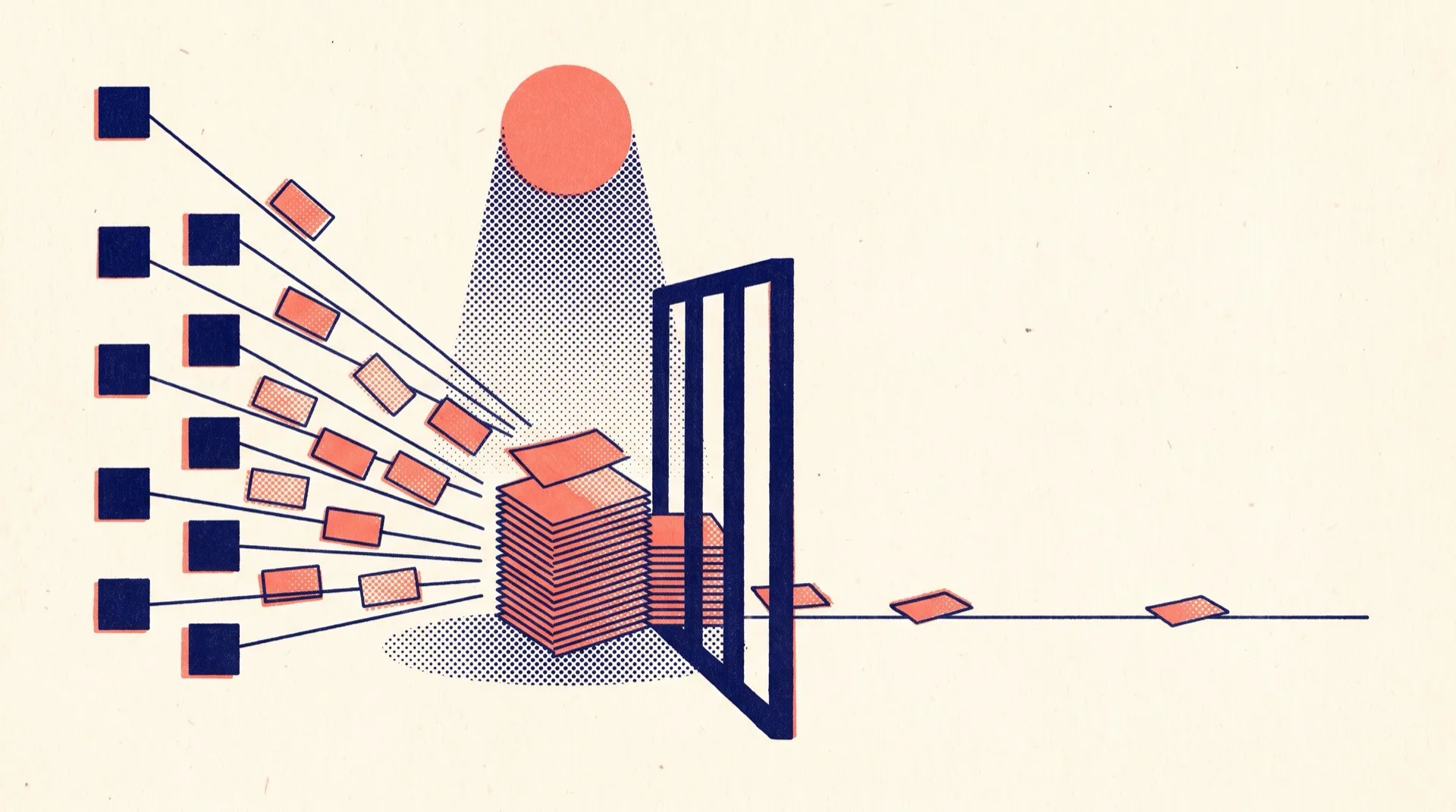
A second post, published on April 30, 2026, calls this “the operator-level manual we wrote for ourselves.” All work is managed on one board divided into five columns: Backlog, Running, Review, Done, and Blocked. A coordinating agent assigns work to the specialist agents, but the specialists cannot call each other directly. The basic rule people follow is that “agents create cards, but operators move them.” An agent can propose new work, but only a person can move it into Running, the column that means in progress. When the operator wants to change a job already running, the operator does not edit the prompt directly. The operator comments on that card.
Four areas are left to people. One is polishing the final wording of important messages sent to customers, partners, or the press. Another is making judgments on legal, financial, medical, or compliance matters. Another is making strategic decisions on incomplete information. The last is making decisions that a regulator may later ask the reasons for. Agents also cannot close sales deals on their own in heavily regulated industries.
Hiring follows a distinctive rule too. Before taking on a new employee, the company first tries for a week to define the job concretely enough that an agent could do it. If that succeeds, the company says, “you have a new agent, not a new hire.”
When the center of work moves from making to reviewing
At an ordinary small software company, different people find prospects, write marketing posts, keep track of project progress, and monitor competitors. But by Knowlee’s account, agents produce the first draft of this work, and the person’s day revolves around reviewing the queue. The person approves, edits, sends back, or decides. The operator no longer writes every draft, researches every company by hand, goes through several systems to gather progress, or schedules follow-up contacts.
The post’s central claim is that “the bottleneck is not model capability.” The important question is whether the operator can review the output as fast as the group of agents produces it. Knowlee argues, “That is a governance problem, not a capability problem.” A group of agents without run logs, risk levels, and review rules, it explains, is only “a liability multiplier, not a leverage multiplier.” The post also gives a practical limit. A solo operator hits the wall when the review queue goes past two to three hours a day. When that point comes, it advises switching low-risk reviews to pass automatically without a person, or hiring a part-time reviewer.
Knowlee runs the company on the very software it sells. In the blog post, it describes its software structure as a way of explaining a category, not as a product pitch. But Knowlee’s glossary gives a different account. It says Knowlee OS “is built as the cockpit for this organizational model,” and that it is closer to “an operator-observability platform” than to a platform that raises agent capability. The dashboard, the review queue, and the run records are themselves the product being sold. The logic about oversight that the post stresses is the same logic the company uses when it sells to customers. According to the manifesto, the product was originally built by the founder as an internal tool. It grew into a full product when consultants who saw it asked to bring it to their own clients.
The company does not publish the specific cost of its own operations, the number of runs, or the volume of output. The blog post says only that keeping the agents costs more each month than a laptop and less than the pay of one junior employee. The figure of replacing a team of twelve to fifteen people is also just the company’s own estimate.
Oversight could matter more than the agents themselves
The nature of entry-level jobs in small companies, which repeat set procedures, could change. If companies adopt the Knowlee approach of first defining a job so an agent could do it before hiring, standardized work such as prospect research, drafting, and status coordination may go to agents first. Actual hiring would then center on roles that need judgment, relationships, and responsibility. This is Knowlee’s own prediction, and it has not been proven in large organizations.
Tools that supervise agents could also become more important than tools that build them. If the claim is right that review capacity is the real limit of an organization, what the market lacks is not another agent but a way to look over and approve agent output quickly. That is also the bet Knowlee is making as a seller. Software companies that sell agent features without a clear review and audit layer may find buyers demanding oversight first.
Other organizations can take four points from this.
First, set the oversight rules before you bring in a second agent. From the moment you build the first agent, decide the risk level, the type of data it handles, and whether human review is required. Once you have grown to 10 agents, it is much harder to attach this kind of record later.
Second, gather all agent work in one place and let agents only propose. If you keep one board and control it so that only people move work into execution, you keep the initiative without watching every step.
Third, the time review takes sets the limit of operating capacity. Knowlee’s manual names operator burnout from too many reports and approval requests as a main failure type. When the queue piles up faster than people can work it down, review can turn from careful checking into plain rubber-stamping. If you measure the time review takes, you can tell when to stop adding agents.
Fourth, define the job clearly before automating it. The reason agents produce unstable results is mostly a vague job definition, not weak model performance. If you narrow the scope of work, limit the tools it can use, and fix the format of the output, it becomes much easier for people to review.
Facts that are still not fully confirmed
The way of operating described here rests entirely on explanations from Knowlee’s own website. No report from independent outside press about the company or how it operates has been found. The key source, the blog post, carries no author name and is one of several hundred marketing posts, and it ends by steering readers to book a consultation.
The wording on company size also differs a little from page to page. The blog post says a one-person company. The founder’s manifesto says it is run largely by the founder himself. The careers page says there is a small European team. The specific names of the eight agents, the actual operating cost, the number of tasks handled, and figures that objectively prove the quality of the output have not been disclosed.
Knowlee has been building agent products since 2023. It started as a consumer assistant and turned to business workflow automation in 2024. But the agent-based internal operating system the company describes was built relatively recently. The operator manual written in April 2026 also gives eight months as the time it has run multi-agent systems in production.
Sources
- Knowlee Blog — The One-Person AI Company, How a Solo Operator Runs a Fleet of Agents in 2026 — https://www.knowlee.ai/blog/one-person-ai-company-2026 — 2026-04-29
- Knowlee Blog — How to Manage Multiple AI Agents: An Operator’s Manual — https://www.knowlee.ai/blog/how-to-manage-multiple-ai-agents-operator-manual — 2026-04-30
- Knowlee — Manifesto (Matteo Mirabelli) — https://www.knowlee.ai/manifesto — accessed 2026-10-22
- Knowlee — Careers — https://www.knowlee.ai/careers — accessed 2026-10-22
- Knowlee — About — https://www.knowlee.ai/about — accessed 2026-10-22
- Knowlee — One-Person AI Company (glossary) — https://www.knowlee.ai/glossary/one-person-ai-company — accessed 2026-10-22
- Knowlee — Home page — https://www.knowlee.ai/ — accessed 2026-10-22
- Internet Archive — knowlee.ai snapshots of 2023-11-27 and 2024-10-11 — https://web.archive.org/web/20231127135019/https://knowlee.ai/ and https://web.archive.org/web/20241011233355/https://knowlee.ai/ — accessed 2026-10-22