All casesNo. 063
Cleveland.com Moves Story Writing to an AI Rewrite Desk
Reporters file notes, one specialist prompts ChatGPT, and the reporter gets the final say
- Case no.
- 063
- Primary source
- Columbia Journalism Review and Washington Post reports
- Source published
- 2026-02-25
1. Why this case
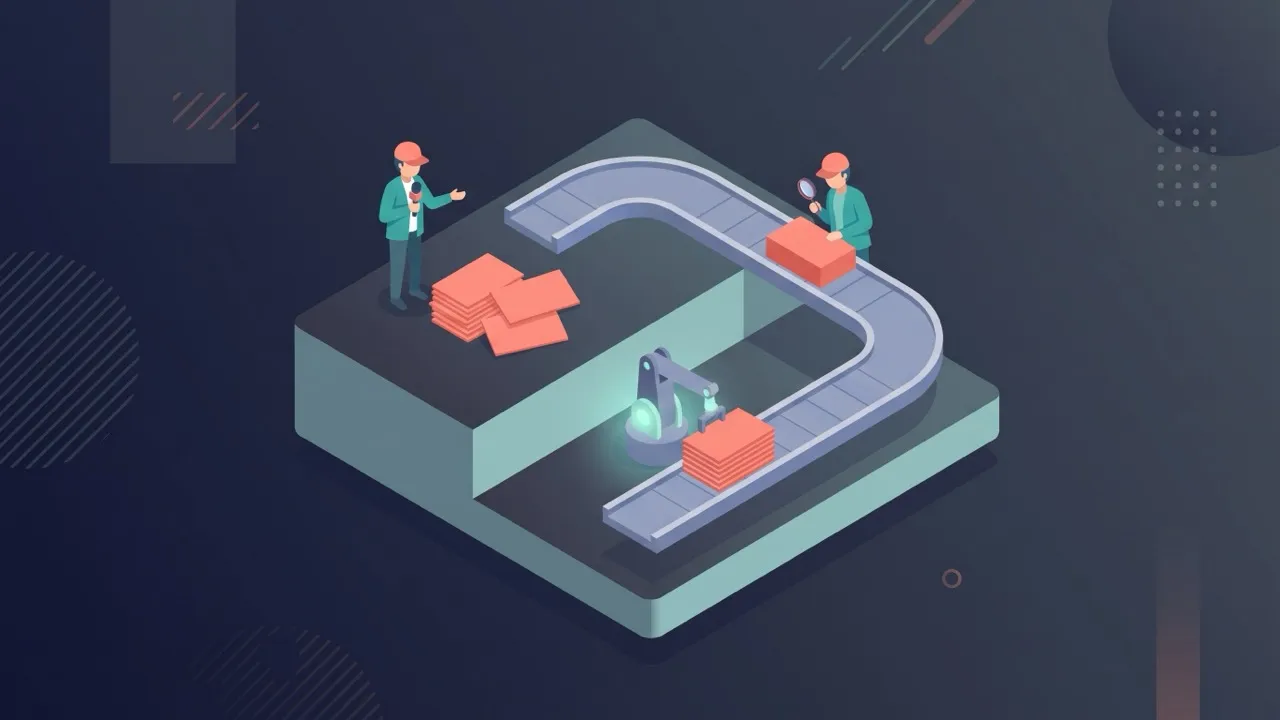
Cleveland.com and The Plain Dealer, the largest newspaper in Cleveland, Ohio, and part of Advance Local, split one newsroom job into two in January 2026. Reporters gather information and type up their notes and quotes. A single “AI rewrite specialist” uses an in-house version of ChatGPT to turn that material into a story draft. The draft then goes back to the reporter for a final review before it is published.
The case is useful because the step that moved is the core of a professional’s daily output: writing the first draft. The newsroom did not hand that step to software on its own. It created a new human role to direct the model, kept the reporter as the last check, and set a byline rule that tracks how much of the reporting the reporter did. Editor Chris Quinn’s stated aim is time, not volume: reporters should spend more of their week reporting and less of it typing.
The case is also contested, and that is part of its value. The move drew public criticism from other journalists, current and former staff criticized it to The Washington Post, and in September 2026 a reporter’s name appeared on an AI-produced story she had not worked on. The sources are independent press reports with on-record interviews. The time and output figures in them are the newsroom’s own claims.
2. Problem
A newsroom a fraction of its former size. Quinn, who has led the newsroom since 2013, told The Washington Post that it shrank from some 400 employees in the late 1990s to 71 in early 2026. The paper closed most of its outlying bureaus more than a decade ago and lost much of its “hyperlocal” coverage of suburban counties.
Earlier AI tools found more work than reporters could write up. Over three years, Quinn’s newsroom added AI tools to transcribe local government meetings, scrape municipal websites for story leads, clean up typos, suggest headlines, and help draft follow-ups. According to CJR, the newsroom had worked with an Advance Local developer to adapt a set of off-the-shelf tools, including AI scrapers, editing-feedback software, and a first-draft tool. The result was more stories than expected, and “reporters spent more time typing than ever.”
The bottleneck was the writing. The tools multiplied the stories to write, but each one still had to be written by the reporter who gathered it. Quinn’s hope for the new role, as CJR describes it, was that reporters would spend more time gathering information and less time typing it up.
Confirmed facts: newsroom of some 400 in the late 1990s, 71 in early 2026 (Quinn to WaPo); most outlying bureaus closed more than a decade ago; three years of AI tools for transcription, lead scraping, typo cleanup, headlines, follow-ups; earlier tool set built with an Advance Local developer surfaced more stories than expected and increased typing time (CJR).
3. Solution
3.1 A new role between the reporter and the model
Quinn posted a job listing for an “AI rewrite specialist” in October 2025. He filled it in January 2026 with Joshua Newman, who had previously covered the University of Texas for LoneStarLive.com in Austin. By mid-January, Newman was working on stories with an in-house version of ChatGPT provided by Advance Local, the newsroom’s corporate parent.
The Washington Post describes the role as modeled on an old newsroom fixture: the rewrite desk, where staff took calls from reporters in the field and turned their interviews and notes into prose. Here, a generative AI tool writes that prose and a human directs it. Leila Atassi, the public interest and advocacy team editor, oversees Newman’s work and the day-to-day running of the experiment. “AI is the assistant, but it’s not the journalist,” she told CJR.
3.2 The handoff and its way back
The Washington Post lays out the flow. The reporter types up the notes and quotes they have gathered and sends them to the rewrite editor. The rewrite editor prompts the AI to turn them into a full article draft. The editor and the reporter then review and adjust the draft as needed, and the reporter does a final review before publication.
Quinn’s February 14 letter to readers, as quoted by journalism professor Dan Kennedy, puts the same sequence in short form: “We fact-check everything. Editors review it. Reporters get the final say.”
The reporter keeps the decisions that shape the story. Hannah Drown, a Plain Dealer reporter covering Lorain County, filed her notes on the possible repossession of 41 county sheriff’s cruisers to the desk, which helped turn them into a 600-word article. She told The Washington Post that she still outlines the story and still decides “what the news is and what the tone should be.” To CJR she said the draft is not exactly what she would have written, and that the model works as long as she supplies correct notes and information.
3.3 Quotes as the checked weak point
Atassi told CJR that AI hallucinations do arise and are handled through a set of checks. Both Newman and the reporters who supply the material verify that the resulting article is accurate, including the quotes, which they have found are the part the AI is most likely to get wrong. Quinn told The Washington Post: “We don’t trust the AI for any original stuff.”
3.4 Which stories go to the desk
So far, Quinn said, the desk is used mostly for brief, straightforward stories from the suburban counties of Lorain, Lake, and Geauga. Some are as simple as rewriting a press release. The paper’s in-depth stories are still written mainly by people. Quinn treats the boundary as an open question. Part of the experiment, he said, is to work out “where to draw the line” at which a story is complex enough that using the rewrite specialist is no longer efficient.
3.5 Bylines and disclosure
CJR describes the byline rule. A story produced with AI help carries only the reporter’s byline, unless the reporter did minimal work, such as forwarding a press release or meeting transcript to the desk. In that case, the reporter shares the byline with “Advance Local Express Desk.” Quinn told CJR he sees AI as a tool like Microsoft Excel, which the newsroom never disclosed either.
The Washington Post, reporting about a week later, describes AI-drafted articles that pair a reporter’s name with “Advance Local Express Desk,” and a note at the bottom of each: “This article was produced with assistance from AI tools and reviewed by Cleveland.com staff.”
3.6 What reporters do with the time
The time saved is meant for reporting that AI cannot do, such as inviting a mayor or police chief to coffee (The Washington Post). Atassi’s example for CJR is Drown’s coverage of a proposed land deal in rural Lorain County, where the State of Ohio had been quietly assembling farmland for large-scale industry. With the desk handling more of the writing, Drown spent time in person with farmers and residents, who described what the land meant to their families.
AI also feeds the reporting end. Drown told The Washington Post she broke and wrote a story about overcrowding at a high school after an alert from an AI tool that scans school board meeting transcripts for newsworthy items. That story led to a larger feature she wrote on how fast growth was straining a small farming community.
Confirmed facts: job listing October 2025; Joshua Newman hired January 2026; in-house ChatGPT from Advance Local; Atassi oversees the desk; flow = reporter notes and quotes → rewrite editor prompts AI → draft → editor and reporter review → reporter final review; both Newman and reporters verify accuracy, quotes most error-prone; desk used mostly for brief, straightforward stories from Lorain, Lake, and Geauga counties; in-depth stories mainly human-written; reporter-only byline unless minimal reporter work, then shared with “Advance Local Express Desk” (CJR); AI-assistance note at the bottom of Express Desk articles (WaPo).
4. Impact
The results below are statements by the newsroom’s editors in February and March 2026, without published baselines.
Time and output. Atassi told CJR that since the desk launched, reporters have produced the same number of stories per week as before and have saved enough time for an extra day of field reporting. Quinn’s letter, as quoted by The Washington Post, said that removing writing from reporters’ workloads had “effectively freed up an extra workday for them each week.” Separately, Quinn told The Washington Post that reporters covering Lorain, Lake, and Geauga counties are now expected to file four stories a day with AI help.
Coverage. According to The Washington Post, the desk’s suburban stories are restoring some of the hyperlocal coverage the paper lost when it closed its outlying bureaus.
Errors. In February, Atassi told CJR that errors come up sometimes but none had reached publication. In an interview published in early March, Quinn told The Washington Post that the desk had yet to suffer an embarrassing mishap of the kind other outlets had with fabricated AI content.
Stated goal. Quinn told CJR the goal is not to replace journalists or reduce their number, and not even to increase production, but to grow the newsroom’s reporting and give reporters more time. He also told The Washington Post that the paper’s wider use of AI, including stories that summarize reporters’ podcasts and readers’ letters, is helping its bottom line and helping it keep staff. He gave no figures for either.
Readers and critics. Quinn told CJR the reader response has been largely positive. Outside the newsroom, the HuffPost editor Philip Lewis said Quinn should resign, and an American Press Institute column said he had not explained how AI improves the journalism.
Inside the newsroom. Four current and former Plain Dealer journalists, speaking anonymously to The Washington Post, said the reliance on AI has hurt editorial quality and morale. One said the AI-generated stories have minimal guardrails. Quinn disputed this, saying every AI-drafted story is reviewed by a human reporter and an editor. Another staffer said the tools risk turning the paper into a “content farm” and deprive younger journalists of on-the-job training. One said their annual performance review flagged insufficient AI use.
The September byline error. On September 7, 2026, government reporter Kaitlin Durbin said a story about the Cuyahoga County law director stepping down had run under her byline while she was on her honeymoon, and that she had not written or reviewed it (Futurism). The story came from the “Cleveland.com Express Desk.” Her name was removed and a correction added. Quinn called it “a simple mistake, the result of a miscommunication between a couple of editors.”
5. Insight
One job split in two, with a person in the new middle. The change is not simply that AI now writes the news. For brief stories, writing moved from each reporter to one specialist who directs a model, and the reporter keeps the outline, the news judgment, the tone, and the final say. The new role exists because a model’s draft needs someone who prompts it and checks it before the reporter sees it.
The earlier tools moved the bottleneck. Lead-finding and first-draft tools gave the newsroom more stories than its reporters could type up. The rewrite desk targets exactly the step those tools left overloaded. A newsroom that automates discovery but not writing can end up with more typing, not less.
Verification sits with the two people who know the material. Quotes are the known failure point, and they are checked by the person who prompted the draft and by the reporter who heard the quote. Quinn’s rule that the AI is not trusted for “any original stuff” limits the model to rewriting what was already gathered.
Scope is drawn by story complexity, and the line is still moving. Brief, straightforward suburban stories go to the desk. In-depth stories stay mainly with human writers. The newsroom says openly that finding where the desk stops being efficient is part of the experiment.
The byline is part of the control system. The byline tells readers how much of the reporting the reporter did, and the reporter’s final review is the last check. The September error was not a fabricated fact in a draft. It was a reporter’s name attached to an AI story she had not reviewed, which Quinn attributed to a miscommunication between editors. The rule holds only as well as the handoff between people.
Limits. All time and output statements come from the newsroom’s editors, with no published baseline. The “extra workday” and “four stories a day” come from different speakers about different groups. Staff dispute the guardrails, and concerns about training younger reporters are unresolved. The sources name one rewrite specialist hire as of early 2026; how the desk scales beyond that is not reported.
One-line takeaway: The Plain Dealer’s desk shows a way to move first-draft writing to AI in a fact-based profession: one person directs the model, the reporter keeps the judgment and the final say, quotes get checked twice, and the byline records who did the reporting, though that last step still depends on people getting the handoff right.
6. Implementation hypotheses (not in the source)
6.1 A filing packet and a quote check against the notes
Basis: The reporter “types up the notes and quotes” and sends them to the rewrite editor (WaPo). Quotes are the part most likely to go wrong, and both Newman and the reporter verify them (CJR). Quinn: “We don’t trust the AI for any original stuff.” Drown says the model works when she supplies correct notes.
The desk most likely works from a fairly fixed filing packet: the reporter’s outline or news angle, the quotes marked with who said them, the facts with where each came from, and any documents or transcripts. The prompt to the in-house ChatGPT would tell the model to use only what is in the packet and to keep quotes word for word. The specialist’s first check is probably mechanical: every quoted sentence in the draft is compared with the reporter’s notes, and anything in quotation marks that is not in the notes is cut or sent back. Any fact in the draft that does not appear in the packet would be treated the same way. That leaves the reporter’s final review for what only the reporter can judge, such as emphasis, framing, and whether a quote is used in the right context.
6.2 Two intake lanes that also set the byline
Basis: Press releases and meeting transcripts forwarded with minimal reporter work get a shared byline with the Express Desk; reporter-notes stories carry the reporter’s byline (CJR). The desk mostly handles brief stories from three counties (WaPo). In September, a reporter’s byline was attached to an Express Desk story she had not reviewed, which Quinn put down to a miscommunication between editors (Futurism).
The desk probably receives two kinds of material: documents forwarded with little reporter input, and packets of a reporter’s own notes and quotes. The kind of material likely decides the byline: a shared byline (reporter plus Express Desk) for documents a reporter forwarded, and the reporter’s name alone for notes packets. The September story was corrected to carry only the Express Desk name. That suggests it reached the desk without a reporter forwarding or reporting it, a case the published rule does not name, and that an editor attached a reporter’s name anyway. That points to bylines being set by hand in the publishing system, separately from the reporter’s final review. A newsroom running this flow would need the reporter’s sign-off recorded before the reporter’s name can be attached, so the byline rule does not depend on editors relaying it to each other.
7. Sources
- Riddhi Setty, Columbia Journalism Review — In This Cleveland Newsroom, AI Is Writing (But Not Reporting) the News
https://www.cjr.org/news/cleveland-newsroom-ai-rewrite-desk-chris-quinn-plain-dealer.php
2026-02-25 - Will Oremus and Scott Nover, The Washington Post, republished by The Spokesman-Review — An Ohio newspaper has a new star writer. It isn’t human.
https://www.spokesman.com/stories/2026/mar/03/an-ohio-newspaper-has-a-new-star-writer-it-isnt-hu/
2026-03-03 - Dan Kennedy, Media Nation — An AI-boosting editor blasts j-schools as being out of touch. The reality is more complex. (quotes Chris Quinn’s February 14, 2026 letter to readers)
https://dankennedy.net/2026/02/17/ai-boosting-editor-blasts-j-schools-as-being-out-of-touch-the-reality-is-more-complex/
2026-02-17 - Maggie Harrison Dupré, Futurism — Journalist Accuses Ohio’s Main Newspaper of Slapping Her Name on an AI “Express Desk” Article Without Her Knowledge, While She Was on Honeymoon
https://futurism.com/artificial-intelligence/journalist-accuses-local-newspaper-ai-article
2026-09-08